Simadibrata Daniel Martin, Lesmana Elvira, Amangku Bagus Ramasha, Wardoyo Muhammad Prasetio, Simadibrata Marcellus
Department of Internal Medicine, Faculty of Medicine Universitas Indonesia, Jakarta 10430, Indonesia.
Nuffield Department of Population Health, University of Oxford, Oxford OX3 7LF, United Kingdom.
World J Clin Cases. 2023 Oct 26;11(30):7329-7336. doi: 10.12998/wjcc.v11.i30.7329.
A limited number of studies have demonstrated that sleeping in the left lateral decubitus (LLD) decreases nocturnal reflux in patients with gastroesophageal reflux disease (GERD) compared to right lateral decubitus (RLD) and supine.
This systematic review summarizes the association between sleeping in the LLD position and nocturnal reflux in patients with GERD.
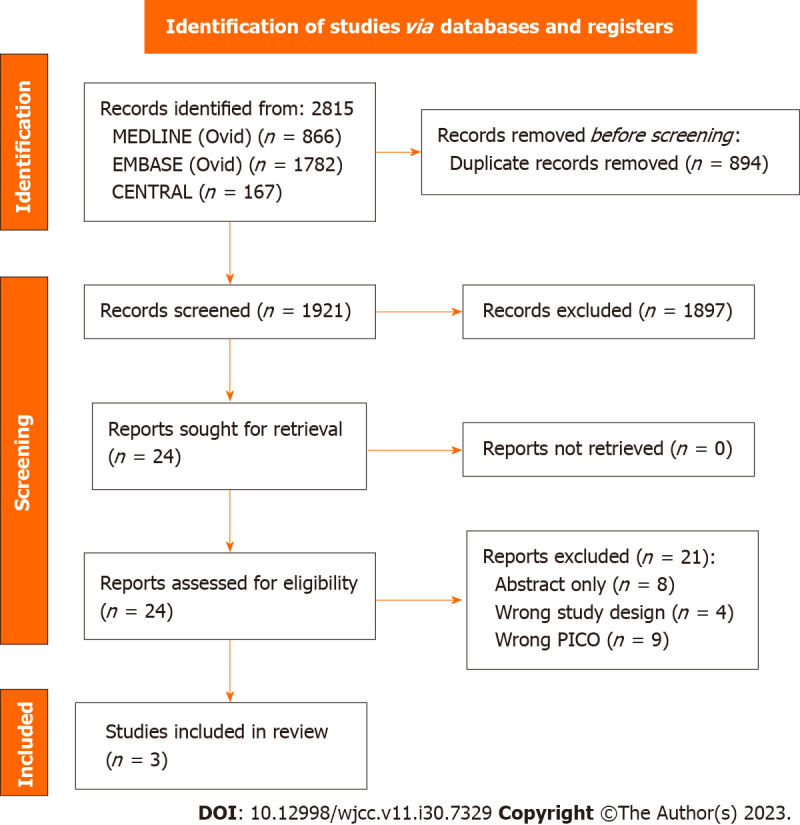
Studies published up to July 17, 2023, in MEDLINE, EMBASE, and CENTRAL were searched. Eligible studies were randomized and nonrandomized studies assessing the effect of sleeping in LLD compared to RLD and supine in reducing nocturnal reflux in GERD patients. Outcomes include the acid exposure time (AET) (% time in pH<4), acid clearance time (ACT) (in sec/episode), number of reflux episodes, and improvement in N-GSSIQ scores.
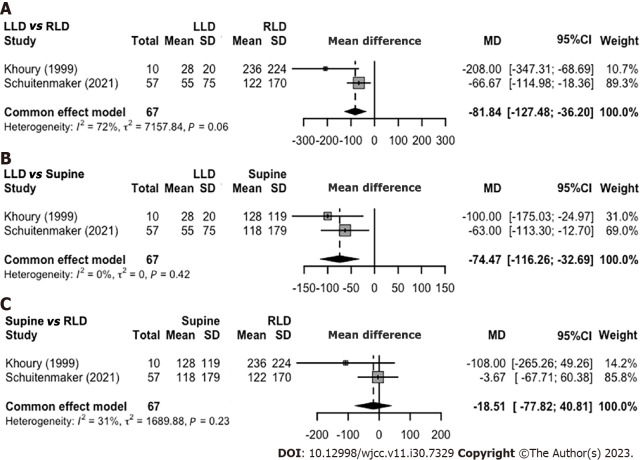
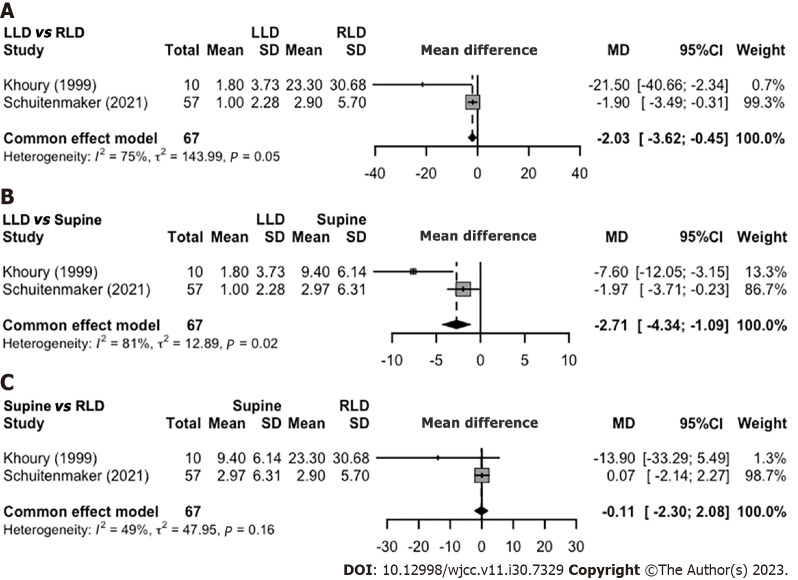
Two nonrandomized studies showed decreased AET and ACT in LLD sleep position in comparison to RLD (mean difference [MD] -2.03 [95%CI: -3.62 to -0.45]; -81.84 [95%CI: -127.48 to -36.20], respectively) and supine position (MD -2.71 [95%CI: -4.34 to -1.09]; -74.47 [95%CI: -116.26 to -32.69], respectively). There was no difference in AET and ACT between RLD sleep position and supine. Furthermore, one randomized controlled trial investigating the use of electronic sleep positional therapy, which increased the duration of LLD sleep and decreased the duration of RLD sleep compared to sham, showed nocturnal symptoms improvement (improved N-GSSIQ score, increased reflux-free nights, and resolution of nocturnal reflux symptoms).
Current evidence suggests that sleeping on the left side could reduce nocturnal reflux and improve GERD-related quality of life, therefore warranting interventions that promote LLD sleep position.
有限的研究表明,与右侧卧位(RLD)和仰卧位相比,左侧卧位(LLD)睡眠可减少胃食管反流病(GERD)患者的夜间反流。
本系统评价总结了GERD患者左侧卧位睡眠与夜间反流之间的关联。
检索截至2023年7月17日发表在MEDLINE、EMBASE和CENTRAL上的研究。符合条件的研究为随机和非随机研究,评估左侧卧位睡眠与右侧卧位和仰卧位相比对减少GERD患者夜间反流的效果。结局指标包括酸暴露时间(AET)(pH<4的时间百分比)、酸清除时间(ACT)(每发作秒数)、反流发作次数以及N-GSSIQ评分的改善情况。
两项非随机研究显示,与右侧卧位相比,左侧卧位睡眠时AET和ACT降低(平均差值[MD]分别为-2.03[95%CI:-3.62至-0.45];-81.84[95%CI:-127.48至-36.20]),与仰卧位相比也降低(MD分别为-2.71[95%CI:-4.34至-1.09];-74.47[95%CI:-116.26至-32.69])。右侧卧位睡眠和仰卧位之间的AET和ACT没有差异。此外,一项调查电子睡眠体位疗法使用情况的随机对照试验表明,与假治疗相比,该疗法增加了左侧卧位睡眠的持续时间,减少了右侧卧位睡眠的持续时间,夜间症状得到改善(N-GSSIQ评分提高、无反流夜晚增加以及夜间反流症状缓解)。
目前的证据表明,左侧卧位睡眠可减少夜间反流并改善GERD相关的生活质量,因此有必要采取促进左侧卧位睡眠的干预措施。