Department of Clinical Lab, Tianjin First Central Hospital, 300192, Tianjin, China.
Department of Immunology, School of Basic Medical Sciences, Tianjin Medical University, 300070, Tianjin, China.
Calcif Tissue Int. 2024 Mar;114(3):228-236. doi: 10.1007/s00223-023-01165-1. Epub 2023 Nov 17.
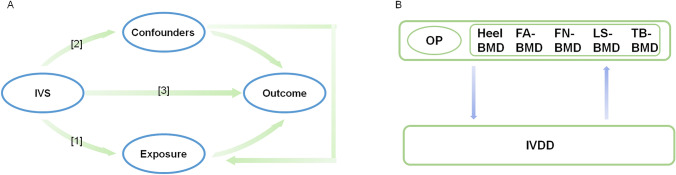
This study aimed to investigate the causal relationship between bone mineral density (BMD) and intervertebral disk degeneration (IVDD) using a two-sample bidirectional Mendelian randomization analysis. Summary-level data from the Genome-Wide Association Study (GWAS) were used. Instrumental variables (IVs) for IVDD were selected from the large-scale Genome-Wide Association Study (GWAS) (20,001 cases and 164,682 controls). Bone mineral density (BMD) at five different sites (heel (n = 426,824), total body (TB) (n = 56,284), forearm (FA) (n = 8143), femoral neck (FN) (n = 32,735), and lumbar spine (LS) (n = 28,498)) was used as a phenotype for OP. Bidirectional causality between IVDD and BMD was assessed using inverse variance weighting (IVW) and other methods. Related sensitivity analyses were performed. Myopia was also analyzed as a negative control result to ensure the validity of IVs. Heel bone mineral density (heel BMD), total body bone mineral density (TB-BMD), femoral neck bone mineral density (FN-BMD), and lumbar spine bone mineral density (LS-BMD) have a direct causal relationship on intervertebral disk degeneration (IVDD) [heel BMD-related analysis: beta = 0.06, p = 0.03; TB-BMD-related analysis: beta = 0.18, p = 8.72E-08; FN-BMD-related analysis: beta = 0.15, p = 4.89E-03; LS-BMD-related analysis: beta = 0.16, p = 1.43E-04]. There was no evidence of a significant causal effect of IVDD on BMD. In conclusion, our study found a significant positive causal effect of lower BMD on IVDD, and we identified significant causal effects of heel, TB-, FN-, and LS-BMD on IVDD, but there was no evidence of a significant causal effect of IVDD on BMD.
本研究旨在使用两样本双向孟德尔随机化分析来探究骨密度(BMD)与椎间盘退变(IVDD)之间的因果关系。使用全基因组关联研究(GWAS)的汇总水平数据。从大规模全基因组关联研究(GWAS)中选择椎间盘退变(IVDD)的工具变量(IV)(20001 例和 164682 例对照)。使用五个不同部位的骨密度(BMD)作为 OP 的表型:足跟(n=426824)、全身(TB)(n=56284)、前臂(FA)(n=8143)、股骨颈(FN)(n=32735)和腰椎(LS)(n=28498)。使用反向方差加权(IVW)和其他方法评估 IVDD 和 BMD 之间的双向因果关系。进行了相关的敏感性分析。近视也被分析为阴性对照结果,以确保 IV 的有效性。足跟骨密度(足跟 BMD)、全身骨密度(TB-BMD)、股骨颈骨密度(FN-BMD)和腰椎骨密度(LS-BMD)与椎间盘退变(IVDD)之间存在直接因果关系[足跟 BMD 相关分析:β=0.06,p=0.03;TB-BMD 相关分析:β=0.18,p=8.72E-08;FN-BMD 相关分析:β=0.15,p=4.89E-03;LS-BMD 相关分析:β=0.16,p=1.43E-04]。没有证据表明 IVDD 对 BMD 有显著的因果影响。总之,我们的研究发现 BMD 降低与 IVDD 之间存在显著的正因果关系,我们确定了足跟、TB-、FN-和 LS-BMD 对 IVDD 的显著因果关系,但没有证据表明 IVDD 对 BMD 有显著的因果关系。