Department of Pediatric Dentistry and Dental Public Health, Faculty of Dentistry, Alexandria University, Champolion St, Azarita, 21527, Alexandria, Egypt.
BMC Oral Health. 2023 Nov 17;23(1):875. doi: 10.1186/s12903-023-03597-5.
Early childhood caries (ECC) is the most prevalent chronic health problem in young children, and it can be arrested using professionally applied fluoride such as Sodium fluoride (NaF) varnish and Silver Diamine Fluoride (SDF). This trial compared two interventions to arrest ECC lesions: 38% SDF combined with 5% NaF varnish versus 38% SDF and assessed whether the arrest rate was affected by baseline lesion severity measured by ICDAS.
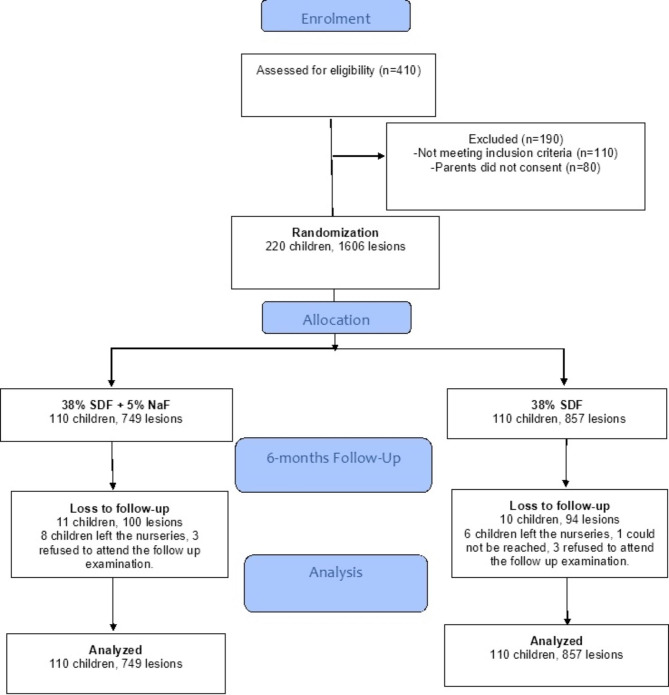
Children aged ≤ 4 years from 4 nurseries in a rural area in Alexandria, Egypt joined the study in March 2022. They were included if they had at least one active carious lesion with ICDAS codes ≥ 3. They were randomized to receive either 38% SDF with 5% NaF varnish or 38% SDF alone. In both groups, the agents were applied at baseline and after 6 months on the caries lesions. NaF was additionally applied on all teeth in the oral cavity, and it was also applied after three months. The primary outcome was lesion arrest status after six months. Parents' satisfaction with their children's appearance was the secondary outcome. Pearson Chi-Square test was used for bivariate comparison and multi-level multiple logistic regression was used to assess the effect of the intervention on caries arrest controlling for confounders. The interaction between the intervention and baseline lesion severity (categorized into moderate and severe lesions) was assessed and the p value was calculated.
The study included 1606 lesions in 220 children, median (IQR) age = 48(9) months. The percentages of arrested lesions after the application of SDF + NaF and SDF only were 77.7% and 73.2% (p = 0.035). In multivariable analysis, SDF + NaF had significantly greater caries arrest effect than SDF alone (AOR = 2.12, p = 0.03) with significant difference (p = 0.03) between moderate (AOR = 4.10, p = 0.005) and advanced (AOR = 1.92, p = 0.08) lesions. Most parents were satisfied with their children's appearance with no significant difference between groups (SDF + NaF = 84.5%, SDF = 78.18%, p = 0.23).
SDF + NaF had a higher arrest rate than SDF alone and this difference was significant in moderate but not advanced lesions. The findings have implications for the non-invasive management of ECC.
This trial was registered in the clinicaltrials.gov registry (#NCT05642494).
幼儿龋齿(ECC)是幼儿中最普遍的慢性健康问题,可以通过专业应用氟化物(如氟化钠[NaF]涂料和银胺氟化氢[SDF])来控制。本试验比较了两种控制 ECC 病变的干预措施:38% SDF 联合 5% NaF 涂料与 38% SDF,并评估了通过 ICDAS 测量的基线病变严重程度是否会影响病变的控制率。
2022 年 3 月,来自埃及亚历山大农村地区的 4 所幼儿园的 4 岁以下儿童参加了这项研究。如果他们有至少一个活动性龋齿病变,ICDAS 编码≥3,则纳入研究。他们被随机分配接受 38% SDF 联合 5% NaF 涂料或 38% SDF 单独治疗。在两组中,药物均在基线时和 6 个月后在龋齿病变部位使用。NaF 还被涂在口腔内的所有牙齿上,并在 3 个月后再次使用。主要结局是 6 个月后病变的控制情况。父母对孩子外观的满意度是次要结局。采用 Pearson Chi-Square 检验进行双变量比较,采用多水平多项逻辑回归评估干预对控制龋齿的效果,同时控制混杂因素。评估了干预与基线病变严重程度(分为中度和重度病变)之间的交互作用,并计算了 p 值。
该研究共纳入 220 名儿童的 1606 个病变,中位(IQR)年龄为 48(9)个月。应用 SDF+NaF 和 SDF 后,病变的控制率分别为 77.7%和 73.2%(p=0.035)。多变量分析显示,SDF+NaF 与 SDF 单独使用相比,对龋齿的控制效果显著更好(AOR=2.12,p=0.03),中度(AOR=4.10,p=0.005)和重度(AOR=1.92,p=0.08)病变之间存在显著差异。大多数父母对孩子的外观表示满意,两组之间无显著差异(SDF+NaF=84.5%,SDF=78.18%,p=0.23)。
SDF+NaF 的控制率高于 SDF 单独使用,且在中度病变而非重度病变中差异有统计学意义。该研究结果对 ECC 的非侵入性管理具有重要意义。
本试验在 clinicaltrials.gov 注册(#NCT05642494)。