Department of Psychology and Neuroscience, The University of North Carolina at Chapel Hill, 235 E. Cameron Avenue, Chapel Hill, NC 27599-3270, USA.
Soc Cogn Affect Neurosci. 2023 Nov 17;18(1). doi: 10.1093/scan/nsad064.
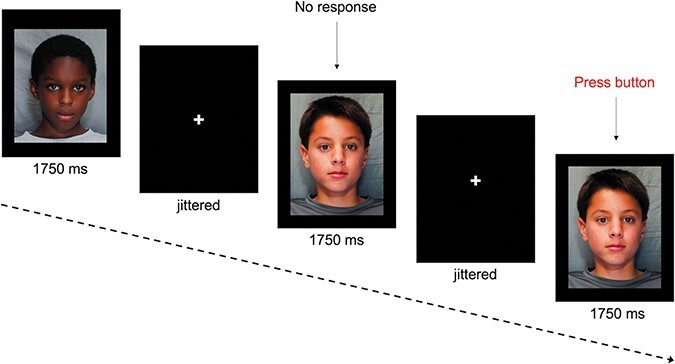
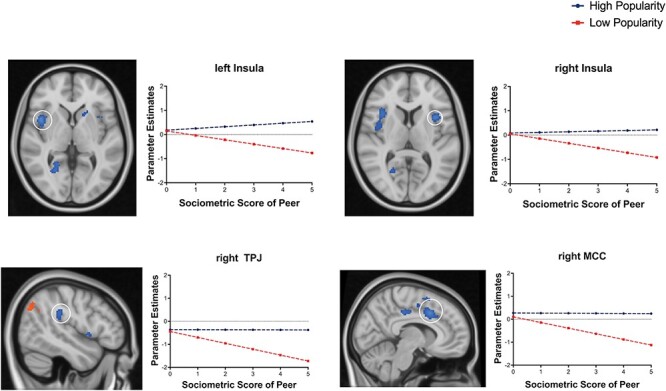
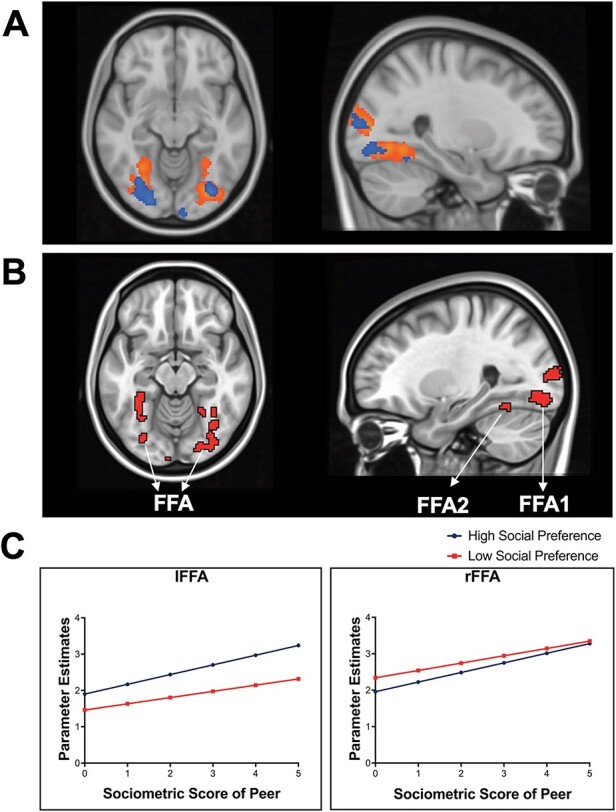
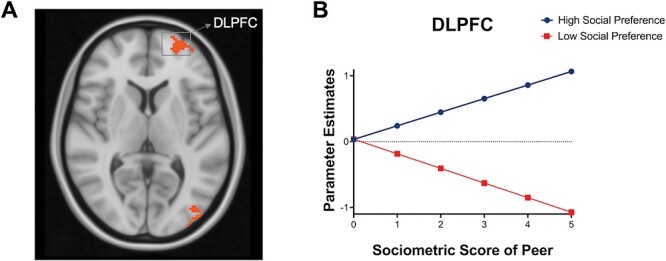
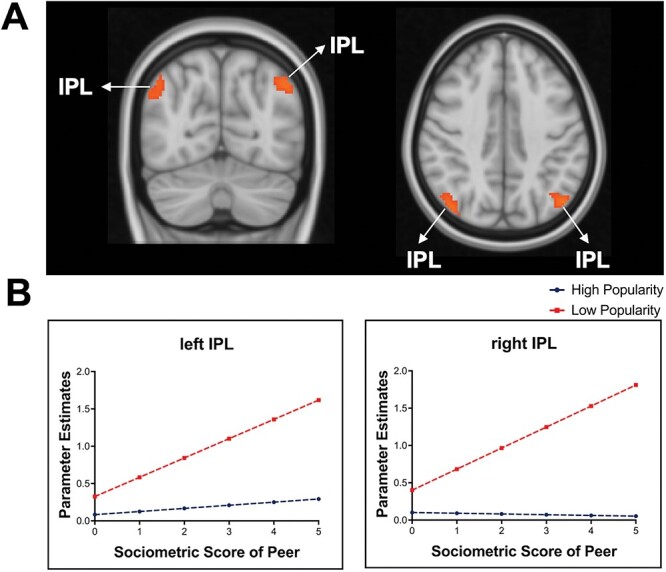
In the current study, we combined sociometric nominations and neuroimaging techniques to examine adolescents' neural tracking of peers from their real-world social network that varied in social preferences and popularity. Adolescent participants from an entire school district (N = 873) completed peer sociometric nominations of their grade at school, and a subset of participants (N = 117, Mage = 13.59 years) completed a neuroimaging task in which they viewed peer faces from their social networks. We revealed two neural processes by which adolescents track social preference: (1) the fusiform face area, an important region for early visual perception and social categorization, simultaneously represented both peers high in social preference and low in social preference; (2) the dorsolateral prefrontal cortex (DLPFC), which was differentially engaged in tracking peers high and low in social preference. No regions specifically tracked peers high in popularity and only the inferior parietal lobe, temporoparietal junction, midcingulate cortex and insula were involved in tracking unpopular peers. This is the first study to examine the neural circuits that support adolescents' perception of peer-based social networks. These findings identify the neural processes that allow youths to spontaneously keep track of peers' social value within their social network.
在当前的研究中,我们结合社交提名和神经影像学技术,研究了青少年对其现实社交网络中社会偏好和受欢迎程度不同的同伴的神经追踪。来自整个学区的青少年参与者(N=873)完成了他们在学校的年级的同伴社交提名,其中一部分参与者(N=117,Mage=13.59 岁)完成了一项神经影像学任务,他们在该任务中观看了来自社交网络的同伴面孔。我们揭示了青少年跟踪社会偏好的两个神经过程:(1)梭状回面孔区,这是一个重要的早期视觉感知和社会分类区域,同时代表了社会偏好高和低的同伴;(2)背外侧前额叶皮层(DLPFC),它在跟踪社会偏好高和低的同伴时表现出不同的参与。没有特定的区域专门跟踪受欢迎的同伴,只有下顶叶、颞顶联合区、中扣带皮层和岛叶参与了跟踪不受欢迎的同伴。这是第一项研究社交网络中同伴的神经回路的研究。这些发现确定了允许青少年在其社交网络中自发跟踪同伴社会价值的神经过程。