Faculty of Medicine and Pharmacy, University of Kisangani, Kisangani, Democratic Republic of the Congo.
School of Medical Laboratory Sciences, Institute of Health, Jimma University, Jimma, Ethiopia.
Malar J. 2023 Nov 19;22(1):354. doi: 10.1186/s12936-023-04790-1.
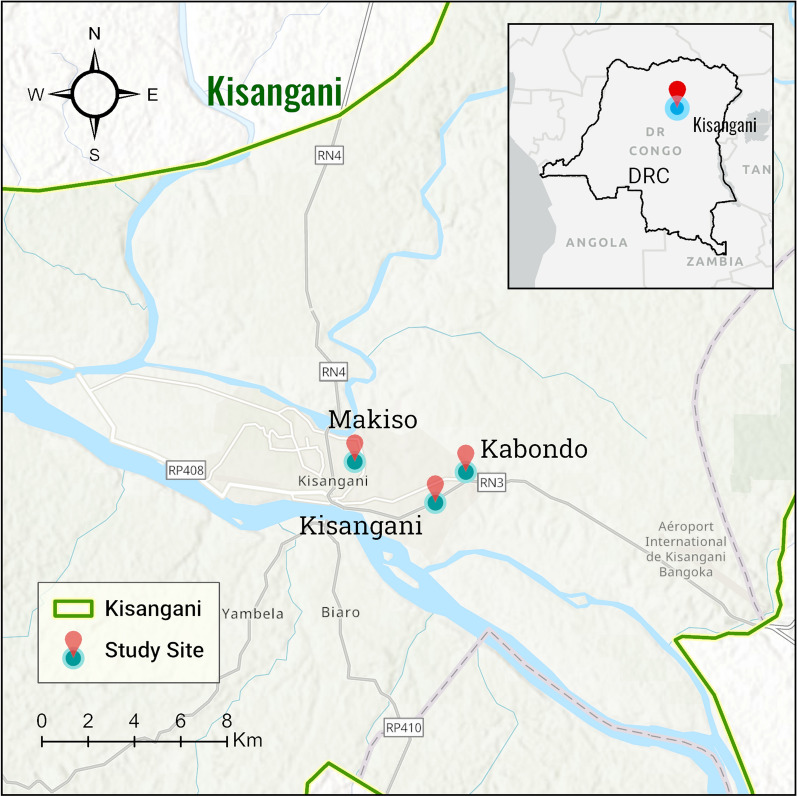
Ultrasensitive rapid diagnostic test (usRDT) was recently developed to improve the detection of low-density Plasmodium falciparum infections. However, its diagnostic performance has not been evaluated in the Democratic Republic of Congo (DRC). This study aims to determine the performance of the usRDT in malaria diagnosis in asymptomatic individuals under field condition in Kisangani, Northeast of DRC.
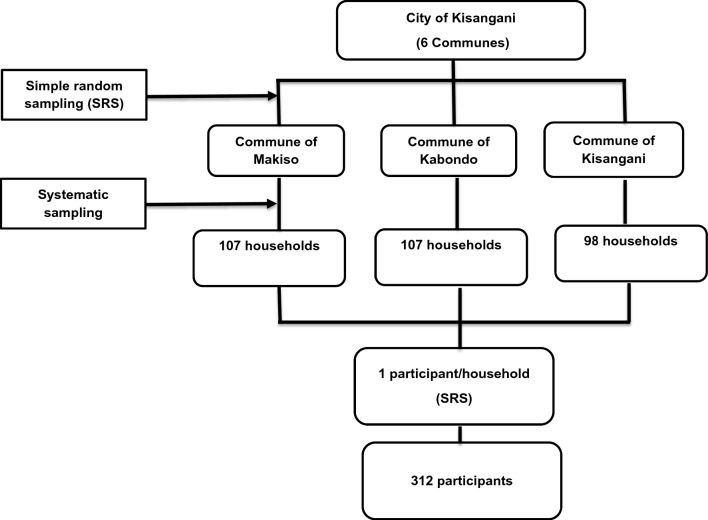
A community-based cross-sectional study was carried out from June to August 2022 on 312 asymptomatic individuals residing in the city of Kisangani. Capillary blood samples were collected by finger prick for microscopic examination of thick and thin blood film, RDTs, and nested polymerase chain reaction (PCR). Alere™ Malaria Ag P.f usRDT and conventional RDT (cRDT/SD Bioline Malaria Ag P.f) kits were used for the detection of Plasmodium histidine rich protein 2 (HRP2) antigen as a proxy for the presence of P. falciparum. The diagnostic performance of the usRDT was compared with cRDT, microscopy and PCR.
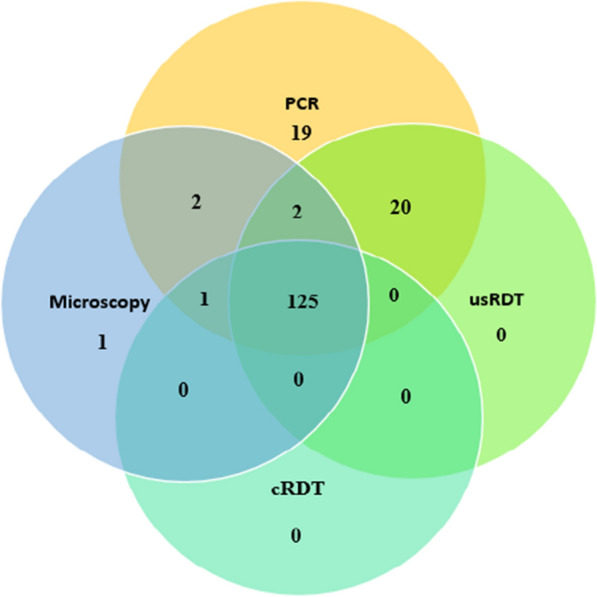
The prevalence of asymptomatic P. falciparum malaria was 40.4%, 42.0%, 47.1% and 54.2% by cRDT, microscopy, usRDT and PCR, respectively. By using PCR as a reference, usRDT had sensitivity and specificity of 87.0% (95% CI 81.4-91.7) and 100.0% (95% CI 97.5-100.0), respectively, whereas the cRDT had sensitivity and specificity of 74.6% (95% CI 67.3-80.9) and 100% (95% CI 97.1-100.0), respectively. By using microscopy as a reference, usRDT had sensitivity and specificity of 96.9% (95% CI 92.4-99.2) and 89.0% (95% CI 83.5-93.1), respectively, while the cRDT had sensitivity and specificity of 96.2% (95% CI 92.3-98.7) and 100% (95% CI 97.9-100.0), respectively.
The usRDT showed better diagnostic performance with higher sensitivity than the cRDT which is currently in use as point-of-care test. Further research is necessary to assess the access and cost-effectiveness of the usRDTs to use for malaria surveillance.
超敏快速诊断检测(usRDT)最近被开发出来,以提高对低密度恶性疟原虫感染的检测。然而,其诊断性能尚未在刚果民主共和国(DRC)进行评估。本研究旨在确定 usRDT 在 DRC 东北部 Kisangani 市无症状个体中的现场条件下进行疟疾诊断的性能。
2022 年 6 月至 8 月,对居住在 Kisangani 市的 312 名无症状个体进行了一项基于社区的横断面研究。通过手指穿刺采集毛细血管血样,用于厚、薄血膜显微镜检查、RDT 和巢式聚合酶链反应(PCR)。Alere™ Malaria Ag P.f usRDT 和常规 RDT(cRDT/SD Bioline Malaria Ag P.f)试剂盒用于检测裂殖体 HRP2 抗原,作为存在恶性疟原虫的替代物。usRDT 的诊断性能与 cRDT、显微镜和 PCR 进行了比较。
cRDT、显微镜、usRDT 和 PCR 检测的无症状恶性疟原虫疟疾患病率分别为 40.4%、42.0%、47.1%和 54.2%。以 PCR 为参考,usRDT 的灵敏度和特异性分别为 87.0%(95%CI 81.4-91.7)和 100.0%(95%CI 97.5-100.0),而 cRDT 的灵敏度和特异性分别为 74.6%(95%CI 67.3-80.9)和 100.0%(95%CI 97.1-100.0)。以显微镜为参考,usRDT 的灵敏度和特异性分别为 96.9%(95%CI 92.4-99.2)和 89.0%(95%CI 83.5-93.1),而 cRDT 的灵敏度和特异性分别为 96.2%(95%CI 92.3-98.7)和 100.0%(95%CI 97.9-100.0)。
usRDT 的敏感性优于目前用作即时检测的 cRDT,具有更好的诊断性能。需要进一步研究以评估 usRDT 的获取和成本效益,以用于疟疾监测。