Department of Medical Parasitology and Mycology, School of Public Health, Tehran University of Medical Sciences, Tehran, Iran.
Department of Biology, Faculty of Natural and Computational Sciences, Woldia University, Woldia, Ethiopia.
PLoS One. 2021 Apr 1;16(4):e0248245. doi: 10.1371/journal.pone.0248245. eCollection 2021.
In Sub-Saharan Africa (SSA), where malaria transmission is stable, malaria infection in pregnancy adversely affects pregnant women, fetuses, and newborns and is often asymptomatic. So far, a plethora of primary studies have been carried out on asymptomatic malaria infection in pregnant women in SSA. Nevertheless, no meta-analysis estimated the burden of asymptomatic malaria infection in pregnant women in SSA, so this meta-analysis was carried out to bridge this gap.
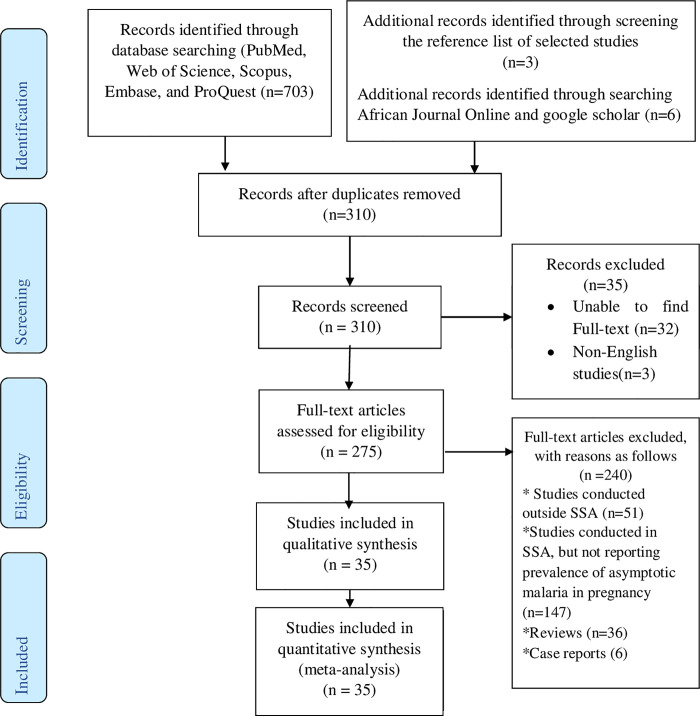
PubMed, Web of Science, Scopus, Embase, and ProQuest were systematically searched for relevant studies published until 4 August 2020, and also the expansion of the search was performed by October 24, 2020. We assessed heterogeneity among included studies using I-squared statistics (I2). Publication bias was assessed by visual inspection of the funnel plot and further quantitatively validated by Egger's and Begg's tests. The pooled prevalence and pooled odds ratio (OR) and their corresponding 95% Confidence Interval (CI) were estimated using the random-effects model in Stata 15 software.
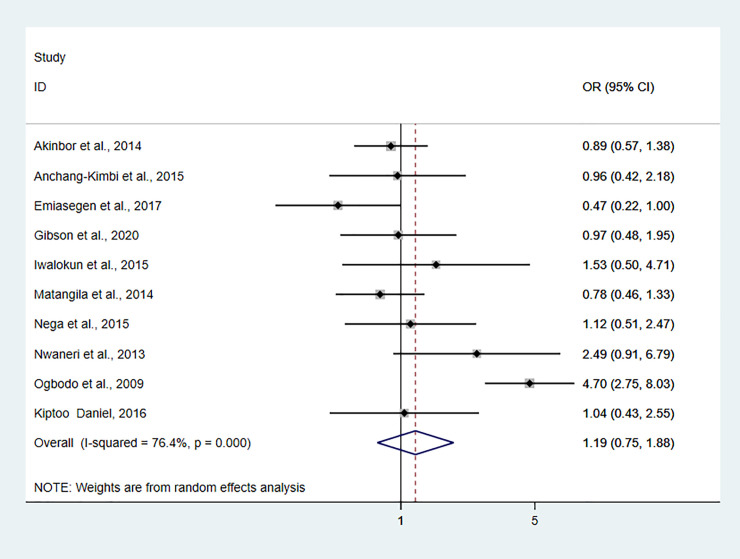
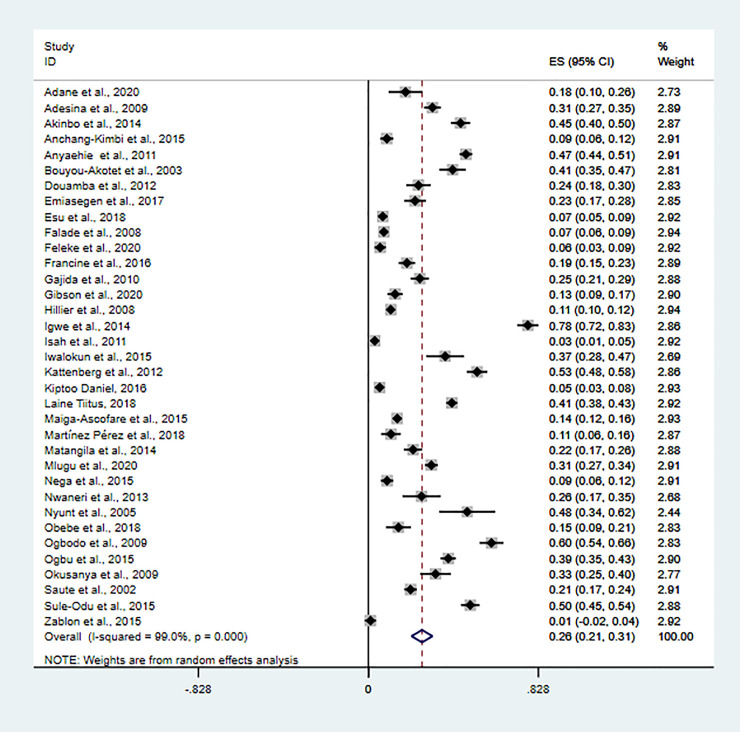
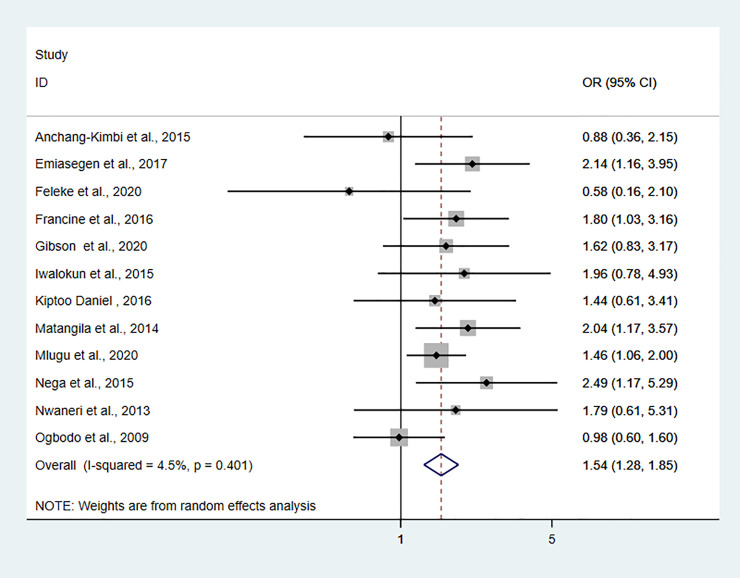
For this meta-analysis, we included 35 eligible studies. The overall prevalence estimate of asymptomatic Plasmodium infection prevalence was 26.1%% (95%CI: 21-31.2%, I2 = 99.0%). According to species-specific pooled prevalence estimate, Plasmodium falciparum was dominant species (22.1%, 95%CI: 17.1-27.2%, I2 = 98.6%), followed by Plasmodium vivax, Plasmodium malariae and Plasmodium ovale, respectively, found to be 3% (95%CI: 0-5%, I2 = 88.3%), 0.8% (95%CI: 0.3-0.13%, I2 = 60.5%), and 0.2% (95%CI: -0.01-0.5%, I2 = 31.5%). Asymptomatic malaria-infected pregnant women were 2.28 times more likely anemic (OR = 2.28, 95%CI: 1.66-3.13, I2 = 56.3%) than in non-infected pregnant women. Asymptomatic malaria infection was 1.54 times higher (OR = 1.54, 95%CI: 1.28-1.85, I2 = 11.5%) in primigravida women compared to multigravida women.
In SSA, asymptomatic malaria infection in pregnant women is prevalent, and it is associated with an increased likelihood of anemia compared to non-infected pregnant women. Thus, screening of asymptomatic pregnant women for malaria and anemia should be included as part of antenatal care.
在疟疾传播稳定的撒哈拉以南非洲(SSA)地区,疟疾感染会对孕妇、胎儿和新生儿造成不良影响,且通常无症状。迄今为止,已经有大量的基础研究针对 SSA 地区孕妇的无症状疟疾感染进行了研究。然而,尚无荟萃分析来评估 SSA 地区孕妇无症状疟疾感染的负担,因此进行了这项荟萃分析以填补这一空白。
系统检索了截至 2020 年 8 月 4 日发表的相关研究,使用 PubMed、Web of Science、Scopus、Embase 和 ProQuest 进行检索,并于 2020 年 10 月 24 日进行了扩展检索。我们使用 I 平方统计量(I2)评估纳入研究的异质性。通过漏斗图直观评估发表偏倚,并进一步通过 Egger 检验和 Begg 检验进行定量验证。使用 Stata 15 软件的随机效应模型估计汇总患病率、汇总优势比(OR)及其相应的 95%置信区间(CI)。
本次荟萃分析共纳入 35 项符合条件的研究。无症状 Plasmodium 感染的总体患病率估计为 26.1%(95%CI:21-31.2%,I2 = 99.0%)。根据种特异性汇总患病率估计,恶性疟原虫是主要的流行物种(22.1%,95%CI:17.1-27.2%,I2 = 98.6%),其次是间日疟原虫、卵形疟原虫和三日疟原虫,分别为 3%(95%CI:0-5%,I2 = 88.3%)、0.8%(95%CI:0.3-0.13%,I2 = 60.5%)和 0.2%(95%CI:-0.01-0.5%,I2 = 31.5%)。无症状疟疾感染的孕妇发生贫血的可能性比未感染的孕妇高 2.28 倍(OR = 2.28,95%CI:1.66-3.13,I2 = 56.3%)。与多产妇相比,初产妇发生无症状疟疾感染的可能性高 1.54 倍(OR = 1.54,95%CI:1.28-1.85,I2 = 11.5%)。
在 SSA,孕妇的无症状疟疾感染较为普遍,与未感染的孕妇相比,其贫血的可能性更高。因此,应将对无症状孕妇的疟疾和贫血筛查纳入产前保健的一部分。