Department of Biological Sciences, Ulsan National Institutes of Science and Technology (UNIST), Ulsan, 44919, Republic of Korea.
SmartinBio Inc., Cheongju, 28160, Republic of Korea.
Adv Sci (Weinh). 2024 Jan;11(2):e2302776. doi: 10.1002/advs.202302776. Epub 2023 Nov 20.
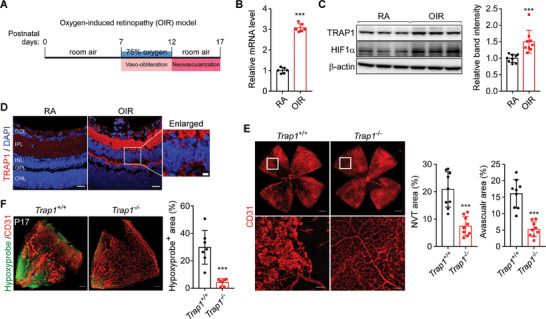
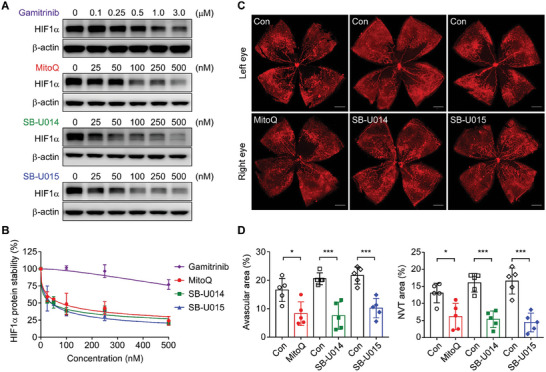
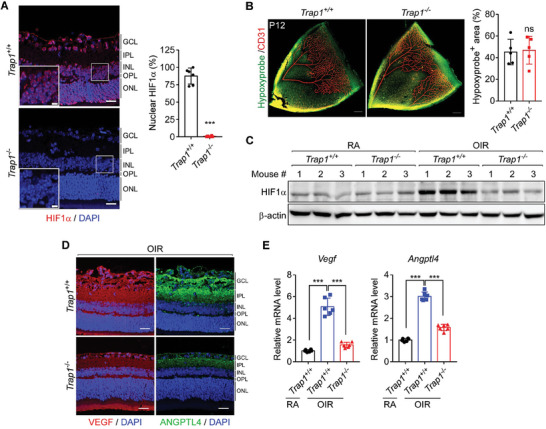
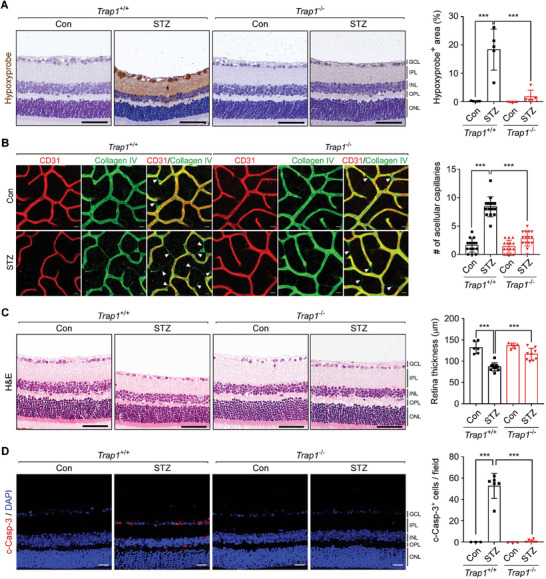
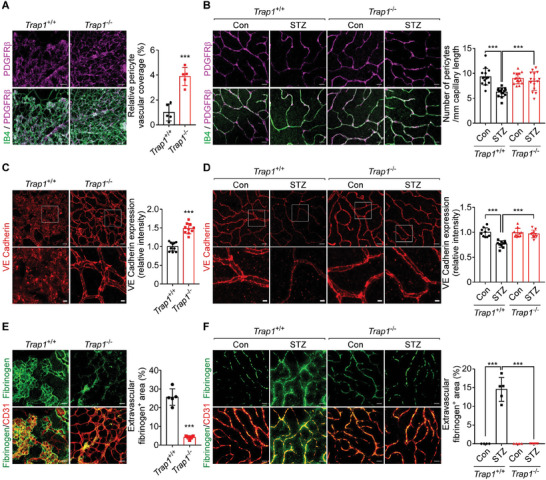
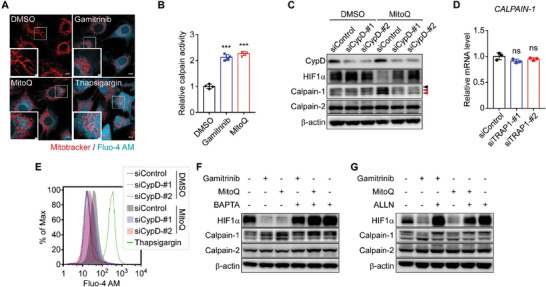
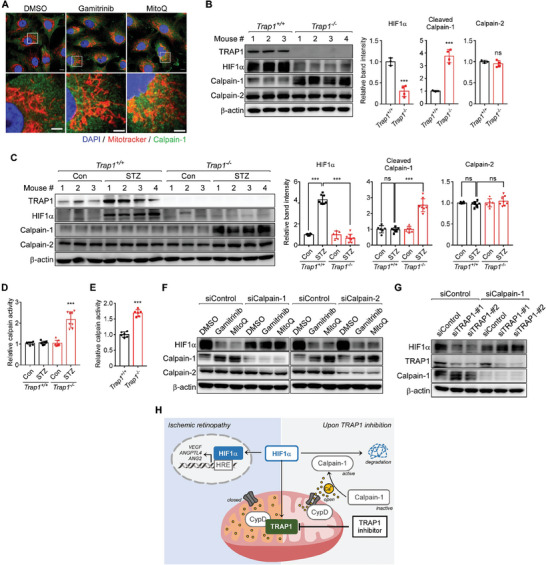
Activation of hypoxia-inducible factor 1α (HIF1α) contributes to blood-retinal barrier (BRB) breakdown and pathological neovascularization responsible for vision loss in ischemic retinal diseases. During disease progression, mitochondrial biology is altered to adapt to the ischemic environment created by initial vascular dysfunction, but the mitochondrial adaptive mechanisms, which ultimately contribute to the pathogenesis of ischemic retinopathy, remain incompletely understood. In the present study, it is identified that expression of mitochondrial chaperone tumor necrosis factor receptor-associated protein 1 (TRAP1) is essential for BRB breakdown and pathologic retinal neovascularization in mouse models mimicking ischemic retinopathies. Genetic Trap1 ablation or treatment with small molecule TRAP1 inhibitors, such as mitoquinone (MitoQ) and SB-U015, alleviate retinal pathologies via proteolytic HIF1α degradation, which is mediated by opening of the mitochondrial permeability transition pore and activation of calcium-dependent protease calpain-1. These findings suggest that TRAP1 can be a promising target for the development of new treatments against ischemic retinopathy, such as retinopathy of prematurity and proliferative diabetic retinopathy.
缺氧诱导因子 1α(HIF1α)的激活有助于血视网膜屏障(BRB)的破坏和病理性新生血管形成,这是缺血性视网膜疾病导致视力丧失的原因。在疾病进展过程中,线粒体生物学发生改变以适应由初始血管功能障碍引起的缺血环境,但最终导致缺血性视网膜病变发病机制的线粒体适应机制仍不完全清楚。在本研究中,确定线粒体伴侣肿瘤坏死因子受体相关蛋白 1(TRAP1)的表达对于模拟缺血性视网膜病变的小鼠模型中的 BRB 破坏和病理性视网膜新生血管形成是必不可少的。通过打开线粒体通透性转换孔和激活钙依赖性蛋白酶钙蛋白酶-1,遗传 Trap1 缺失或用小分子 TRAP1 抑制剂(如 mitoquinone(MitoQ)和 SB-U015)进行治疗,可通过蛋白水解 HIF1α降解来减轻视网膜病变。这些发现表明,TRAP1 可能成为开发新的缺血性视网膜病变治疗方法(如早产儿视网膜病变和增生性糖尿病视网膜病变)的有前途的靶点。