Dipartimento di Scienze Biomediche, Università di Padova, viale G. Colombo 3, 35131, Padova, Italy.
Dipartimento di Biologia, Università di Padova, viale G. Colombo 3, 35131, Padova, Italy.
Cell Death Dis. 2021 May 1;12(5):434. doi: 10.1038/s41419-021-03716-6.
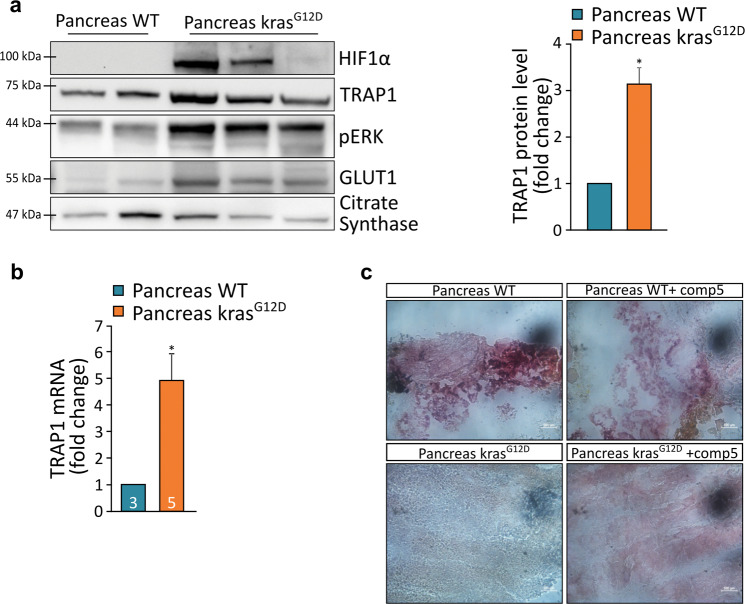
The mitochondrial paralog of the Hsp90 chaperone family TRAP1 is often induced in tumors, but the mechanisms controlling its expression, as well as its physiological functions remain poorly understood. Here, we find that TRAP1 is highly expressed in the early stages of Zebrafish development, and its ablation delays embryogenesis while increasing mitochondrial respiration of fish larvae. TRAP1 expression is enhanced by hypoxic conditions both in developing embryos and in cancer models of Zebrafish and mammals. The TRAP1 promoter contains evolutionary conserved hypoxic responsive elements, and HIF1α stabilization increases TRAP1 levels. TRAP1 inhibition by selective compounds or by genetic knock-out maintains a high level of respiration in Zebrafish embryos after exposure to hypoxia. Our data identify TRAP1 as a primary regulator of mitochondrial bioenergetics in highly proliferating cells following reduction in oxygen tension and HIF1α stabilization.
热休克蛋白 90 伴侣家族的线粒体同工型 TRAP1 通常在肿瘤中被诱导,但控制其表达的机制及其生理功能仍知之甚少。在这里,我们发现 TRAP1 在斑马鱼发育的早期阶段高度表达,其缺失会延迟胚胎发生,同时增加鱼幼虫的线粒体呼吸。在发育中的胚胎和斑马鱼及哺乳动物的癌症模型中,缺氧条件均增强了 TRAP1 的表达。TRAP1 启动子包含进化保守的缺氧反应元件,HIF1α 稳定增加 TRAP1 水平。通过选择性化合物或基因敲除抑制 TRAP1,可在斑马鱼胚胎暴露于低氧后维持高水平的呼吸。我们的数据表明,在氧张力降低和 HIF1α 稳定后,TRAP1 是高度增殖细胞中线粒体生物能量的主要调节剂。