Division of Biokinesiology and Physical Therapy, University of Southern California, Los Angeles, CA, USA.
Department of Mechanical and Biomedical Engineering, Boise State University, Boise, ID, USA.
J Appl Biomech. 2023 Nov 20;40(2):105-111. doi: 10.1123/jab.2023-0127. Print 2024 Apr 1.
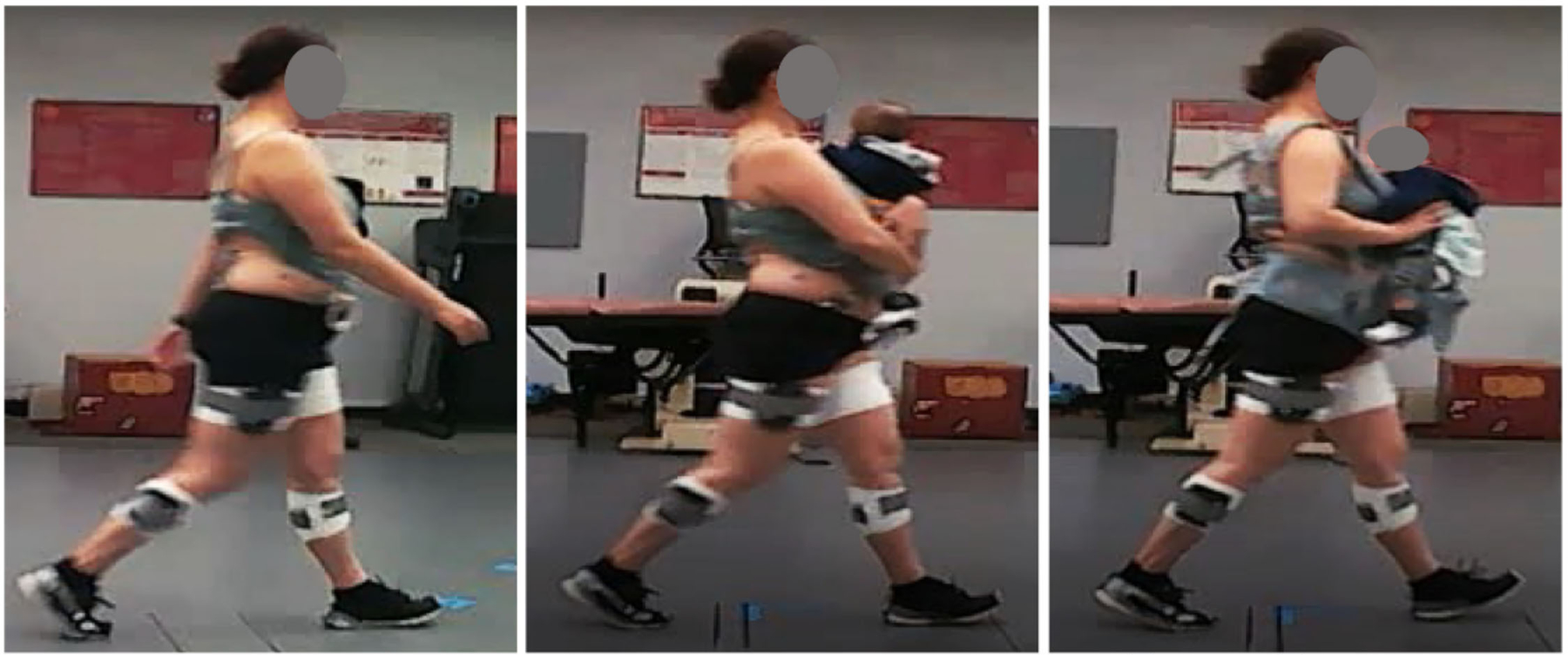
Postpartum mothers are susceptible to lumbopelvic pain which may be exacerbated by loading, like carrying their infant in arms and with baby carriers. Nulliparous women carrying infant mannequins may biomechanically mimic mother-infant dyad, but this has not been studied. The purpose of our study was to investigate biomechanical differences of 10 mothers carrying their infants and 10 nulliparous women carrying infant mannequins under 3 gait conditions: carrying nothing, carrying in arms, and carrying in a baby carrier (babywearing). Spatiotemporal gait parameters, peak ground reaction forces and impulses, and lower extremity and trunk kinematics were collected using motion capture and force plates and compared using a mixed 2 × 3 (parity × condition) analysis of variance (α ≤ .05). The largest differences occurred between carrying conditions: carrying in arms or babywearing increased vertical and anteroposterior ground reaction forces, trunk extension, ankle dorsiflexion, and hip and knee flexion. Kinematic differences were identified between arms and babywearing conditions. Together this suggests alterations in joint loading for both groups. Our study also contributes a novel understanding of postpartum health by demonstrating alterations in step time, anterior forces, and ankle and knee mechanics, suggesting that during gait, mothers carrying their own infants choose different propulsive strategies than nulliparous women carrying mannequins.
产后母亲易患腰骶部疼痛,这种疼痛可能因负重而加重,如抱婴儿或使用婴儿背带。未生育的女性怀抱婴儿假人可能在生物力学上模拟母婴对,但这尚未被研究过。我们的研究目的是研究 10 位抱着婴儿的母亲和 10 位怀抱婴儿假人的未生育女性在 3 种步态条件下的生物力学差异:不抱任何东西、抱在怀里和使用婴儿背带(背带)。使用运动捕捉和力板收集时空步态参数、峰值地面反作用力和冲量以及下肢和躯干运动学,并使用混合 2×3(奇偶性×条件)方差分析(α≤.05)进行比较。最大的差异发生在抱持条件之间:抱在怀里或使用背带会增加垂直和前后方向的地面反作用力、躯干伸展、踝关节背屈、髋关节和膝关节屈曲。在手臂和背带条件之间还确定了运动学差异。这表明两组的关节负荷都发生了改变。我们的研究还通过展示步幅时间、前向力以及踝关节和膝关节力学的改变,为产后健康提供了新的认识,这表明在行走过程中,抱着自己婴儿的母亲会选择与怀抱假人的未生育女性不同的推进策略。