Center for Children's Healthy Lifestyles and Nutrition, Children's Mercy Kansas City, Kansas City, MO, USA.
Department of Behavioral and Social Health Sciences, School of Public Health, Brown University, Providence, RI, USA.
BMC Public Health. 2023 Nov 21;23(1):2301. doi: 10.1186/s12889-023-17179-1.
The food and beverages served in family childcare homes (FCCHs) may play an important role in the development of childhood overweight and obesity. This analysis examines whether children's diet quality mediates the relationship between foods and beverages served in FCCHs and preschool-aged children's weight status.
Trained and certified staff conducted observations for two days in each FCCH, using the Environment and Policy Assessment and Observation (EPAO) measure to determine the foods and beverages served to children (N = 370) in FCCHs (N = 120). They also used the Dietary Observation in Child Care (DOCC) protocol to assess children's food and beverage intake during childcare, from which we calculated the Healthy Eating Index-2015 (HEI), a measure of diet quality. Height and weight were measured for each child with parent consent from which the child's body mass index (BMI) z-scores were calculated. A multilevel mediation analysis was conducted to indicate whether children's diet quality mediates the relations between food and beverage served in FCCHs and preschool-aged children's weight status.
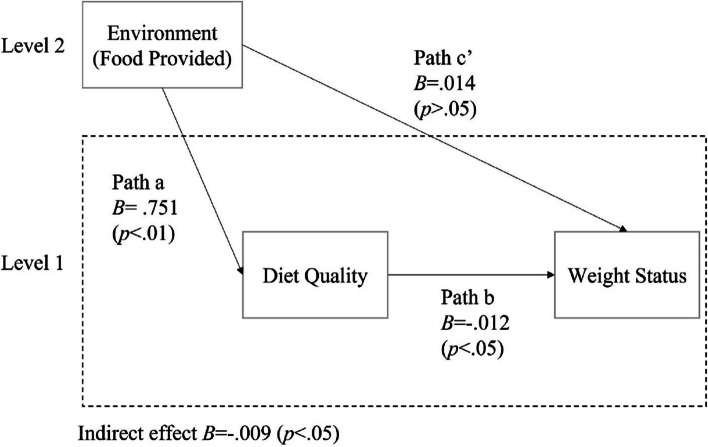
Children's total HEI scores significantly mediated the relationship between the EPAO subscale Food Provided and children's BMI z-scores (B=-0.01, p < .05, 95% CI = [-0.03, - 0.002]). Further, the EPAO subscale Food Provided was positively associated with the total HEI score (B = 0.75, p < .01, 95% CI = [0.32, 1.18]). Total HEI scores were negatively associated with BMI z-score (B=-0.01, p < .05, 95% CI = [-0.02, - 0.001]).
Children's diet quality did significantly mediate the relationship between the food served in FCCHs and children's weight status. More longitudinal studies with longer follow-up periods need to be conducted to confirm these relationships. Further, future studies need to examine the relationships between a broader spectrum of FCCH environmental characteristics and home environment with children's weight status, as well as other mediators including physical activity.
家庭日托中心(FCCH)供应的食品和饮料可能在儿童超重和肥胖的发展中发挥重要作用。本分析研究了 FCCH 供应的食品和饮料与学龄前儿童体重状况之间的关系是否通过儿童饮食质量来介导。
经过培训和认证的工作人员在每个 FCCH 进行了两天的观察,使用环境和政策评估与观察(EPAO)措施来确定 FCCH 中供应给儿童(N=370)的食品和饮料(N=120)。他们还使用儿童保育中的膳食观察(DOCC)协议来评估儿童在保育期间的食物和饮料摄入量,从中我们计算了健康饮食指数-2015(HEI),这是衡量饮食质量的一个指标。经父母同意,为每个孩子测量身高和体重,计算出孩子的体重指数(BMI)z 分数。进行多水平中介分析,以表明 FCCH 供应的食品和饮料与学龄前儿童体重状况之间的关系是否通过儿童的饮食质量来介导。
儿童的总 HEI 评分显著介导了 EPAO 分量表提供的食物与儿童 BMI z 分数之间的关系(B=-0.01,p<.05,95%置信区间=-0.03,-0.002)。此外,EPAO 分量表提供的食物与总 HEI 评分呈正相关(B=0.75,p<.01,95%置信区间=0.32,1.18)。总 HEI 评分与 BMI z 分数呈负相关(B=-0.01,p<.05,95%置信区间=-0.02,-0.001)。
儿童的饮食质量确实显著介导了 FCCH 供应的食物与儿童体重状况之间的关系。需要进行更多具有更长随访时间的纵向研究来证实这些关系。此外,未来的研究需要研究更广泛的 FCCH 环境特征和家庭环境与儿童体重状况之间的关系,以及包括体力活动在内的其他中介因素。