J Cardiovasc Nurs. 2024;39(6):571-582. doi: 10.1097/JCN.0000000000001064. Epub 2023 Nov 22.
Ventricular assist device (VAD) implantation has become an alternative treatment for patients with end-stage heart failure. In Germany, valid and reliable instruments to assess health-related quality of life in patients with VAD are lacking.
The aim of this study was to present the psychometric validation of the German version of the Quality of Life with a Ventricular Assist Device questionnaire.
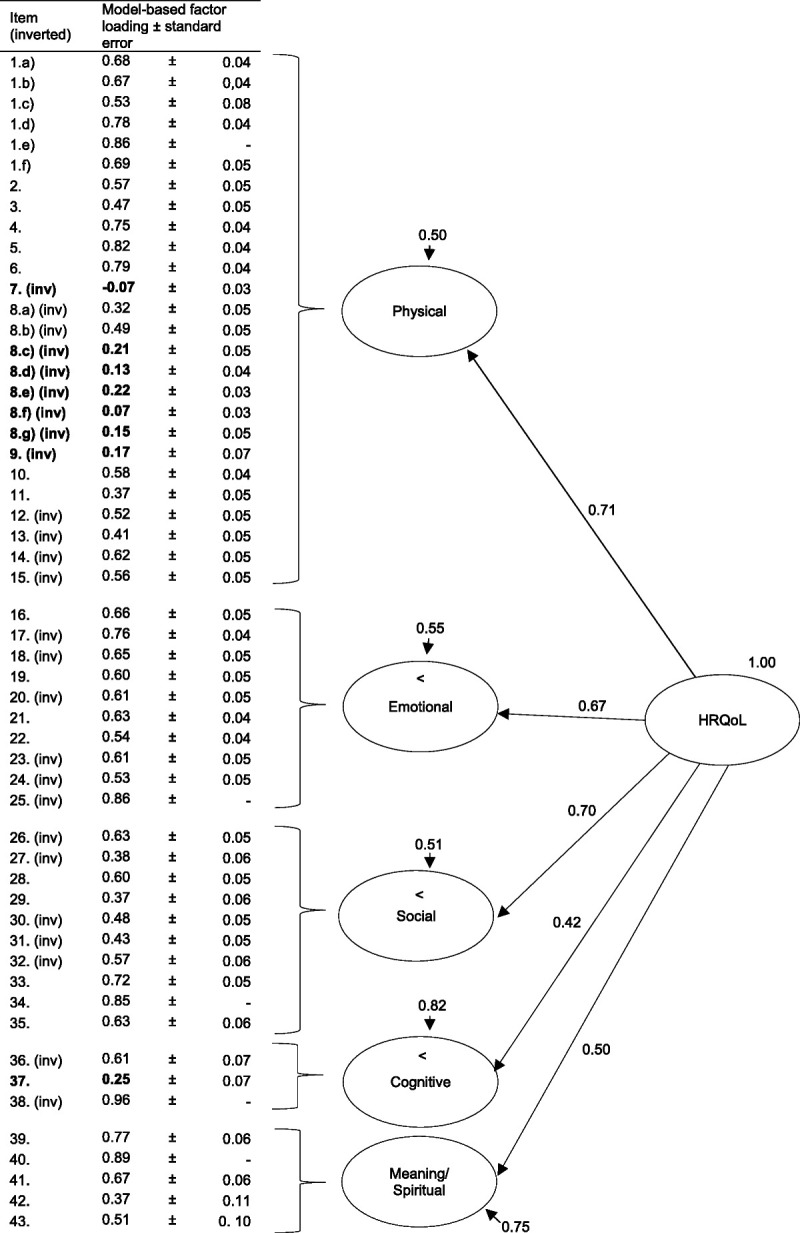
In a multicenter, cross-sectional study, 393 participants (mean age, 58.3 years; 85.8% male, 60.3% bridge to transplant, and 72.8% living with VAD for ≤2 years) completed the German Quality of Life with a Ventricular Assist Device questionnaire of physical, emotional, social, cognitive, and meaning/spiritual domains. Item and confirmatory factor analyses were conducted to test item difficulty and discrimination and the underlying structure, respectively. To examine internal consistency, Cronbach α was assessed. Convergent construct validity was tested using the Kansas City Cardiomyopathy Questionnaire and the Patient Health Questionnaire-9. Readability was examined using Flesch Reading Ease index and Vienna Factual Text Formula.
The Quality of Life with a Ventricular Assist Device showed reasonable item difficulty ( Ptotal = .67) and mostly moderate to high discriminatory power ( rit > 0.30). In confirmatory factor analysis, root-mean-square error of approximation (0.07) was acceptable for model fit, but no other indices. Acceptable internal consistency was found ( α ≥ 0.79), with the exception of the cognitive domain ( α = 0.58). The overall questionnaire and single domains demonstrated convergent validity ( r ≥ 0.45, P < .001). The questionnaire showed adequate readability (Flesch Reading Ease, 64.11; Vienna Factual Text Formula, 6.91).
Findings indicate a promising standardized clinical instrument to assess health-related quality of life in patients with VAD.
心室辅助装置(VAD)的植入已成为治疗终末期心力衰竭患者的一种替代疗法。在德国,缺乏评估 VAD 患者健康相关生活质量的有效且可靠的工具。
本研究旨在介绍德国版心室辅助装置生活质量问卷的心理测量学验证结果。
在一项多中心、横断面研究中,393 名参与者(平均年龄 58.3 岁;85.8%为男性,60.3%为桥接移植,72.8%为 VAD 治疗≤2 年)完成了德国版心室辅助装置生活质量问卷的身体、情绪、社会、认知和意义/精神领域的评估。进行项目和验证性因子分析,分别用于检验项目难度和区分度以及潜在结构。为了检验内部一致性,评估了 Cronbach α。使用堪萨斯城心肌病问卷和患者健康问卷-9 检验聚合结构效度。使用 Flesch 阅读舒适度指数和维也纳真实文本公式检验易读性。
心室辅助装置生活质量问卷显示出合理的项目难度( Ptotal =.67)和中等至高的区分度( rit > 0.30)。在验证性因子分析中,接近均方根误差(0.07)表明模型拟合可接受,但其他指标不可接受。除认知领域( α = 0.58)外,其他领域均显示出可接受的内部一致性( α ≥ 0.79)。问卷整体和各单领域均显示出聚合效度( r ≥ 0.45, P <.001)。问卷具有良好的易读性(Flesch 阅读舒适度指数,64.11;维也纳真实文本公式,6.91)。
研究结果表明,该问卷是一种有前途的标准化临床工具,可用于评估 VAD 患者的健康相关生活质量。