Department of Psychiatry, University of Occupational and Environmental Health, 807-8555, Kitakyushu, Fukuoka, 8078555, Japan.
Third Department of Internal Medicine, University of Occupational and Environmental Health, Fukuoka, Japan.
Eur Arch Psychiatry Clin Neurosci. 2024 Oct;274(7):1697-1707. doi: 10.1007/s00406-023-01713-8. Epub 2023 Nov 22.
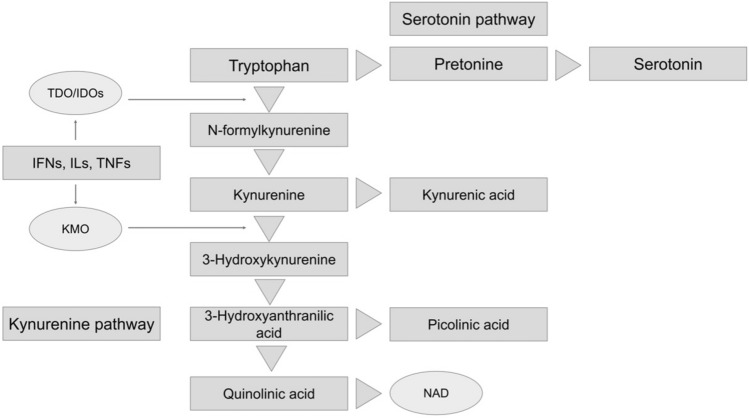
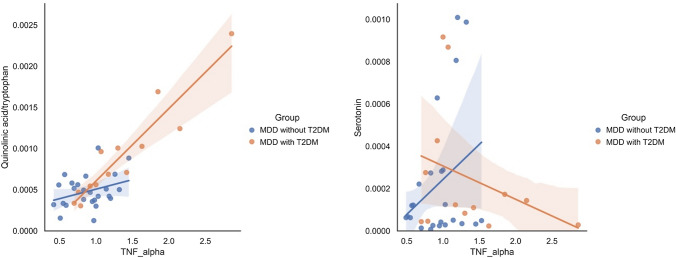
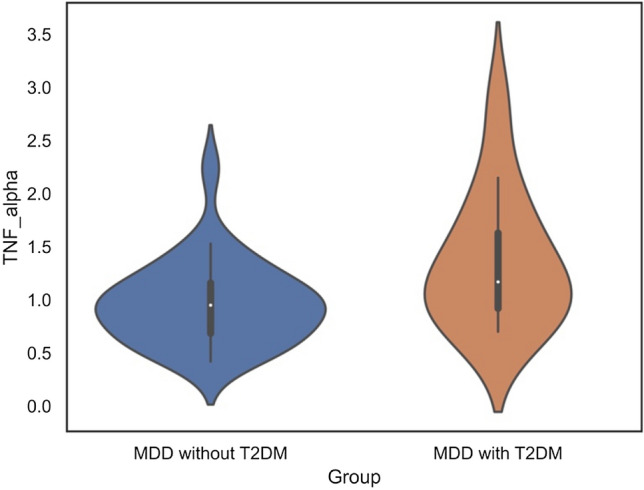
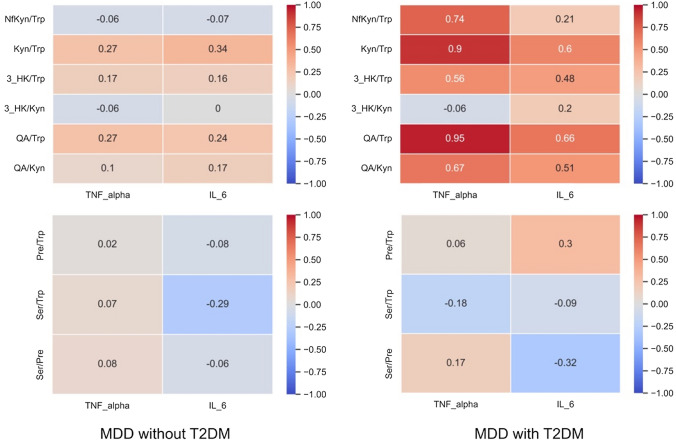
Major depressive disorder (MDD) is strongly associated with type 2 diabetes mellitus (T2DM). The kynurenine and serotonin pathways, as well as chronic low-grade inflammation, are being considered potential links between them. MDD associated with T2DM is less responsive to treatment than that without T2DM; however, the underlying mechanism remains unknown. We aimed to investigate the effects of inflammatory cytokines on the kynurenine and serotonin pathways in patients with comorbid MDD and T2DM and those with only MDD. We recruited 13 patients with comorbid MDD and T2DM and 27 patients with only MDD. We measured interleukin-6 and tumor necrosis factor-α (TNF-α) levels as inflammatory cytokines and metabolites of the kynurenine pathway and examined the relationship between the two. TNF-α levels were significantly higher in patients with comorbid MDD and T2DM than in those with only MDD in univariate (p = 0.044) and multivariate (adjusted p = 0.036) analyses. TNF-α showed a statistically significant effect modification (interaction) with quinolinic acid/tryptophan and serotonin in patients from both groups (β = 1.029, adjusted p < 0.001; β = - 1.444, adjusted p = 0.047, respectively). Limitations attributed to the study design and number of samples may be present. All patients were Japanese with mild to moderate MDD; therefore, the generalizability of our findings may be limited. MDD with T2DM has more inflammatory depression components and activations of the kynurenine pathway by inflammatory cytokines than MDD without T2DM. Hence, administering antidepressants and anti-inflammatory drugs in combination may be more effective in patients with comorbid MDD and T2DM.
重度抑郁症(MDD)与 2 型糖尿病(T2DM)密切相关。色氨酸和血清素途径以及慢性低度炎症被认为是它们之间的潜在联系。与没有 T2DM 的 MDD 相比,与 T2DM 相关的 MDD 对治疗的反应较差;然而,其潜在机制尚不清楚。我们旨在研究炎症细胞因子对合并 MDD 和 T2DM 以及仅 MDD 的患者的犬尿氨酸和血清素途径的影响。我们招募了 13 名合并 MDD 和 T2DM 的患者和 27 名仅有 MDD 的患者。我们测量了白细胞介素-6 和肿瘤坏死因子-α(TNF-α)水平作为炎症细胞因子和犬尿氨酸途径的代谢产物,并检查了两者之间的关系。在单变量(p=0.044)和多变量(调整后 p=0.036)分析中,合并 MDD 和 T2DM 的患者的 TNF-α 水平明显高于仅有 MDD 的患者。TNF-α 在两组患者中均显示与喹啉酸/色氨酸和血清素的统计学显著效应修饰(交互作用)(β=1.029,调整后 p<0.001;β=−1.444,调整后 p=0.047)。可能存在归因于研究设计和样本数量的限制。所有患者均为日本籍,患有轻度至中度 MDD;因此,我们研究结果的普遍性可能有限。与没有 T2DM 的 MDD 相比,合并 T2DM 的 MDD 具有更多的炎症性抑郁成分和炎症细胞因子对犬尿氨酸途径的激活。因此,在合并 MDD 和 T2DM 的患者中联合使用抗抑郁药和抗炎药可能更有效。