Verville Leslie, Hincapié Cesar A, Southerst Danielle, Yu Hainan, Bussières André, Gross Douglas P, Pereira Paulo, Mior Silvano, Tricco Andrea C, Cedraschi Christine, Brunton Ginny, Nordin Margareta, Connell Gaelan, Shearer Heather M, Wong Jessica J, Hofstetter Léonie, Romanelli Andrew, Guist Brett, To Daphne, Stuber Kent, da Silva-Oolup Sophia, Stupar Maja, Myrtos Danny, Lee Joyce G B, DeSouza Astrid, Muñoz Laguna Javier, Murnaghan Kent, Cancelliere Carol
Institute for Disability and Rehabilitation Research and Faculty of Health Sciences, Ontario Tech University, Oshawa, Canada.
EBPI-UWZH Musculoskeletal Epidemiology Research Group, University of Zurich and Balgrist University Hospital, Zurich, Switzerland.
J Occup Rehabil. 2023 Dec;33(4):651-660. doi: 10.1007/s10926-023-10121-7. Epub 2023 Nov 22.
To evaluate benefits and harms of transcutaneous electrical nerve stimulation (TENS) for chronic primary low back pain (CPLBP) in adults to inform a World Health Organization (WHO) standard clinical guideline.
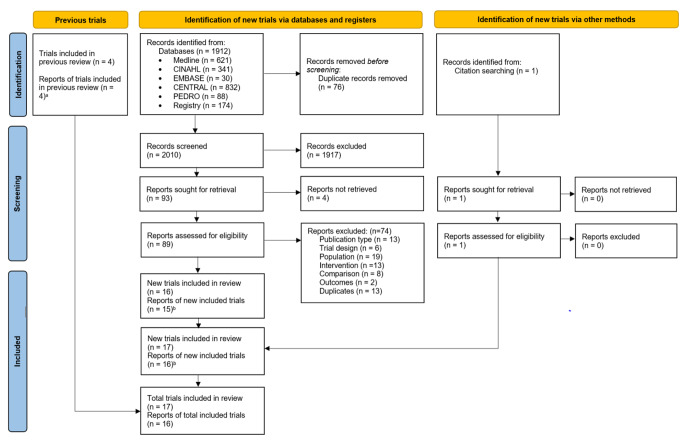
We searched for randomized controlled trials (RCTs) from various electronic databases from July 1, 2007 to March 9, 2022. Eligible RCTs targeted TENS compared to placebo/sham, usual care, no intervention, or interventions with isolated TENS effects (i.e., combined TENS with treatment B versus treatment B alone) in adults with CPLBP. We extracted outcomes requested by the WHO Guideline Development Group, appraised the risk of bias, conducted meta-analyses where appropriate, and graded the certainty of evidence using GRADE.
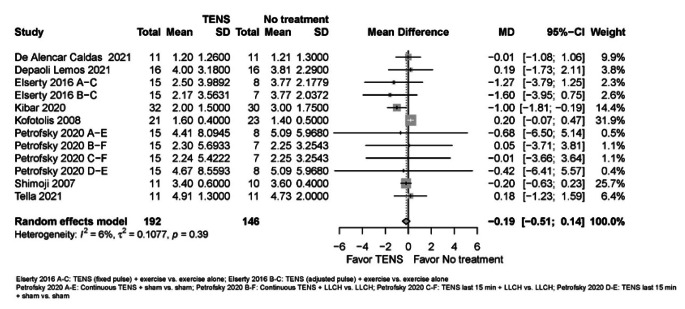
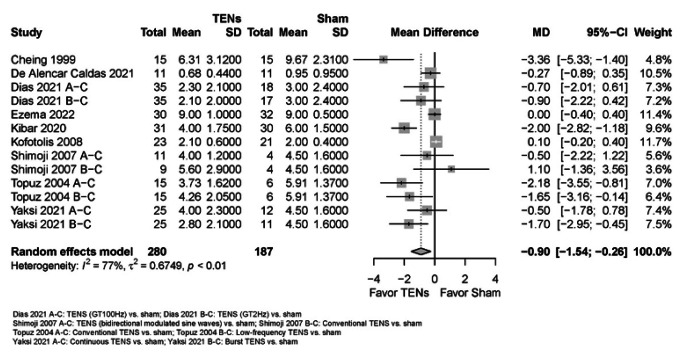
Seventeen RCTs (adults, n = 1027; adults ≥ 60 years, n = 28) out of 2010 records and 89 full text RCTs screened were included. The evidence suggested that TENS resulted in a marginal reduction in pain compared to sham (9 RCTs) in the immediate term (2 weeks) (mean difference (MD) = -0.90, 95% confidence interval -1.54 to -0.26), and a reduction in pain catastrophizing in the short term (3 months) with TENS versus no intervention or interventions with TENS specific effects (1 RCT) (MD = -11.20, 95% CI -17.88 to -3.52). For other outcomes, little or no difference was found between TENS and the comparison interventions. The certainty of the evidence for all outcomes was very low.
Based on very low certainty evidence, TENS resulted in brief and marginal reductions in pain (not deemed clinically important) and a short-term reduction in pain catastrophizing in adults with CPLBP, while little to no differences were found for other outcomes.
评估经皮电刺激神经疗法(TENS)对成人慢性原发性下腰痛(CPLBP)的益处和危害,以为世界卫生组织(WHO)的标准临床指南提供参考。
我们检索了2007年7月1日至2022年3月9日期间多个电子数据库中的随机对照试验(RCT)。符合条件的RCT针对CPLBP成人患者,比较了TENS与安慰剂/假刺激、常规护理、无干预措施,或与具有单独TENS效应的干预措施(即TENS联合治疗B与单独治疗B)。我们提取了WHO指南制定小组要求的结果,评估了偏倚风险,在适当情况下进行了荟萃分析,并使用GRADE对证据的确定性进行了分级。
在筛选的2010条记录和89篇全文RCT中,纳入了17项RCT(成人,n = 1027;60岁及以上成人,n = 28)。证据表明,与假刺激相比,TENS在短期内(2周)导致疼痛略有减轻(9项RCT)(平均差(MD)=-0.90,95%置信区间 -1.54至-0.26),并且与无干预措施或具有TENS特定效应的干预措施相比,TENS在短期内(3个月)可减轻疼痛灾难化程度(1项RCT)(MD = -11.20,95%CI -17.88至-3.52)。对于其他结果,TENS与对照干预措施之间几乎没有差异。所有结果的证据确定性都非常低。
基于确定性非常低的证据,TENS可使CPLBP成人患者的疼痛在短期内略有减轻(不认为具有临床重要性),并在短期内减轻疼痛灾难化程度,而在其他结果方面几乎没有差异。