Animal and Veterinary Service, National Parks Board (NParks), 1 Cluny Road, Singapore Botanic Gardens, Singapore, 259569, Singapore.
Wildlife Management, National Parks Board (NParks), 1 Cluny Road, Singapore Botanic Gardens, Singapore, 259569, Singapore.
Parasit Vectors. 2023 Nov 22;16(1):432. doi: 10.1186/s13071-023-06040-4.
Babesia is a protozoal, tick-borne parasite that can cause life-threatening disease in humans, wildlife and domestic animals worldwide. However, in Southeast Asia, little is known about the prevalence and diversity of Babesia species present in wildlife and the tick vectors responsible for its transmission. Recently, a novel Babesia species was reported in confiscated Sunda pangolins (Manis javanica) in Thailand. To investigate the presence of this parasite in Singapore, we conducted a molecular survey of Babesia spp. in free-roaming Sunda pangolins and their main ectoparasite, the Amblyomma javanense tick.
Ticks and tissue samples were opportunistically collected from live and dead Sunda pangolins and screened using a PCR assay targeting the 18S rRNA gene of Babesia spp. DNA barcoding of the cytochrome oxidase subunit I (COI) mitochondrial gene was used to confirm the species of ticks that were Babesia positive.
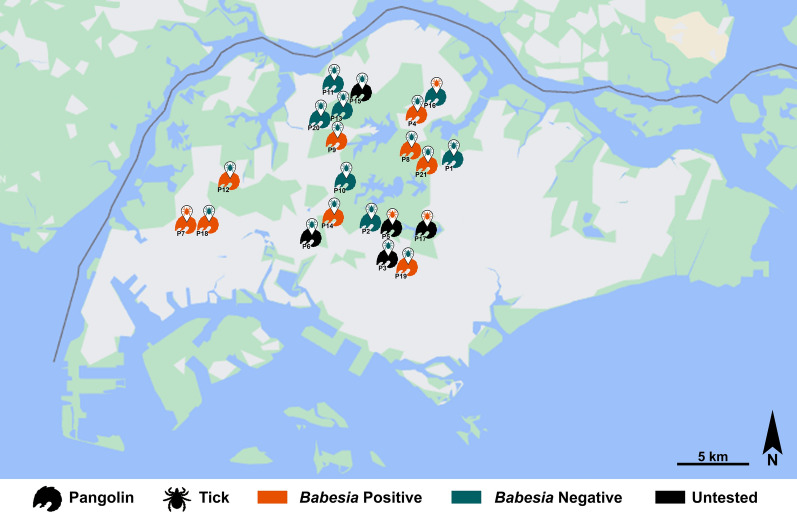
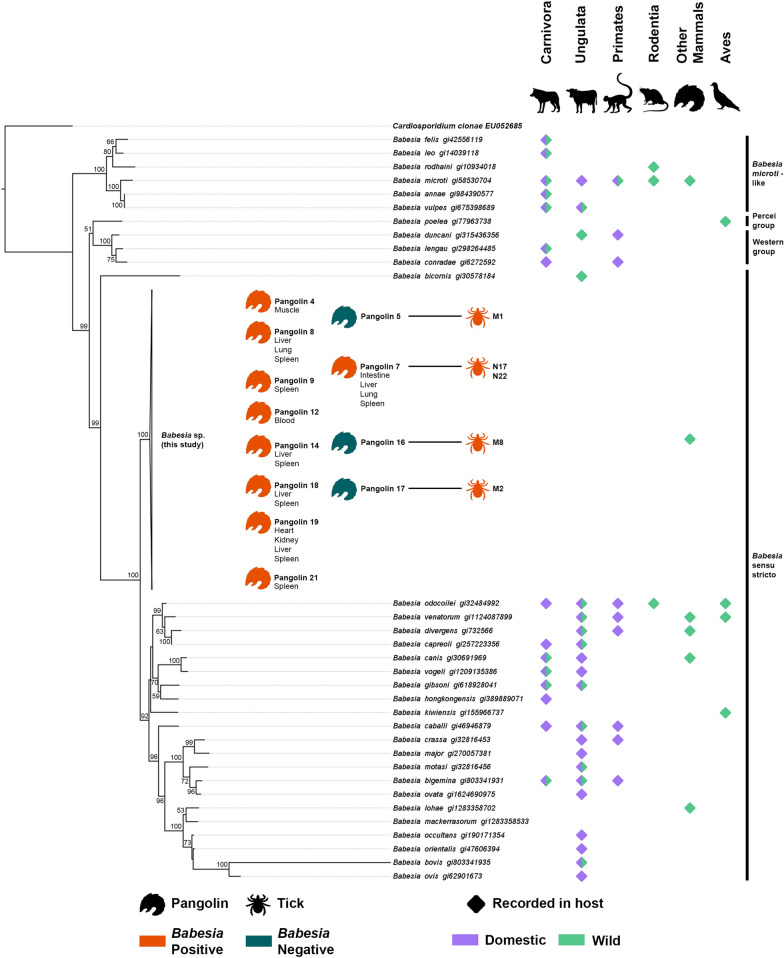
A total of 296 ticks and 40 tissue samples were obtained from 21 Sunda pangolins throughout the 1-year study period. Babesia DNA was detected in five A. javanense ticks (minimum infection rate = 1.7%) and in nine different pangolins (52.9%) located across the country. Phylogenetic analysis revealed that the Babesia 18S sequences obtained from these samples grouped into a single monophyletic clade together with those derived from Sunda pangolins in Thailand and that this evolutionarily distinct species is basal to the Babesia sensu stricto clade, which encompasses a range of Babesia species that infect both domestic and wildlife vertebrate hosts.
This is the first report documenting the detection of a Babesia species in A. javanense ticks, the main ectoparasite of Sunda pangolins. While our results showed that A. javanense can carry this novel Babesia sp., additional confirmatory studies are required to demonstrate vector competency. Further studies are also necessary to investigate the role of other transmission pathways given the low infection rate of ticks in relation to the high infection rate of Sunda pangolins. Although it appears that this novel Babesia sp. is of little to no pathogenicity to Sunda pangolins, its potential to cause disease in other animals or humans cannot be ruled out.
巴贝虫是一种原生动物,蜱传寄生虫,可在全球范围内导致人类、野生动物和家畜的致命疾病。然而,在东南亚,人们对野生动物中存在的巴贝虫物种的流行情况和多样性以及传播其的蜱类媒介知之甚少。最近,在泰国没收的巽他穿山甲(Manis javanica)中报告了一种新型巴贝虫。为了调查这种寄生虫在新加坡的存在情况,我们对自由放养的巽他穿山甲及其主要外寄生虫——红缘革蜱(Amblyomma javanense)中的巴贝虫 spp. 进行了分子调查。
从活体和死体的巽他穿山甲以及红缘革蜱中机会性采集蜱和组织样本,并使用针对巴贝虫 spp.18S rRNA 基因的 PCR 检测进行筛查。使用细胞色素氧化酶亚单位 I(COI)线粒体基因的 DNA 条码来确认巴贝虫阳性的蜱的种类。
在为期 1 年的研究期间,从 21 只巽他穿山甲中总共获得了 296 只蜱和 40 个组织样本。在 5 只红缘革蜱(最低感染率为 1.7%)和 9 只不同的穿山甲(52.9%)中检测到巴贝虫 DNA,这些穿山甲分布在全国各地。系统发育分析显示,从这些样本中获得的巴贝虫 18S 序列与来自泰国的巽他穿山甲的序列一起聚集在一个单系分支中,该进化独特的物种是巴贝虫严格意义上的进化枝的基础,该进化枝包含一系列感染家畜和野生动物脊椎动物宿主的巴贝虫物种。
这是首次报道在巽他穿山甲的主要外寄生虫红缘革蜱中检测到巴贝虫物种。虽然我们的结果表明红缘革蜱可以携带这种新型巴贝虫,但需要进一步的确认性研究来证明其传播媒介的能力。鉴于蜱的感染率与巽他穿山甲的高感染率相比相对较低,还需要进一步研究其他传播途径的作用。虽然这种新型巴贝虫 sp. 似乎对巽他穿山甲的致病性很小,但不能排除其对其他动物或人类造成疾病的可能性。