Programa de Pós-Gradução em Genética e Biologia Molecular, Universidade Estadual de Campinas, R. Monteiro Lobato, 255-Barão Geraldo, Campinas, São Paulo, CEP 13083-862, Brazil.
Department of Botany and Biodiversity Research, University of Vienna, Rennweg 14, 1030, Wien, Austria.
Sci Rep. 2023 Nov 23;13(1):20635. doi: 10.1038/s41598-023-44631-4.
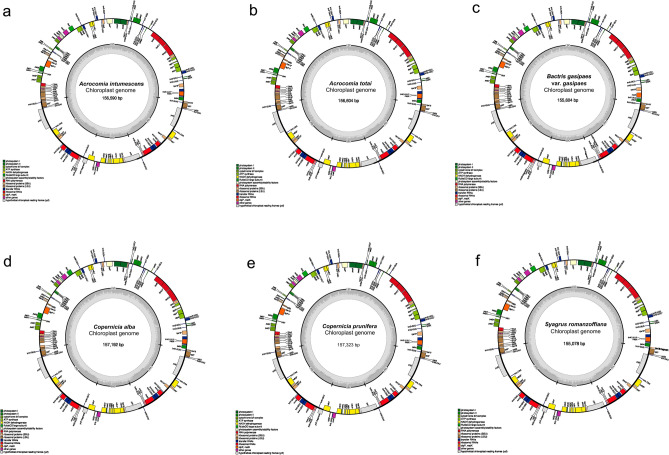
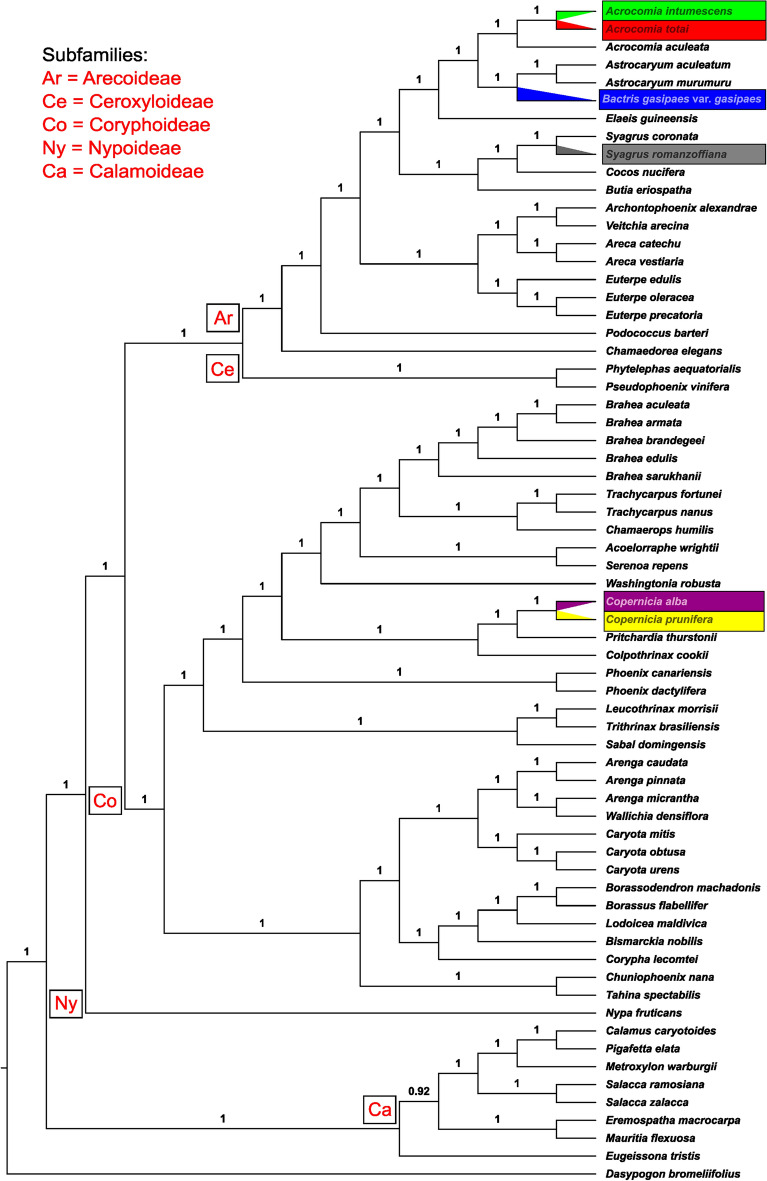
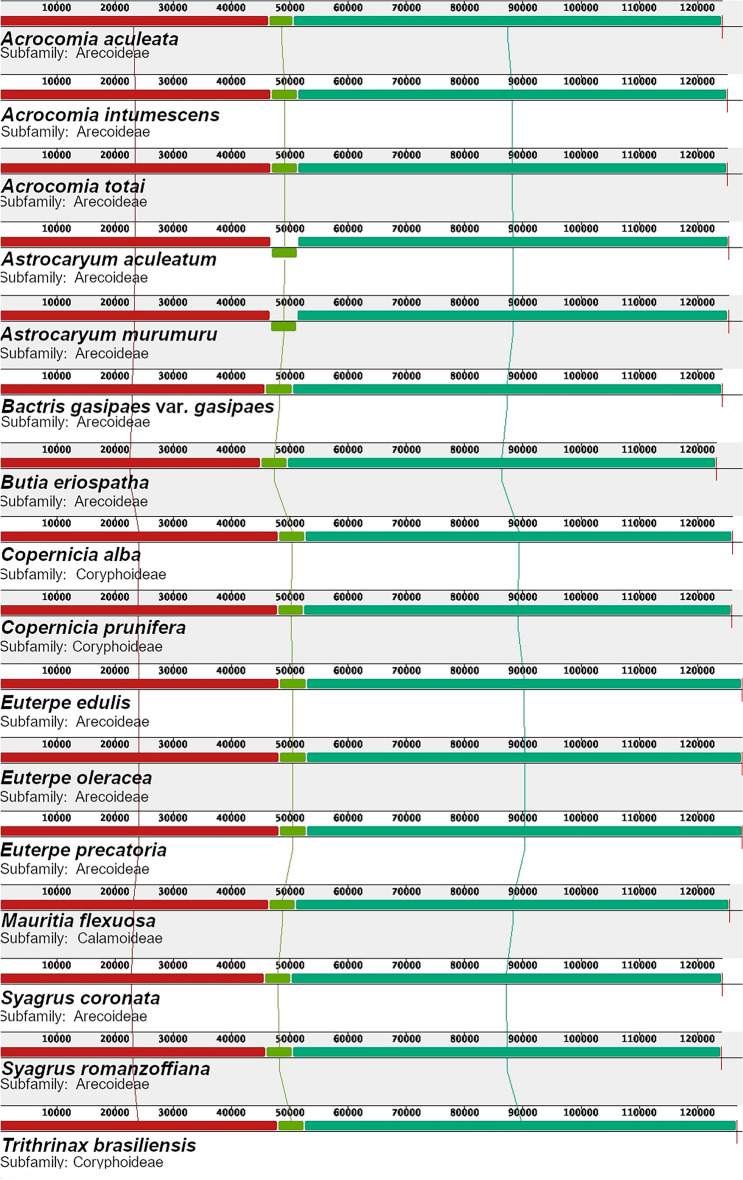
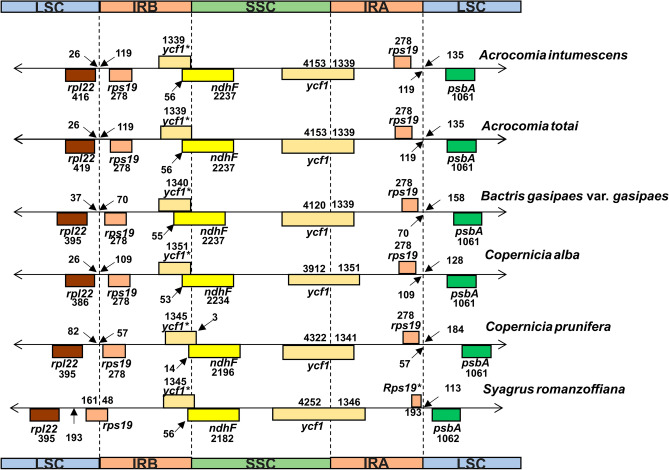
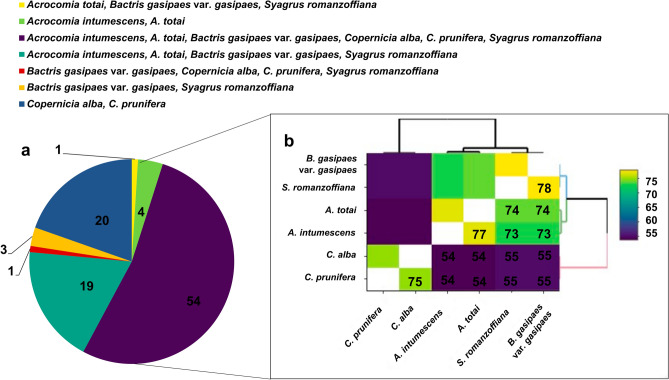
The Arecaceae family has a worldwide distribution, especially in tropical and subtropical regions. We sequenced the chloroplast genomes of Acrocomia intumescens and A. totai, widely used in the food and energy industries; Bactris gasipaes, important for palm heart; Copernicia alba and C. prunifera, worldwide known for wax utilization; and Syagrus romanzoffiana, of great ornamental potential. Copernicia spp. showed the largest chloroplast genomes (C. prunifera: 157,323 bp and C. alba: 157,192 bp), while S. romanzoffiana and B. gasipaes var. gasipaes presented the smallest (155,078 bp and 155,604 bp). Structurally, great synteny was detected among palms. Conservation was also observed in the distribution of single sequence repeats (SSR). Copernicia spp. presented less dispersed repeats, without occurrence in the small single copy (SSC). All RNA editing sites were C (cytidine) to U (uridine) conversions. Overall, closely phylogenetically related species shared more sites. Almost all nodes of the phylogenetic analysis showed a posterior probability (PP) of 1.0, reaffirming the close relationship between Acrocomia species. These results elucidate the conservation among palm chloroplast genomes, but point to subtle structural changes, providing support for the evolutionary dynamics of the Arecaceae family.
棕榈科植物在全球范围内分布广泛,尤其在热带和亚热带地区。我们对广泛应用于食品和能源工业的 Acrocomia intumescens 和 A. totai、重要的食用棕榈心作物 Bactris gasipaes、以利用其蜡质而闻名的 Copernicia alba 和 C. prunifera ,以及具有巨大观赏潜力的 Syagrus romanzoffiana 进行了叶绿体基因组测序。Copernicia spp. 的叶绿体基因组最大(C. prunifera:157,323 bp,C. alba:157,192 bp),而 S. romanzoffiana 和 B. gasipaes var. gasipaes 的叶绿体基因组最小(155,078 bp 和 155,604 bp)。结构上,棕榈科植物之间具有高度的同线性。单核苷酸重复(SSR)的分布也具有保守性。Copernicia spp. 呈现出较少分散的重复序列,而在小单拷贝(SSC)中则没有出现。所有 RNA 编辑位点均为 C(胞嘧啶)到 U(尿嘧啶)的转换。总体而言,亲缘关系较近的物种共享更多的位点。系统发育分析的几乎所有节点的后验概率(PP)均为 1.0,再次证实了 Acrocomia 物种之间的密切关系。这些结果阐明了棕榈科叶绿体基因组之间的保守性,但也指出了微妙的结构变化,为棕榈科的进化动态提供了支持。