Affiliated Hospital of Jining Medical University, Jining Medical University, Jining, Shandong, 272000, China.
Postdoctoral Mobile Station of Shandong University of Traditional Chinese Medicine, Jinan, Shandong, 250399, China.
BMC Pulm Med. 2023 Nov 23;23(1):468. doi: 10.1186/s12890-023-02766-0.
We analyzed the clinical characteristics of children with plastic bronchitis (PB) caused by Mycoplasma pneumoniae (MP) and explored its risk factors.
We prospectively analyzed clinical data of children with MP pneumonia (MPP) treated with fiberoptic bronchoscopy (FB). Patients were classified into a PB and non-PB group. General information, clinical manifestations, laboratory tests, results of computed tomography scan, and FB findings were compared between groups. We conducted statistical analysis of risk factors for developing PB.
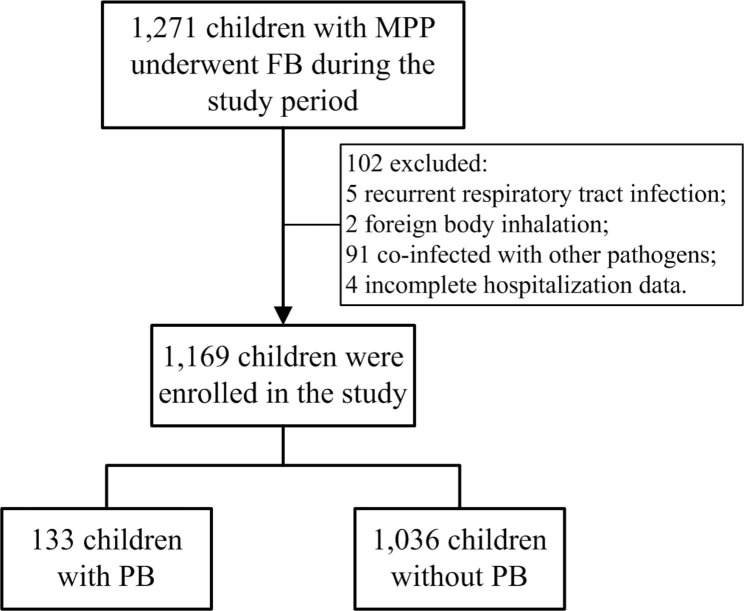
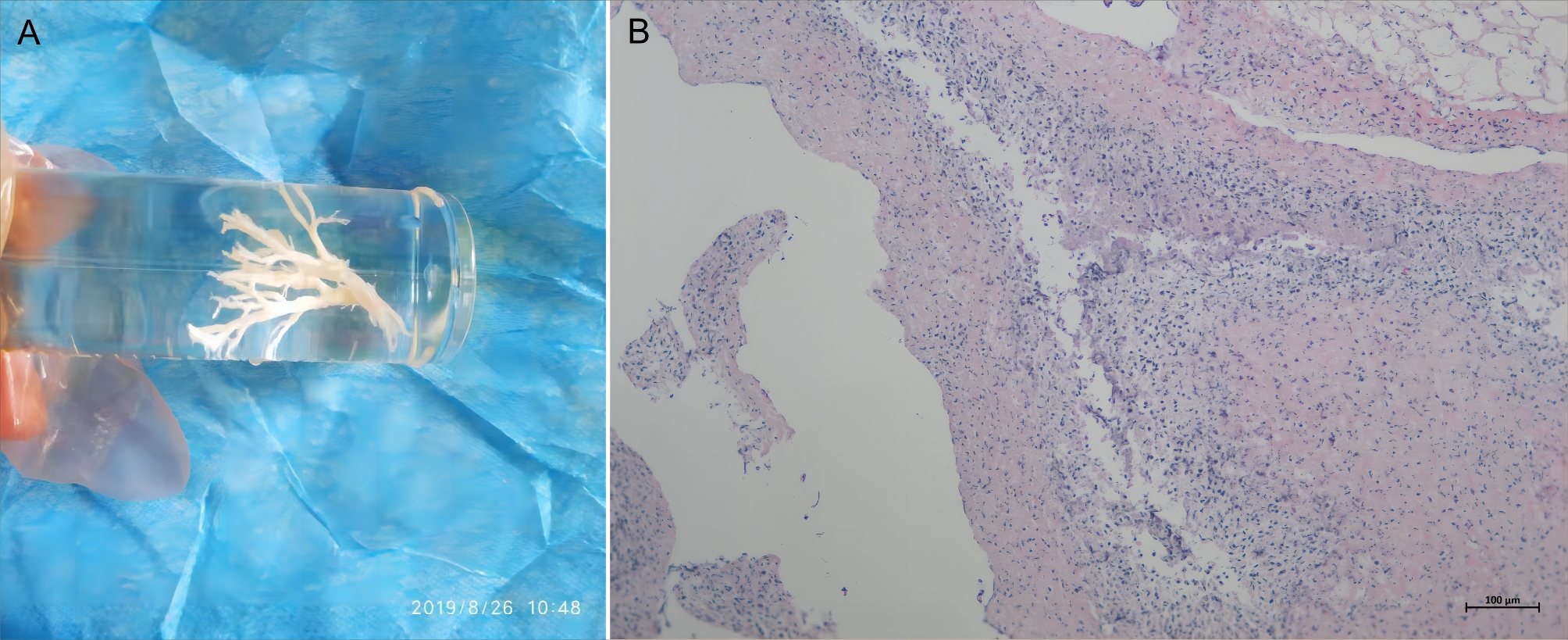
Of 1169 children who had MPP and were treated with FB, 133 and 1036 were in the PB and non-PB groups, respectively. There were no significant differences in sex, age, and incident season between groups (P > 0.05). The number of children in the PB group decreased during the COVID-19 pandemic. Compared with children in the non-PB group, those in the PB group had longer duration of hospitalization, increased levels of neutrophil (N), C-reactive protein (CRP), procalcitonin (PCT), D-dimer, lactate dehydrogenase (LDH), alanine transaminase (ALT) and aspartate transaminase (AST); lower levels of lymphocyte (L) and platelet (PLT); and higher incidence of lack of appetite, decreased breath sounds, single lobar infiltrate, pleural effusion, pericardial effusion, mucosal erosion and/or necrosis, and bronchial embolization. L levels and pleural effusion were identified as risk factors in multivariate logistic regression.
Children with PB caused by MPP had a strong and local inflammatory response. L levels and pleural effusion were independent risk factors of PB with MPP in children. Our findings will help clinicians identify potential PB in pediatric patients for early and effective intervention.
我们分析了肺炎支原体(MP)引起的小儿塑性支气管炎(PB)的临床特征,并探讨了其危险因素。
我们前瞻性分析了纤维支气管镜(FB)治疗的 MP 肺炎(MPP)患儿的临床资料。将患者分为 PB 组和非 PB 组。比较两组的一般资料、临床表现、实验室检查、CT 扫描结果和 FB 发现。对发生 PB 的危险因素进行统计学分析。
在 1169 例接受 FB 治疗的 MPP 患儿中,PB 组和非 PB 组分别为 133 例和 1036 例。两组间性别、年龄和发病季节差异无统计学意义(P>0.05)。PB 组患儿在 COVID-19 大流行期间数量减少。与非 PB 组患儿相比,PB 组患儿住院时间延长,中性粒细胞(N)、C 反应蛋白(CRP)、降钙素原(PCT)、D-二聚体、乳酸脱氢酶(LDH)、丙氨酸氨基转移酶(ALT)和天冬氨酸氨基转移酶(AST)水平升高,淋巴细胞(L)和血小板(PLT)水平降低,食欲不振、呼吸音减弱、单叶浸润、胸腔积液、心包积液、黏膜糜烂和/或坏死、支气管栓塞发生率升高。多变量逻辑回归显示 L 水平和胸腔积液是 PB 的独立危险因素。
MP 引起的小儿 PB 具有强烈的局部炎症反应。L 水平和胸腔积液是小儿 MP 相关 PB 的独立危险因素。我们的研究结果将有助于临床医生识别小儿潜在的 PB,以便早期有效干预。