Department of Clinical Laboratory, Children's Hospital Affiliated to Capital Institute of Pediatrics, Beijing, China.
Child Health Big Data Research Center, Capital Institute of Pediatrics, Beijing, China.
Front Cell Infect Microbiol. 2022 Apr 29;12:854505. doi: 10.3389/fcimb.2022.854505. eCollection 2022.
() is an important pathogen of community acquired pneumonia. With the outbreak of coronavirus disease 2019 (COVID-19), the prevalence of some infectious respiratory diseases has varied. Epidemiological features of in children from Beijing (China) before and during the COVID-19 pandemic were investigated.
Between June 2016 and May 2021, a total of 569,887 children with respiratory infections from Children's Hospital Affiliated to Capital Institute of Pediatrics (Beijing, China) were included in this study. specific-IgM antibody in serum specimens of these patients was tested by a rapid immunochromatographic assay kit. The relevant clinical data of -positive cases were also collected, and analyzed by RStudio software.
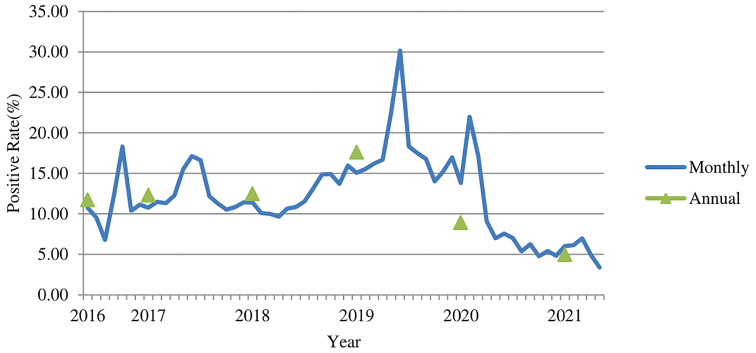
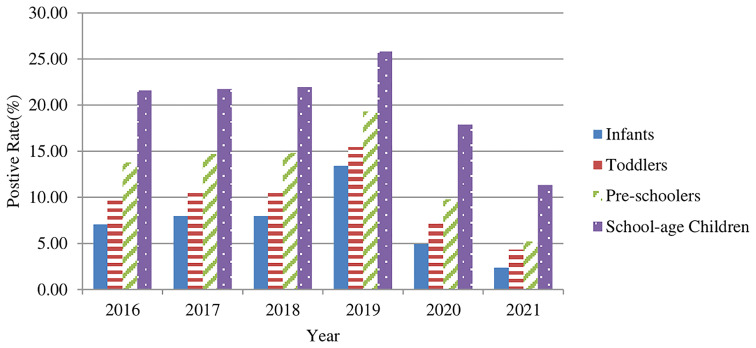
The results showed that 13.08% of collected samples were positive for specific-IgM antibody. The highest annual positive rate was 17.59% in 2019, followed by 12.48% in 2018, 12.31% in 2017, and 11.73% in 2016, while the rate dropped to 8.9% in 2020 and 4.95% in 2021, with significant difference. Among the six years, the positive rates in summer and winter seasons were significantly higher than those in spring and autumn seasons ( < 0.001). The positive rate was the highest in school-age children (22.20%), and lowest in the infant group (8.76%, < 0.001). The positive rate in boys (11.69%) was lower than that in girls (14.80%, < 0.001). There were no significant differences in different seasons, age groups, or genders before and during the COVID-19 pandemic ( > 0.05).
Our study demonstrated that an outbreak started from the summer of 2019 in Beijing. After the COVID-19 pandemic outbreak in the end of 2019, the positive rates dropped dramatically. This may be due to the restrictive measures of the COVID-19 pandemic, which effectively controlled the transmission of . The relationships between positive rates and season, age, and gender were not statistically significant before and during the COVID-19 pandemic.
肺炎支原体()是社区获得性肺炎的重要病原体。随着 2019 年冠状病毒病(COVID-19)的爆发,一些传染性呼吸道疾病的流行情况有所不同。本研究旨在调查 COVID-19 大流行前后北京儿童中肺炎支原体的流行病学特征。
本研究共纳入 2016 年 6 月至 2021 年 5 月首都儿科研究所附属儿童医院收治的 569887 例呼吸道感染患儿。采用快速免疫层析法检测血清标本中肺炎支原体特异性 IgM 抗体。收集肺炎支原体阳性病例的相关临床资料,并使用 RStudio 软件进行分析。
结果显示,采集的样本中肺炎支原体特异性 IgM 抗体阳性率为 13.08%。其中,2019 年的年阳性率最高,为 17.59%,其次为 2018 年的 12.48%、2017 年的 12.31%、2016 年的 11.73%,而 2020 年和 2021 年的阳性率分别降至 8.9%和 4.95%,差异有统计学意义。在六年中,夏季和冬季的阳性率明显高于春季和秋季(<0.001)。各年龄段中,学龄期儿童的阳性率最高(22.20%),婴儿组最低(8.76%,<0.001)。男孩(11.69%)的阳性率低于女孩(14.80%,<0.001)。但 COVID-19 大流行前后,不同季节、年龄组和性别之间的阳性率差异无统计学意义(>0.05)。
本研究表明,北京的肺炎支原体疫情始于 2019 年夏季。2019 年底 COVID-19 大流行爆发后,肺炎支原体的阳性率显著下降。这可能是由于 COVID-19 大流行的限制性措施有效控制了的传播。COVID-19 大流行前后,肺炎支原体阳性率与季节、年龄和性别之间无统计学关联。