Department of Respiratory Medicine, Children's Hospital of Nanjing Medical University, Nanjing, China.
BMC Infect Dis. 2021 Jan 6;21(1):14. doi: 10.1186/s12879-020-05700-5.
The levels of serum D-dimer (D-D) in children with Mycoplasma pneumoniae pneumonia (MPP) were assessed to explore the clinical significance of D-D levels in refractory MPP (RMPP).
A total of 430 patients with MPP were enrolled between January 2015 and December 2015 and divided into a general MPP (GMPP) group (n = 306) and a RMPP group (n = 124). Clinical data, D-D level, white blood cell (WBC) count, proportion of neutrophils (N%), C-reactive protein (CRP), erythrocyte sedimentation rate (ESR), alanine transaminase (ALT), aspartate aminotransferase (AST), and lactate dehydrogenase (LDH) were compared between the two groups. Multivariate logistic regression was performed to identify independent predictors of RMPP.
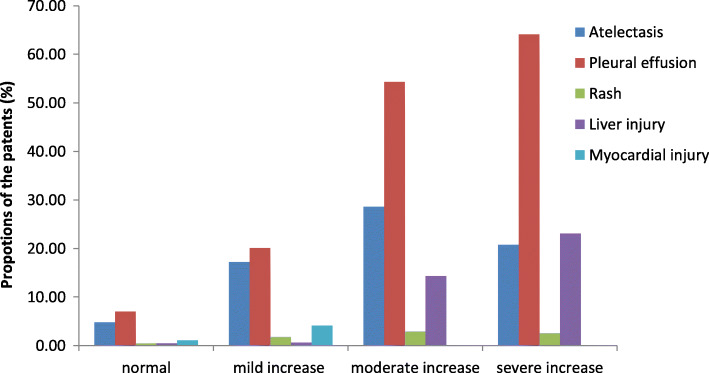
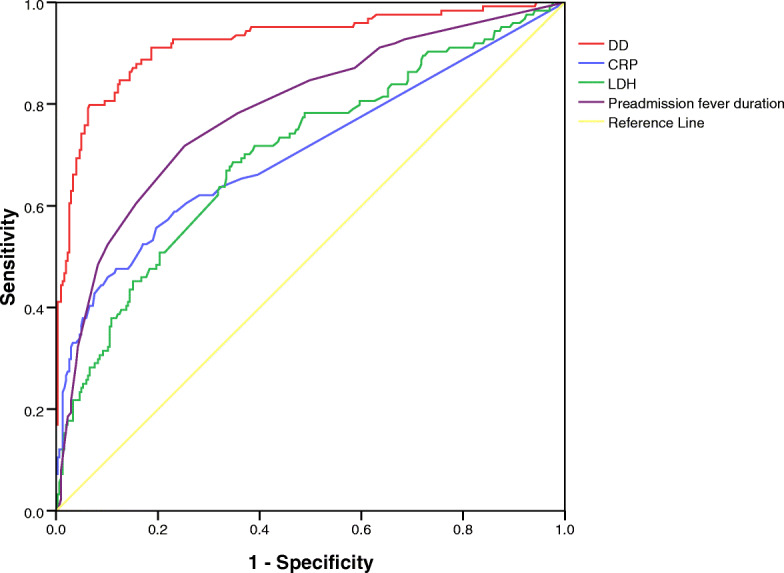
(1) Hospitalization time, preadmission fever duration, total fever duration, WBC, N %, CRP, LDH, ESR, ALT, AST, and D-D were significantly higher in the RMPP group than those in the GMPP group (all P < 0.05). (2) Correlation analysis showed that D-D was positively correlated with WBC, CRP, ESR, and LDH, and could be used to jointly evaluate the severity of the disease. (3) Multivariate logistic regression analysis identified preadmission fever duration, CRP, LDH and DD as independent risk factors for RMPP (all P < 0. 05). D-D had the highest predictive power for RMPP (P < 0.01). The D-D level also had a good ability to predict pleural effusion and liver injury (all P < 0.01).
Serum D-D levels were significantly increased in patients with RMPP, indicating that excessive inflammatory response and vascular endothelial injury with prolonged duration existed in this patient population. Increased levels of serum D-D may be used as an early predictor of RMPP and the occurrence of complications. Our findings provide a theoretical basis for the early diagnosis of RMPP, early intervention and excessive inflammatory response in the pathogenesis of mycoplasma.
评估儿童肺炎支原体肺炎(MPP)患者血清 D-二聚体(D-D)水平,以探讨 D-D 水平在难治性 MPP(RMPP)中的临床意义。
选取 2015 年 1 月至 2015 年 12 月收治的 430 例 MPP 患儿,分为普通 MPP(GMPP)组(n=306)和 RMPP 组(n=124)。比较两组患儿的临床资料、D-D 水平、白细胞(WBC)计数、中性粒细胞(N%)比例、C 反应蛋白(CRP)、红细胞沉降率(ESR)、丙氨酸转氨酶(ALT)、天门冬氨酸转氨酶(AST)、乳酸脱氢酶(LDH),采用多因素 logistic 回归分析 RMPP 的独立预测因素。
(1)RMPP 组患儿的住院时间、入院前发热时间、总发热时间、WBC、N%、CRP、LDH、ESR、ALT、AST、D-D 均显著高于 GMPP 组(均 P<0.05)。(2)相关性分析显示,D-D 与 WBC、CRP、ESR、LDH 呈正相关,可联合用于评估病情严重程度。(3)多因素 logistic 回归分析显示,入院前发热时间、CRP、LDH、D-D 是 RMPP 的独立危险因素(均 P<0.05)。D-D 对 RMPP 预测价值最高(P<0.01)。D-D 水平对胸腔积液、肝损伤的预测能力亦较好(均 P<0.01)。
RMPP 患儿血清 D-D 水平显著升高,提示此类患者体内存在过度炎症反应和血管内皮损伤,且持续时间较长。血清 D-D 水平升高可能作为 RMPP 及并发症发生的早期预测指标。本研究结果为 RMPP 早期诊断、发病机制中支原体早期干预和过度炎症反应提供了理论依据。