Co-Innovation Center for Sustainable Forestry in Southern China, College of Life Science, Nanjing Forestry University, Nanjing 210037, China.
Int J Mol Sci. 2023 Nov 9;24(22):16118. doi: 10.3390/ijms242216118.
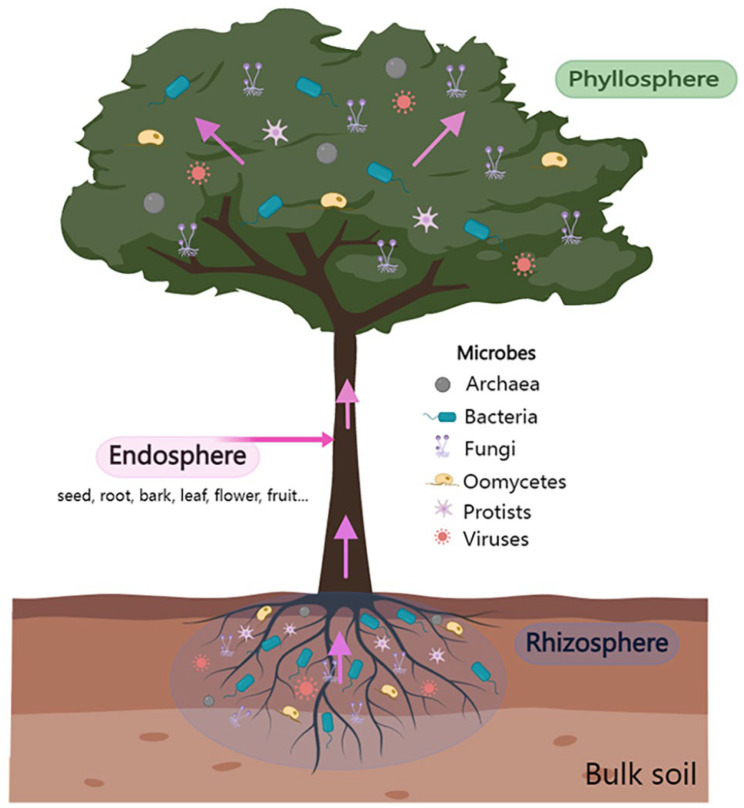
Pathogens, especially invasive species, have caused significant global ecological, economic, and social losses in forests. Plant disease research has traditionally focused on direct interactions between plants and pathogens in an appropriate environment. However, recent research indicates that the microbiome can interact with the plant host and pathogens to modulate plant resistance or pathogen pathogenicity, thereby altering the outcome of plant-pathogen interactions. Thus, this presents new opportunities for studying the microbial management of forest diseases. Compared to parallel studies on human and crop microbiomes, research into the forest tree microbiome and its critical role in forest disease progression has lagged. The rapid development of microbiome sequencing and analysis technologies has resulted in the rapid accumulation of a large body of evidence regarding the association between forest microbiomes and diseases. These data will aid the development of innovative, effective, and environmentally sustainable methods for the microbial management of forest diseases. Herein, we summarize the most recent findings on the dynamic structure and composition of forest tree microbiomes in belowground and aboveground plant tissues (i.e., rhizosphere, endosphere, and phyllosphere), as well as their pleiotropic impact on plant immunity and pathogen pathogenicity, highlighting representative examples of biological control agents used to modulate relevant tree microbiomes. Lastly, we discuss the potential application of forest tree microbiomes in disease control as well as their future prospects and challenges.
病原体,特别是入侵物种,在森林中造成了重大的全球生态、经济和社会损失。植物病害研究传统上侧重于在适当环境中植物与病原体之间的直接相互作用。然而,最近的研究表明,微生物组可以与植物宿主和病原体相互作用,调节植物抗性或病原体致病性,从而改变植物-病原体相互作用的结果。因此,这为研究森林病害的微生物管理提供了新的机会。与人类和作物微生物组的平行研究相比,对森林树木微生物组及其在森林病害进展中的关键作用的研究滞后。微生物组测序和分析技术的快速发展导致大量证据迅速积累,这些证据表明森林微生物组与疾病之间存在关联。这些数据将有助于开发创新、有效和环境可持续的森林病害微生物管理方法。在此,我们总结了最近关于地下和地上植物组织(即根际、内共生和叶际)中森林树木微生物组的动态结构和组成的发现,以及它们对植物免疫和病原体致病性的多效性影响,突出了用于调节相关树木微生物组的生物防治剂的代表性例子。最后,我们讨论了森林树木微生物组在疾病控制中的潜在应用及其未来的前景和挑战。