Department of Community Pharmacy, Faculty of Pharmaceutical Sciences in Sosnowiec, Medical University of Silesia in Katowice, Kasztanowa 3, 41-200 Sosnowiec, Poland.
Department of Microbiology and Immunology, Faculty of Medical Sciences in Zabrze, Medical University of Silesia in Katowice, Jordana 19, 41-808 Zabrze, Poland.
Molecules. 2023 Nov 8;28(22):7477. doi: 10.3390/molecules28227477.
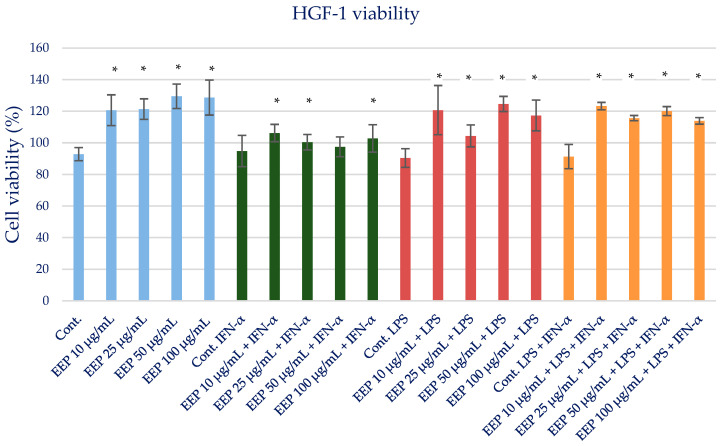
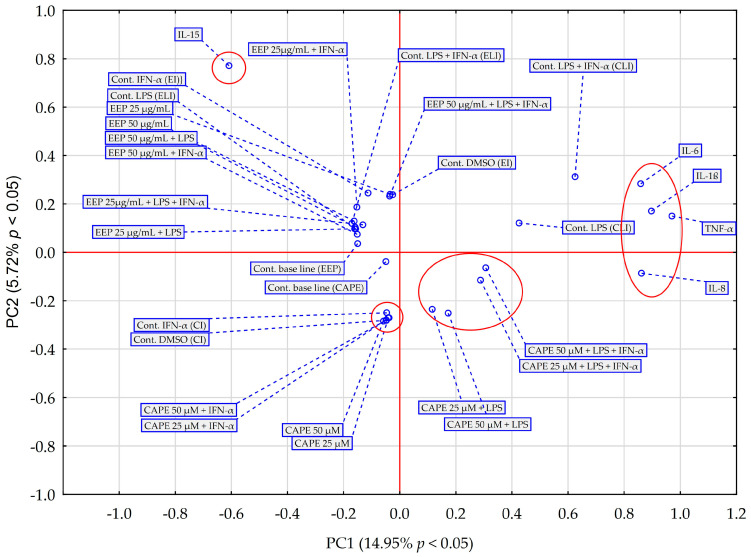
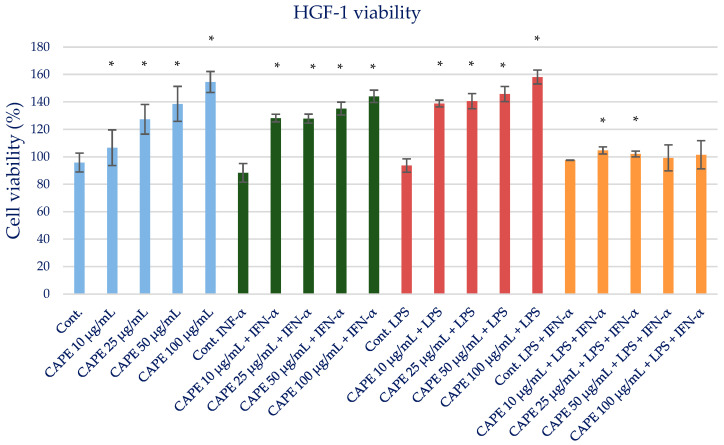
Propolis, owing to its antibacterial and anti-inflammatory properties, acts as a cariostatic agent, capable of preventing the accumulation of dental plaque and inhibiting inflammation. The anti-inflammatory properties of propolis are attributed to caffeic acid phenethyl ester (CAPE), which is present in European propolis. The objective of the conducted study was to assess the anti-inflammatory effects of the Polish ethanolic extract of propolis (EEP) and isolated CAPE on stimulated with LPS and IFN-α, as well as the combination of LPS and IFN-α. The cytotoxicity of the tested compounds was determined using the MTT assay. The concentrations of specific cytokines released by the HGF-1 cell line following treatment with EEP (25-50 µg/mL) or CAPE (25-50 µg/mL) were assessed in the culture supernatant. In the tested concentrations, both CAPE and EEP did not exert cytotoxic effects. Our results demonstrate that CAPE reduces TNF-α and IL-6 in contrast to EEP. Propolis seems effective in stimulating HGF-1 to release IL-6 and IL-8. A statistically significant difference was observed for IL-8 in HGF-1 stimulated by LPS+IFN-α and treated EEP at a concentration of 50 µg/mL ( = 0.021201). Moreover, we observed that CAPE demonstrates a stronger interaction with IL-8 compared to EEP, especially when CAPE was administered at a concentration of 50 µg/mL after LPS + IFN-α stimulation ( = 0.0005). Analysis of the phenolic profile performed by high-performance liquid chromatography allowed identification and quantification in the EEP sample of six phenolic acids, five flavonoids, and one aromatic ester-CAPE. Propolis and its compound-CAPE-exhibit immunomodulatory properties that influence the inflammatory process. Further studies may contribute to explaining the immunomodulatory action of EEP and CAPE and bring comprehensive conclusions.
蜂胶因其抗菌和抗炎特性,可作为一种防龋剂,能够防止牙菌斑的积累并抑制炎症。蜂胶的抗炎特性归因于咖啡酸苯乙酯 (CAPE),它存在于欧洲蜂胶中。进行这项研究的目的是评估波兰蜂胶乙醇提取物 (EEP) 和分离的 CAPE 对 LPS 和 IFN-α刺激的抗炎作用,以及 LPS 和 IFN-α联合刺激的抗炎作用。使用 MTT 测定法测定测试化合物的细胞毒性。通过 EEP(25-50μg/mL)或 CAPE(25-50μg/mL)处理后,在培养上清液中评估 HGF-1 细胞系释放的特定细胞因子的浓度。在测试浓度下,CAPE 和 EEP 均未表现出细胞毒性作用。我们的结果表明,CAPE 可降低 TNF-α和 IL-6,而 EEP 则不然。蜂胶似乎可有效刺激 HGF-1 释放 IL-6 和 IL-8。在 LPS+IFN-α刺激的 HGF-1 中,用 50μg/mL 的 EEP 处理时,观察到 IL-8 有统计学意义的差异(=0.021201)。此外,我们观察到 CAPE 与 IL-8 的相互作用比 EEP 更强,尤其是在 LPS+IFN-α 刺激后给予 50μg/mL 的 CAPE 时(=0.0005)。通过高效液相色谱法进行的酚类分析允许在 EEP 样品中鉴定和定量六种酚酸、五种类黄酮和一种芳香酯-CAPE。蜂胶及其化合物 CAPE 具有影响炎症过程的免疫调节特性。进一步的研究可能有助于解释 EEP 和 CAPE 的免疫调节作用,并得出全面的结论。