Department of Biochemistry and Molecular Biology, University of Nebraska Medical Center, Omaha, NE, USA.
School of Interdisciplinary Informatics, College of Information Science & Technology, University of Nebraska at Omaha, Omaha, NE, USA.
Gut Microbes. 2023 Dec;15(2):2282789. doi: 10.1080/19490976.2023.2282789. Epub 2023 Nov 27.
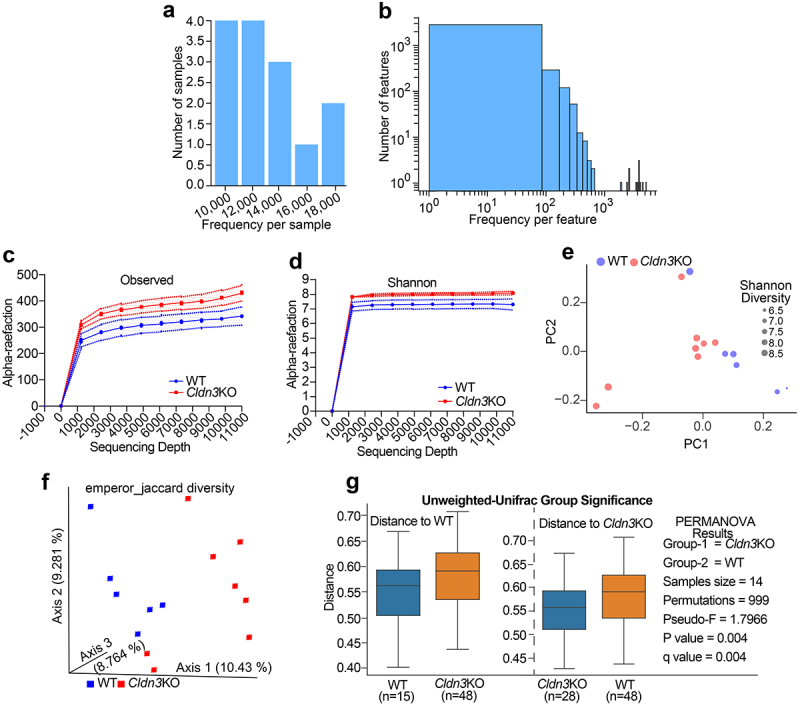
Dysregulation of both the gut barrier and microbiota (dysbiosis) promotes susceptibility to and severity of Inflammatory Bowel Diseases (IBD). Leaky gut and dysbiosis often coexist; however, potential interdependence and molecular regulation are not well understood. Robust expression of claudin-3 (CLDN3) characterizes the gut epithelium, and studies have demonstrated a positive association between CLDN3 expression and gut barrier maturity and integrity, including in response to probiotics. However, the exact status and causal role of CLDN3 in IBD and regulation of gut dysbiosis remain unknown. Analysis of mouse and human IBD cohorts helped examine expression in IBD. The causal role was determined by modeling CLDN3 loss of expression during experimental colitis. 16S sequencing and analysis helped examine gut microbiota diversity between KO and WT mice and potential host metabolic responses. Fecal microbiota transplant (FMT) studies were performed to assess the role of gut dysbiosis in the increased susceptibility of KO mice to colitis. A significant decrease in CLDN3 expression characterized IBD and CLDN3 loss of expression promoted colitis. 16S sequencing analysis suggested gut microbiota changes in KO mice that were capable of modulating fatty acid metabolism and oxidative stress response. FMT from naïve KO mice promoted colitis susceptibility in recipient germ-free mice (GFM) compared with GFM-receiving microbiota from WT mice. Our data demonstrate a critical role of CLDN3 in maintaining normal gut microbiota and inflammatory responses, which can be harnessed to develop novel therapeutic opportunities for patients with IBD.
肠道屏障和微生物群落(失调)的失调会增加炎症性肠病(IBD)的易感性和严重程度。肠漏和失调通常并存;然而,它们之间的潜在相互依存关系和分子调节机制尚不清楚。紧密连接蛋白 3(CLDN3)的强表达特征化了肠道上皮细胞,研究表明 CLDN3 的表达与肠道屏障的成熟和完整性呈正相关,包括对益生菌的反应。然而,CLDN3 在 IBD 中的确切状态和因果作用以及对肠道失调的调节仍然未知。对患有 IBD 的小鼠和人类队列的分析有助于研究 CLDN3 在 IBD 中的表达情况。通过在实验性结肠炎期间模拟 CLDN3 表达缺失来确定其因果作用。16S 测序和代谢组学分析有助于研究 KO 和 WT 小鼠之间的肠道微生物多样性以及潜在的宿主代谢反应。进行粪便微生物移植(FMT)研究以评估肠道失调在 KO 小鼠对结肠炎易感性增加中的作用。CLDN3 表达的显著下降是 IBD 的特征,CLDN3 缺失表达促进了结肠炎。16S 测序分析表明,KO 小鼠的肠道微生物群发生了变化,这些变化能够调节脂肪酸代谢和氧化应激反应。与从 WT 小鼠接收的微生物群相比,来自 naive KO 小鼠的 FMT 促进了受体无特定病原体(GFM)小鼠的结肠炎易感性。我们的数据表明 CLDN3 在维持正常肠道微生物群和炎症反应方面起着关键作用,这可以被利用来为 IBD 患者开发新的治疗机会。