Genequest Inc., Siba 5-29-11, Minato-ku, Tokyo, 108-0014, Japan.
Department of Infectious Diseases, Internal Medicine, Tohoku University Graduate School of Medicine, 2-1 Seiryo-machi, Aoba-ku, Sendai, 980-8574, Japan.
Sci Rep. 2023 Nov 27;13(1):20820. doi: 10.1038/s41598-023-47632-5.
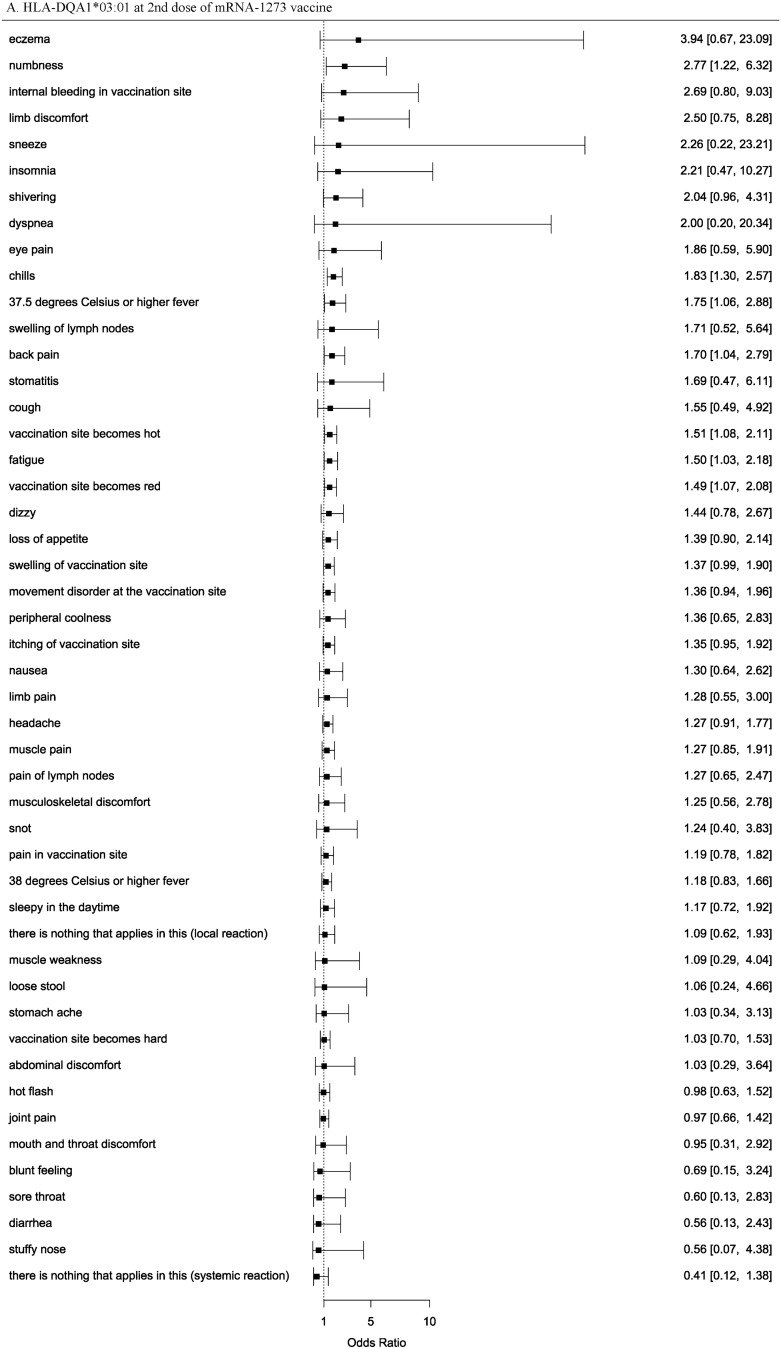
The coronavirus disease 2019 (COVID-19) pandemic has spread rapidly worldwide. To prevent its spread, mRNA-based vaccines made by Pfizer/BioNTech (BNT162b1) and Moderna (mRNA-1273) have been widely used, including in Japan. Various adverse events have been reported following the COVID-19 mRNA vaccination, with differences observed among individuals. However, analyses of the genetic background associated with the susceptibility to side effects have been limited. In the present study, we performed genome-wide association studies (GWAS) for self-reported adverse events of the COVID-19 mRNA vaccination in 4545 Japanese individuals and identified 14 associated loci. Among these, 6p21 was associated with 37.5 °C or higher fever, 38 °C or higher fever, and muscle pain. HLA allele association analysis revealed that various HLA alleles were associated with the adverse effects; HLA-DQA103:01 and HLA-A11:01 were more reliably associated with the adverse effects. Our results may enable the preparation and management of adverse effects by identifying the susceptibility to these adverse events. Furthermore, we obtained valuable data that may lead to a better understanding of the mechanisms of action of the COVID-19 mRNA vaccines.
新型冠状病毒病(COVID-19)大流行在全球迅速蔓延。为了防止其传播,辉瑞/生物科技(BNT162b1)和 Moderna(mRNA-1273)生产的基于 mRNA 的疫苗已被广泛使用,包括在日本。COVID-19 mRNA 疫苗接种后报告了各种不良反应事件,个体之间存在差异。然而,与副作用易感性相关的遗传背景分析有限。在本研究中,我们对 4545 名日本个体中 COVID-19 mRNA 疫苗接种的自我报告不良反应进行了全基因组关联研究(GWAS),并确定了 14 个相关位点。其中,6p21 与 37.5°C 或更高的发热、38°C 或更高的发热和肌肉疼痛有关。HLA 等位基因关联分析显示,各种 HLA 等位基因与不良反应有关;HLA-DQA103:01 和 HLA-A11:01 与不良反应更可靠地相关。我们的结果可以通过识别对这些不良反应的易感性,从而为不良反应的准备和管理提供依据。此外,我们获得了有价值的数据,可能有助于更好地了解 COVID-19 mRNA 疫苗的作用机制。