Biogen, Cambridge, MA, USA.
Takeda Pharmaceuticals, Cambridge, MA, USA.
Nat Aging. 2023 Dec;3(12):1591-1601. doi: 10.1038/s43587-023-00523-w. Epub 2023 Nov 27.
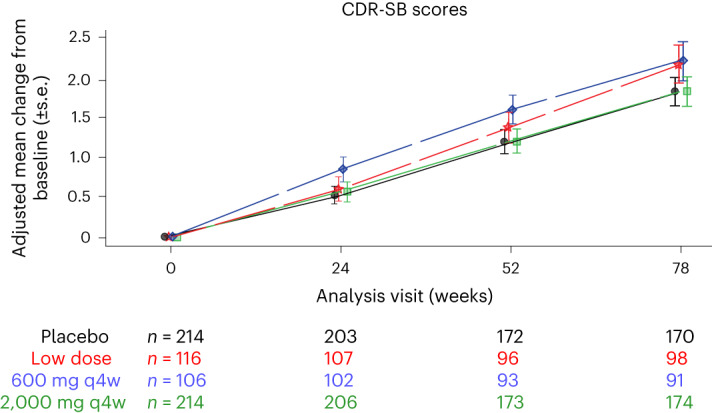
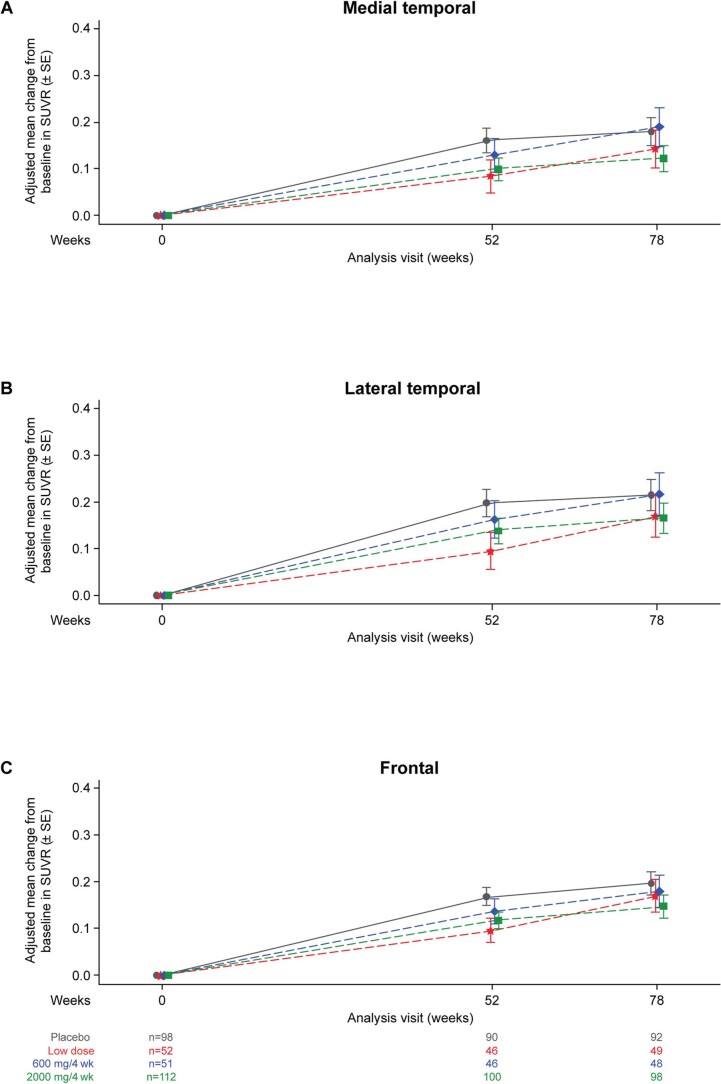
In Alzheimer's disease, the spread of aberrantly phosphorylated tau is an important criterion in the Braak staging of disease severity and correlates with disease symptomatology. Here, we report the results of TANGO ( NCT03352557 ), a randomized, double-blind, placebo-controlled, parallel-group and multiple-dose long-term trial of gosuranemab-a monoclonal antibody to N-terminal tau-in patients with early Alzheimer's disease. The primary objective was to assess the safety and tolerability of gosuranemab compared to placebo. The secondary objectives were to assess the efficacy of multiple doses of gosuranemab in slowing cognitive and functional impairment (using the Clinical Dementia Rating Scale Sum of Boxes (CDR-SB) scores at week 78) and evaluate the immunogenicity of gosuranemab (using the incidence of anti-gosuranemab antibody responses). Participants were randomized (n = 654); received (n = 650) low-dose (125 mg once every 4 weeks (q4w), n = 58; 375 mg q12w, n = 58), intermediate-dose (600 mg q4w, n = 106) or high-dose (2,000 mg q4w, n = 214) gosuranemab or placebo (q4w, n = 214) intravenously for 78 weeks; and assigned to cerebrospinal fluid (n = 327) and/or tau positron emission tomography (n = 357) biomarker substudies. Gosuranemab had an acceptable safety profile and was generally well tolerated (incidence of serious adverse events: placebo, 12.1%; low dose, 10.3%; intermediate dose, 12.3%; high dose, 11.7%). The incidence of treatment-emergent gosuranemab antibody responses was low at all time points. No significant effects were identified in cognitive and functional tests as no dose resulted in a favorable change from the baseline CDR-SB score at week 78 compared to placebo control (adjusted mean change: placebo, 1.85; low dose, 2.20; intermediate dose, 2.24; high dose, 1.85). At week 76, all doses caused significant (P < 0.0001) reductions in the cerebrospinal fluid levels of unbound N-terminal tau compared to placebo.
在阿尔茨海默病中,异常磷酸化 tau 的扩散是疾病严重程度 Braak 分期的一个重要标准,与疾病症状相关。在这里,我们报告了 TANGO(NCT03352557)的结果,这是一项针对早期阿尔茨海默病患者的gosuranemab-a 单抗(一种针对 N 端 tau 的单克隆抗体)的随机、双盲、安慰剂对照、平行分组和多剂量长期试验。主要目的是评估与安慰剂相比 gosuranemab 的安全性和耐受性。次要目标是评估多剂量 gosuranemab 对减缓认知和功能障碍的疗效(使用第 78 周的临床痴呆评定量表总和评分(CDR-SB)),并评估 gosuranemab 的免疫原性(使用抗 gosuranemab 抗体反应的发生率)。参与者被随机分组(n=654);接受(n=650)低剂量(125mg 每 4 周一次(q4w),n=58;375mg q12w,n=58)、中剂量(600mg q4w,n=106)或高剂量(2000mg q4w,n=214)gosuranemab 或安慰剂(q4w,n=214)静脉输注 78 周;并被分配到脑脊液(n=327)和/或 tau 正电子发射断层扫描(n=357)生物标志物子研究。gosuranemab 具有可接受的安全性,总体耐受性良好(严重不良事件发生率:安慰剂,12.1%;低剂量,10.3%;中剂量,12.3%;高剂量,11.7%)。在所有时间点,治疗引起的 gosuranemab 抗体反应的发生率均较低。在认知和功能测试中未发现显著影响,因为与安慰剂对照组相比,没有任何剂量在第 78 周时导致 CDR-SB 评分的基线有有利变化(调整后的平均变化:安慰剂,1.85;低剂量,2.20;中剂量,2.24;高剂量,1.85)。在第 76 周时,与安慰剂相比,所有剂量均显著(P<0.0001)降低了脑脊液中未结合的 N 端 tau 水平。