School of Health Sciences, Faculty of Medicine and Health, The University of Sydney, Camperdown, NSW, 2006, Australia.
The George Institute for Global Health, The University of New South Wales, Camperdown, NSW, 2006, Australia.
BMC Public Health. 2023 Nov 27;23(1):2344. doi: 10.1186/s12889-023-17283-2.
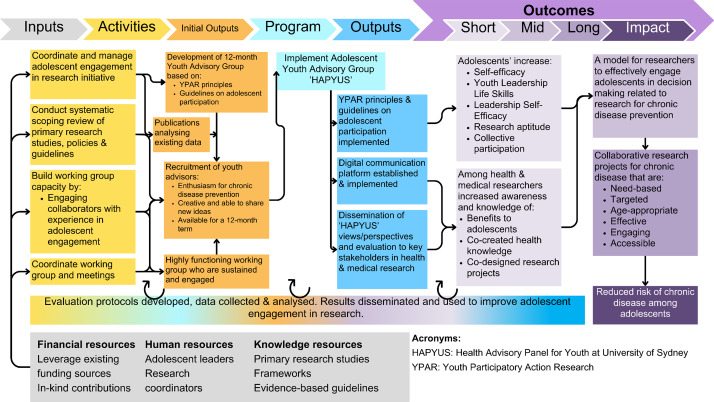
Youth Advisory Groups (YAGs) represent a promising method to engage adolescents in research of relevance to them and their peers. However, YAGs are rarely implemented or evaluated in chronic disease prevention research. The aims of this study were firstly, to evaluate the effect of participation in a 12-month YAG on adolescents' leadership skills and perceptions related to chronic disease prevention research and secondly, to evaluate the process of establishing and facilitating a 12-month YAG and identify barriers and enablers to establishment and facilitation.
This study was a 12-month pre-post study. Eligible participants were adolescents (13-18-years) and current members of an established YAG. Data collection involved online surveys and semi-structured interviews at baseline, six-months and 12-months follow-up. Participatory outcomes such as self-efficacy, leadership skills, and collective participation were derived from Youth Participatory Action Research Principles (YPAR), and the Lansdown-UNICEF conceptual framework for measuring outcomes of adolescent participation. Process evaluation data were captured via meeting minutes, Slack metrics and researcher logs. Quantitative data was analysed using descriptive statistics and qualitative data was thematically analysed using a reflexive thematic analysis approach.
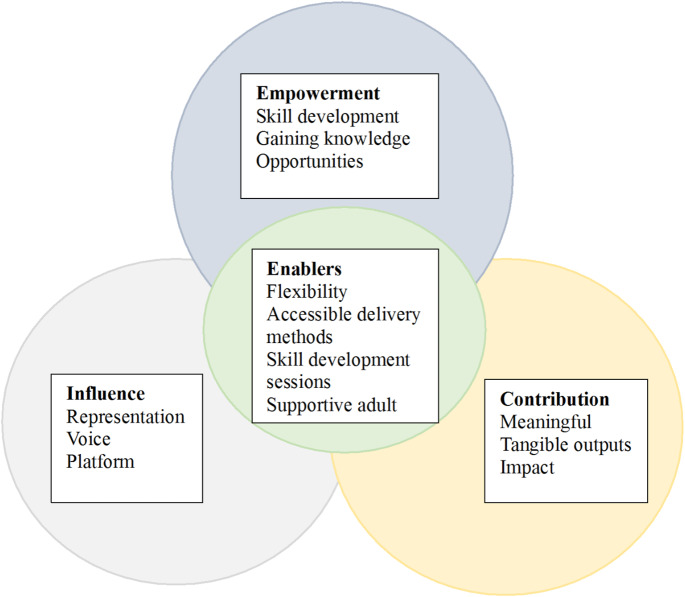
Thirteen (13/16) YAG youth advisors consented to participate in the evaluation study (mean age 16.0 years, SD 1.3; 62% (8/13) identified as female). Survey data assessing participatory outcomes found an increase in leadership and life skills scores over 12-months (+ 8.90 points). Semi-structured interview data collected over the 12-month term revealed three key themes namely: influence, empowerment, and contribution. Comparison of pre-post themes determined a positive trend at follow-ups, demonstrating improved participatory outcomes. Process indicators revealed that at 12-month follow-up the YAG was implemented as planned. Semi-structured interview data determined barriers to YAG facilitation included time and limited face-to-face components, while enablers to YAG facilitation included flexibility, accessible delivery methods, and a supportive adult facilitator.
This study found that a YAG fostered positive participatory outcomes and unique opportunities for youth participants. A successful YAG based on YPAR principles requires researchers to ensure YAG establishment and facilitation is an iterative process. Taking into consideration important barriers and enablers to YAG facilitation ensures adolescent engagement in a YAG is both meaningful and impactful.
青年咨询小组(YAG)是一种有前途的方法,可以让青少年参与与他们和同龄人相关的研究。然而,YAG 在慢性病预防研究中很少实施或评估。本研究的目的首先是评估参与为期 12 个月的 YAG 对青少年领导技能和对慢性病预防研究的看法的影响,其次是评估建立和促进为期 12 个月的 YAG 的过程,并确定建立和促进的障碍和促成因素。
这是一项为期 12 个月的前后研究。合格的参与者是青少年(13-18 岁)和已建立的 YAG 的现任成员。数据收集包括基线、六个月和 12 个月随访时的在线调查和半结构化访谈。参与性结果,如自我效能感、领导技能和集体参与,源自青年参与行动研究原则(YPAR)和兰斯顿-儿基会衡量青少年参与成果的概念框架。通过会议记录、Slack 指标和研究人员日志捕获过程评估数据。使用描述性统计分析对定量数据进行分析,使用反思性主题分析方法对定性数据进行主题分析。
16 名 YAG 青年顾问中有 13 名(13/16)同意参与评估研究(平均年龄 16.0 岁,标准差 1.3;62%(8/13)为女性)。评估参与性成果的调查数据发现,12 个月内领导能力和生活技能得分有所提高(+8.90 分)。在 12 个月的期限内收集的半结构化访谈数据揭示了三个关键主题,即:影响、赋权和贡献。主题的预-后比较确定了随访中的积极趋势,表明参与性成果得到了改善。过程指标显示,在 12 个月的随访中,YAG 按计划实施。阻碍 YAG 促进的因素包括时间和有限的面对面部分,而促进 YAG 促进的因素包括灵活性、可访问的交付方法和支持性的成人促进者。
本研究发现,YAG 促进了积极的参与性成果和青少年参与者的独特机会。基于 YPAR 原则的成功 YAG 需要研究人员确保 YAG 的建立和促进是一个迭代过程。考虑到 YAG 促进的重要障碍和促成因素,确保青少年参与 YAG 既有意义又有影响力。