Biotechnology/Biomolecular Chemistry program, Chemistry Department, Faculty of Science, Cairo University, Giza, 12613, Egypt.
Department of Zoology, Faculty of Science, Cairo University, Giza, 12613, Egypt.
BMC Cancer. 2023 Nov 27;23(1):1151. doi: 10.1186/s12885-023-11649-w.
Triple-negative breast cancer (TNBC) is a lethal mammary carcinoma subtype that affects females and is associated with a worse prognosis. Chemotherapy is the only conventional therapy available for patients with TNBC due to the lack of therapeutic targets. Yttrium oxide (YO) is a rare earth metal oxide, whose nanoparticle (NPs) formulations are used in various applications, including biological imaging, the material sciences, and the chemical synthesis of inorganic chemicals. However, the biological activity of YO-NPs against TNBC cells has not been fully explored. The current study was conducted to assess YO-NPs' anticancer activity against the human TNBC MDA-MB-231 cell line.
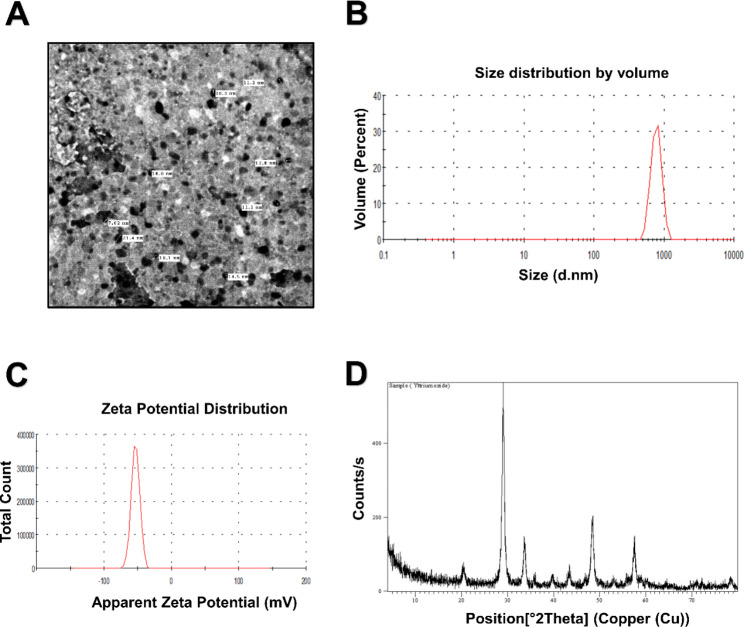
Transmission electron microscopy (TEM), X-ray diffraction, Zeta potential, and dynamic light scattering (DLS) were used to characterize the YO-NPs. SRB cell viability, reactive oxygen species (ROS) measurement, single-cell gel electrophoresis (comet assay), qPCR, flow cytometry, and Western blot were employed to assess the anticancer activity of the YO-NPs.
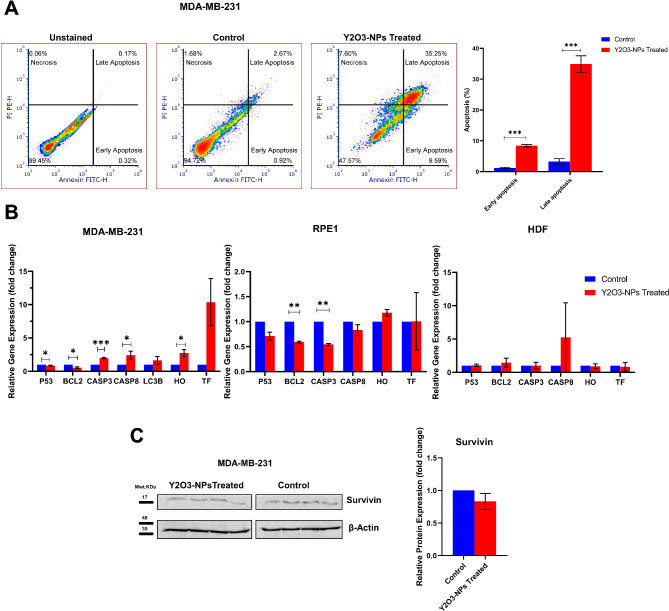
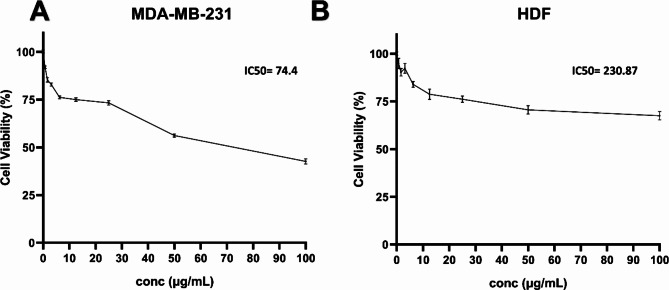
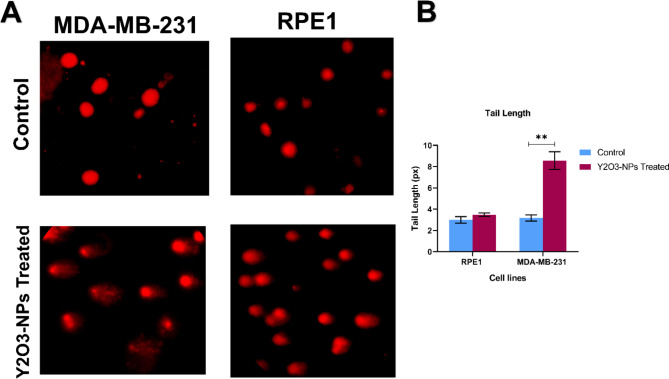
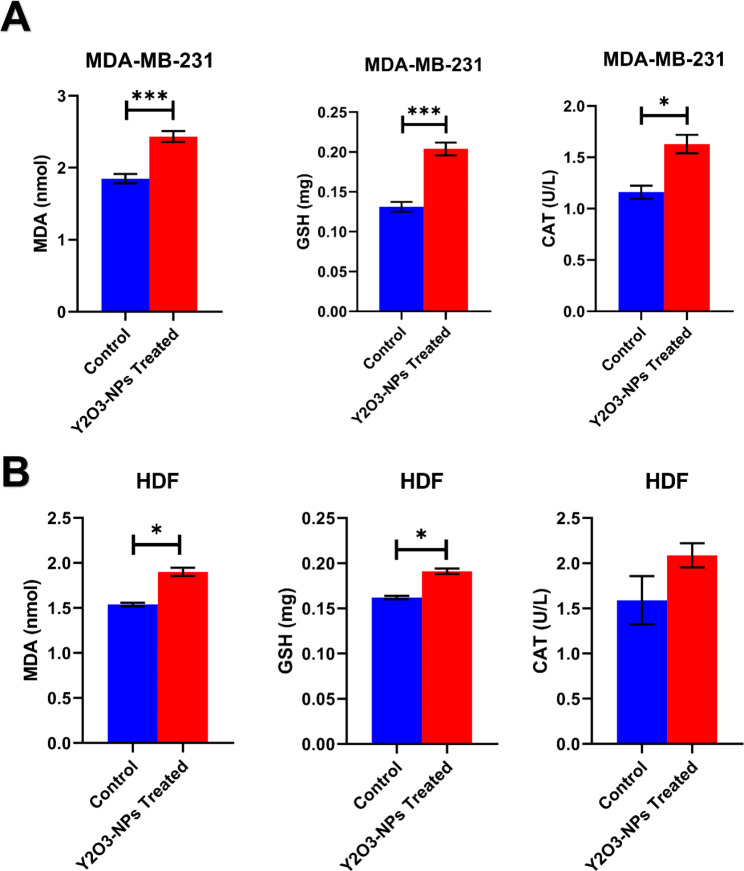
Our results indicate favorable physiochemical properties of YO-NPs (with approximately average size 14 nm, Zeta Potential about - 53.2 mV, and polydispersity index = 0.630). YO-NPs showed a potent cytotoxic effect against MDA-MB-231 cells, with IC50 values of 74.4 µg/mL, without cytotoxic effect on the normal retina REP1 and human dermal fibroblast HDF cell lines. Further, treatment of MDA-MB-231 cells with IC50 YO-NPs resulted in increased oxidative stress, accumulation of intracellular ROS levels, and induced DNA damage assessed by Comet assay. Upon YO-NPs treatment, a significant increase in the early and late phases of apoptosis was revealed in MDA-MB-231 cells. qPCR results showed that YO-NPs significantly upregulated the pro-apoptotic genes CASP3 and CASP8 as well as ferroptosis-related gene heme oxygenase-1 (HO-1), whereas the anti-apoptotic gene BCL2 was significantly downregulated.
This study suggests that YO-NPs are safe on normal REP1 and HDF cells and exhibited a potent selective cytotoxic effect against the TNBC MDA-MB-231 cells through increasing levels of ROS generation with subsequent DNA damage, and induction of apoptosis and ferroptosis.
三阴性乳腺癌(TNBC)是一种影响女性且预后较差的致命乳腺癌亚型。由于缺乏治疗靶点,化疗是 TNBC 患者唯一可用的常规治疗方法。氧化钇(YO)是一种稀土金属氧化物,其纳米颗粒(NPs)制剂已应用于生物成像、材料科学和无机化学品的化学合成等多个领域。然而,YO-NPs 对 TNBC 细胞的抗癌活性尚未得到充分探索。本研究旨在评估 YO-NPs 对人 TNBC MDA-MB-231 细胞系的抗癌活性。
透射电子显微镜(TEM)、X 射线衍射、Zeta 电位和动态光散射(DLS)用于表征 YO-NPs。SRB 细胞活力、活性氧(ROS)测量、单细胞凝胶电泳(彗星试验)、qPCR、流式细胞术和 Western blot 用于评估 YO-NPs 的抗癌活性。
我们的结果表明,YO-NPs 具有良好的物理化学性质(平均粒径约为 14nm,Zeta 电位约为-53.2mV,多分散指数=0.630)。YO-NPs 对 MDA-MB-231 细胞表现出强大的细胞毒性作用,IC50 值为 74.4µg/mL,对正常视网膜 REP1 和人皮肤成纤维细胞 HDF 细胞系无细胞毒性作用。此外,用 IC50 YO-NPs 处理 MDA-MB-231 细胞会导致氧化应激增加,ROS 水平升高,并通过彗星试验评估诱导 DNA 损伤。在 YO-NPs 处理后,MDA-MB-231 细胞中早期和晚期凋亡明显增加。qPCR 结果显示,YO-NPs 显著上调促凋亡基因 CASP3 和 CASP8 以及铁死亡相关基因血红素加氧酶-1(HO-1),而抗凋亡基因 BCL2 则显著下调。
本研究表明,YO-NPs 在正常 REP1 和 HDF 细胞上是安全的,对 TNBC MDA-MB-231 细胞表现出强大的选择性细胞毒性作用,通过增加 ROS 生成水平导致 DNA 损伤,进而诱导细胞凋亡和铁死亡。