Centre for Global Health Research, Kenya Medical Research Institute, P.O. Box 1578-40100, Kisumu, Kenya.
Trials. 2023 Nov 27;24(1):763. doi: 10.1186/s13063-023-07790-3.
Schistosomiasis control relies on praziquantel for preventive chemotherapy. Alternative drugs are needed for the treatment and control of schistosomiasis. Praziquantel is effective against adult schistosome worms but ineffective against larval stages of the parasite and cannot prevent re-infection or interrupt the transmission of infection. Continued reliance on praziquantel for wide-scale schistosomiasis control will likely accelerate the emergence of drug resistance. Artemisinin derivatives are effective against the juvenile stages but ineffective against adult worms. The SCHISTOACT study aimed to evaluate the efficacy and safety of praziquantel plus one of four artemisinin-based combinations in treating Schistosoma mansoni infection in Kenya.
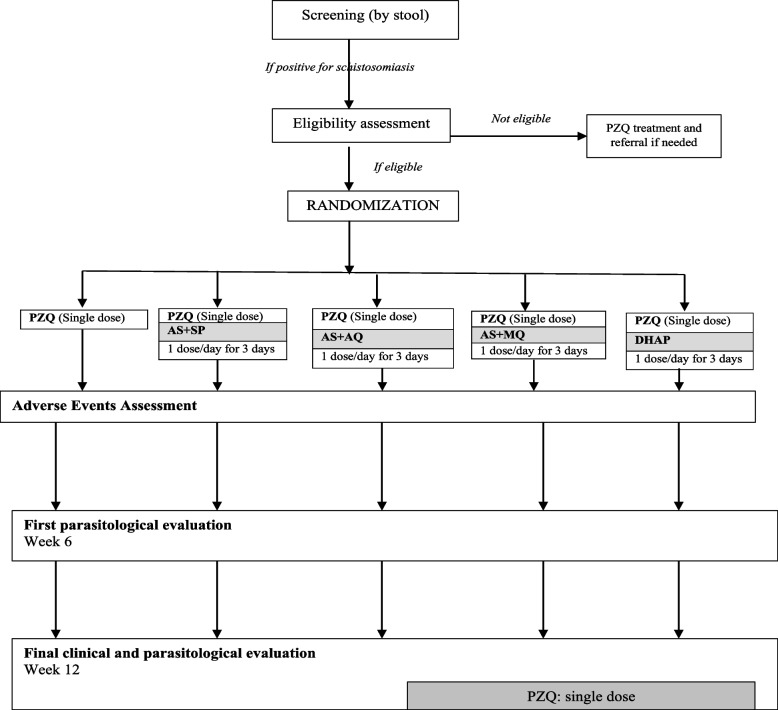
The SCHISTOACT study is an open-label, head-to-head, five-arm, proof-of-concept, non-inferiority, individually randomized controlled trial with a follow-up of 12 weeks. A total of 540 primary school-aged children from the Mwea area, Kirinyaga County in central Kenya, diagnosed with S. mansoni infection (by Kato-Katz method) are randomly allocated (1:1:1:1:1) to a single dose of praziquantel plus a 3-day course of artesunate-sulfalene/pyrimethamine, or artesunate-amodiaquine, or artesunate plus mefloquine, or dihydroartemisinin-piperaquine, or praziquantel control arm. The primary endpoints are efficacy (cure rate, assessed by microscopy) and safety (adverse events) of each study arm 6 weeks after treatment. Secondary endpoints include cumulative cure rate, egg reduction rate, and re-infection 12 weeks after treatment. The non-inferiority margin is set at - 10 for the risk difference in cure rates between praziquantel and the combined treatment.
This study assesses a strategy for repurposing artemisinin-based combination therapies (ACTs) for treating schistosomiasis. It adopts a head-to-head comparison of four different ACTs to test a non-inferiority hypothesis and to strengthen local capacity to conduct clinical trials for interventions against neglected tropical diseases.
Pan-African Clinical Trials Registry PACTR202001919442161 . Retrospectively registered on 6 January 2020.
血吸虫病防治依赖于吡喹酮进行预防性化疗。需要有替代药物来治疗和控制血吸虫病。吡喹酮对成体血吸虫有效,但对寄生虫的幼虫阶段无效,不能预防再次感染或中断感染的传播。继续广泛依赖吡喹酮进行血吸虫病防治可能会加速耐药性的出现。青蒿素衍生物对幼虫阶段有效,但对成虫无效。SCHISTOACT 研究旨在评估吡喹酮加四种青蒿素类复方药物中的一种在肯尼亚治疗曼氏血吸虫感染的疗效和安全性。
SCHISTOACT 研究是一项开放标签、头对头、五臂、概念验证、非劣效性、个体随机对照试验,随访 12 周。总共从肯尼亚中部基里尼亚加县姆韦亚地区的 540 名小学年龄的儿童中,诊断出曼氏血吸虫感染(加藤法),随机分为(1:1:1:1:1)一组,给予单次剂量的吡喹酮加 3 天疗程的青蒿琥酯-磺胺多辛/乙胺嘧啶、青蒿琥酯-阿莫地喹、青蒿琥酯加甲氟喹、双氢青蒿素-哌喹或吡喹酮对照治疗。主要终点是治疗后 6 周时每个研究组的疗效(治愈率,通过显微镜评估)和安全性(不良事件)。次要终点包括累积治愈率、卵减少率和治疗后 12 周的再感染率。非劣效性边界设定为吡喹酮和联合治疗之间治愈率差异的 -10。
本研究评估了一种重新利用青蒿素类复方药物(ACTs)治疗血吸虫病的策略。它采用了四种不同的 ACTs 的头对头比较来检验非劣效性假设,并加强了在当地开展针对被忽视的热带病干预措施临床试验的能力。
泛非临床试验注册中心 PACTR202001919442161 。2020 年 1 月 6 日回顾性注册。