Laboratorio de Inmunología y Parasitología Molecular, IBSAL-CIETUS, Facultad de Farmacia, Universidad de Salamanca, Salamanca, Spain.
PLoS One. 2012;7(9):e45867. doi: 10.1371/journal.pone.0045867. Epub 2012 Sep 21.
Chemotherapy based on repeated doses of praziquantel is still the most effective control strategy against Schistosomiasis, however artemisinin derivatives emerged as a family of compounds with schistomicide activity. The aim of the present work is to compare the efficacy of artemisinin-based therapies in the treatment and prophylaxis of human schistosomiasis. The design of this work involved a quantitative systematic review and meta-analysis.
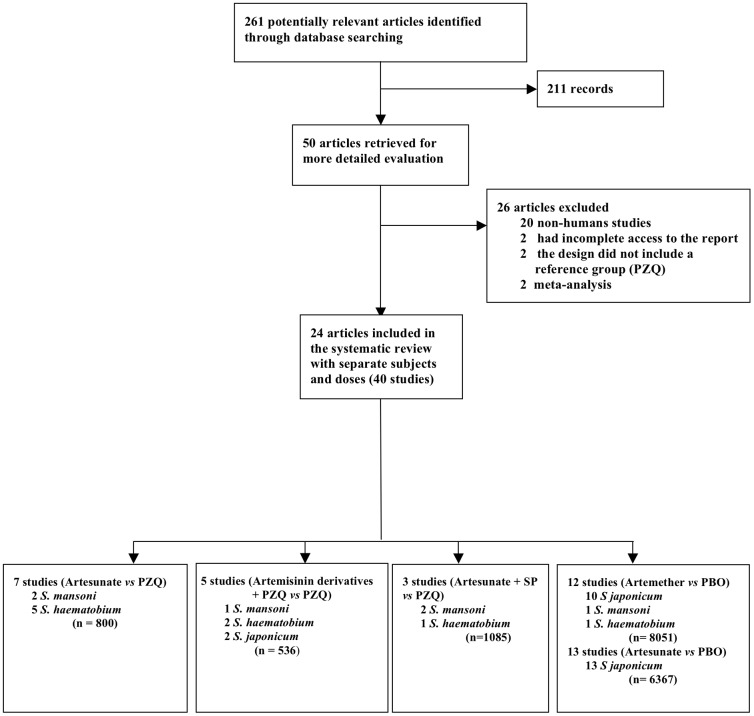
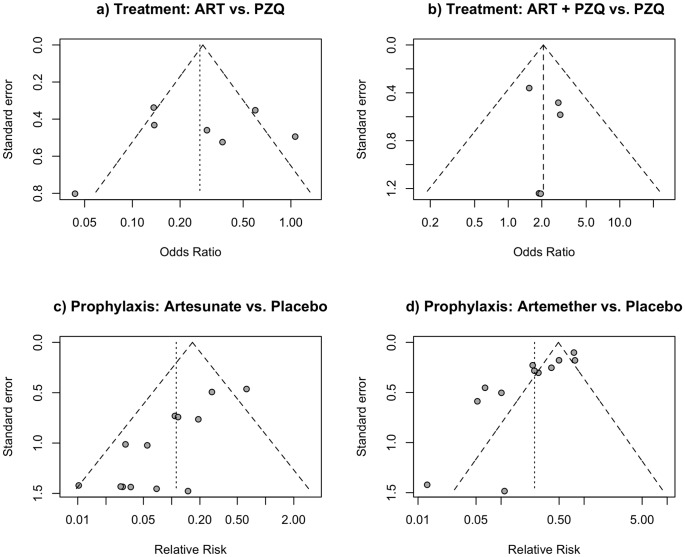
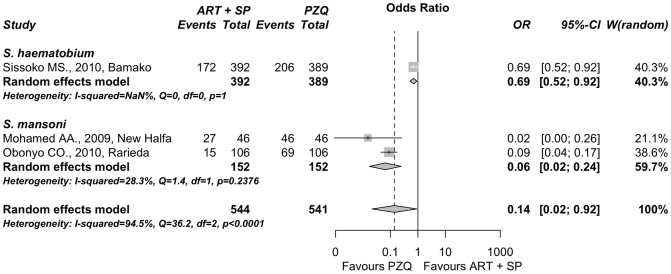
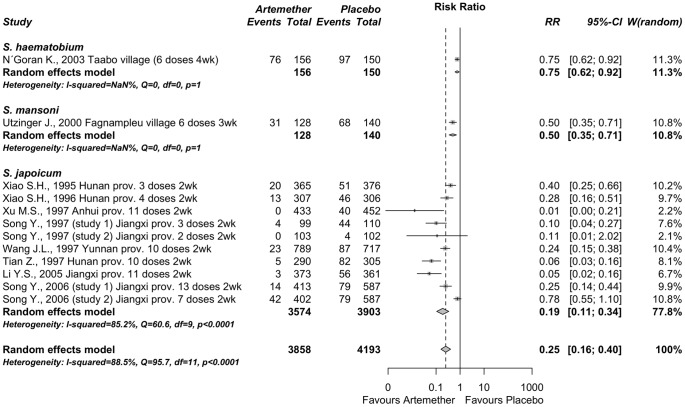
METHODOLOGY/PRINCIPAL FINDINGS: Retrieval of published studies was carried out through an electronic search of the PubMed (MEDLINE), EMBASE, Cochrane Library and CINAHL databases. This included reports comparing the therapeutic efficacy of artesunate alone, artesunate plus sulfadoxine-pyrimethamine and a combination of artemisinin derivatives plus praziquantel against praziquantel alone on different types of schistosomiasis. Moreover, studies on artesunate and artemether used as preventive drugs were also analyzed against placebo. The primary outcome measure for schistosomiasis treatment was "parasitological cure", whereas for the prophylaxis the outcome evaluated was "infection rate". Our results show that patients treated with artesunate alone have significantly lower cure rates than those treated with praziquantel (OR = 0.27 (95% C.I. 0.13-0.53; p<0.001)) and that the combined therapy of artesunate plus sulfadoxine-pyrimethamine is also significantly less effective than praziquantel treatment (OR = 0.14 (95% C.I. 0.02-0.92; p = 0.04)). However, the combination of an artemisinin derivatives plus praziquantel showed a higher cure rate than praziquantel monotherapy with OR = 2.07 (95% C.I. 1.27-3.36; p = 0.003). Finally, chemoprophylaxis with either artesunate (RR = 0.11 (95% C.I. 0.06-0.22; p<0.001)) or artemether (RR = 0.25 (95% C.I. 0.16-0.40; p<0.001)) was significantly better than a placebo in both cases.
CONCLUSIONS/SIGNIFICANCE: This meta-analysis confirms that artemisinin derivatives used in combination with praziquantel have the potential to increase the cure rates in schistosomiasis treatment, but not artesunate alone. It is also confirmed that repeated doses of artemisinin derivatives play a prophylactic role, significantly reducing the incidence of Schistosoma japonicum infections compared with placebo.
基于重复剂量吡喹酮的化疗仍然是对抗血吸虫病最有效的控制策略,然而青蒿素衍生物作为一类具有杀血吸虫活性的化合物出现了。本工作的目的是比较青蒿素类疗法在治疗和预防人体血吸虫病中的疗效。这项工作的设计包括定量系统评价和荟萃分析。
方法/主要发现:通过电子检索 PubMed(MEDLINE)、EMBASE、Cochrane 图书馆和 CINAHL 数据库,检索已发表的研究。这包括比较青蒿琥酯单独治疗、青蒿琥酯加磺胺多辛-乙胺嘧啶联合治疗和青蒿素衍生物联合吡喹酮单独治疗不同类型血吸虫病的疗效的报告。此外,还分析了青蒿琥酯和蒿甲醚作为预防药物与安慰剂相比的效果。血吸虫病治疗的主要结局测量是“寄生虫学治愈率”,而预防的结局评估是“感染率”。我们的结果表明,单独使用青蒿琥酯治疗的患者的治愈率明显低于使用吡喹酮治疗的患者(OR = 0.27(95%CI 0.13-0.53;p<0.001)),青蒿琥酯加磺胺多辛-乙胺嘧啶联合治疗也明显不如吡喹酮治疗有效(OR = 0.14(95%CI 0.02-0.92;p = 0.04))。然而,青蒿素衍生物联合吡喹酮的联合治疗显示出比吡喹酮单药治疗更高的治愈率,OR = 2.07(95%CI 1.27-3.36;p = 0.003)。最后,青蒿琥酯(RR = 0.11(95%CI 0.06-0.22;p<0.001))或蒿甲醚(RR = 0.25(95%CI 0.16-0.40;p<0.001))的化学预防在这两种情况下均明显优于安慰剂。
结论/意义:这项荟萃分析证实,青蒿素衍生物联合吡喹酮联合使用具有提高血吸虫病治疗治愈率的潜力,但单独使用青蒿琥酯则不然。它还证实,青蒿素衍生物的重复剂量具有预防作用,与安慰剂相比,可显著降低日本血吸虫感染的发生率。