Dadonaite Bernadeta, Brown Jack, McMahon Teagan E, Farrell Ariana G, Asarnow Daniel, Stewart Cameron, Logue Jenni, Murrell Ben, Chu Helen Y, Veesler David, Bloom Jesse D
Basic Sciences Division and Computational Biology Program, Fred Hutchinson Cancer Center, Seattle, Washington, 98109, USA.
Department of Biochemistry, University of Washington, Seattle, Washington, USA.
bioRxiv. 2023 Nov 14:2023.11.13.566961. doi: 10.1101/2023.11.13.566961.
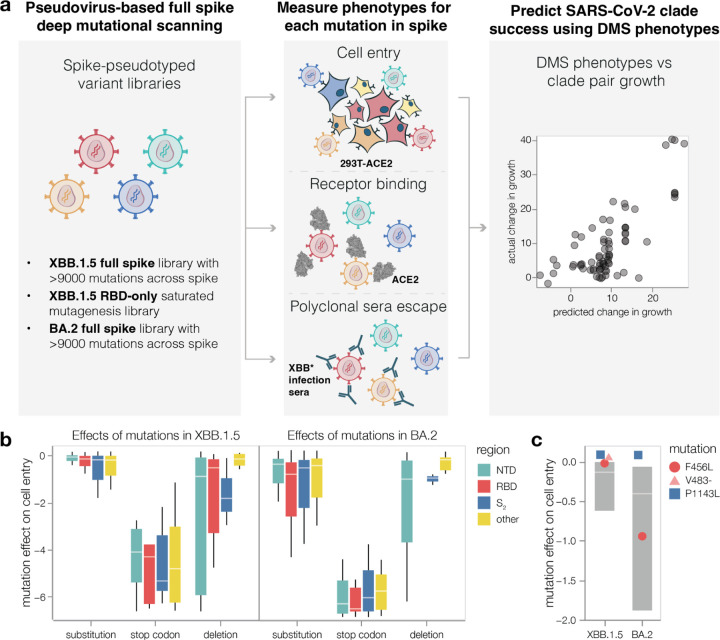
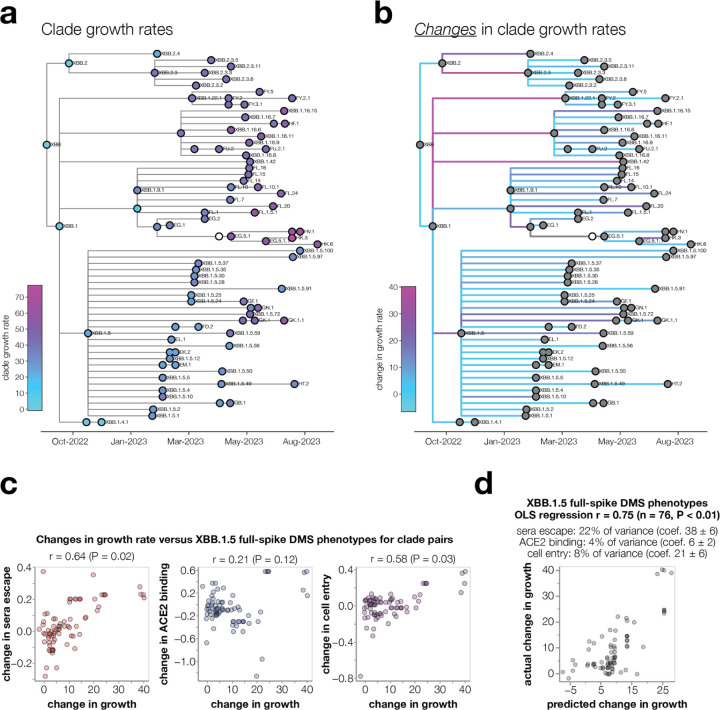
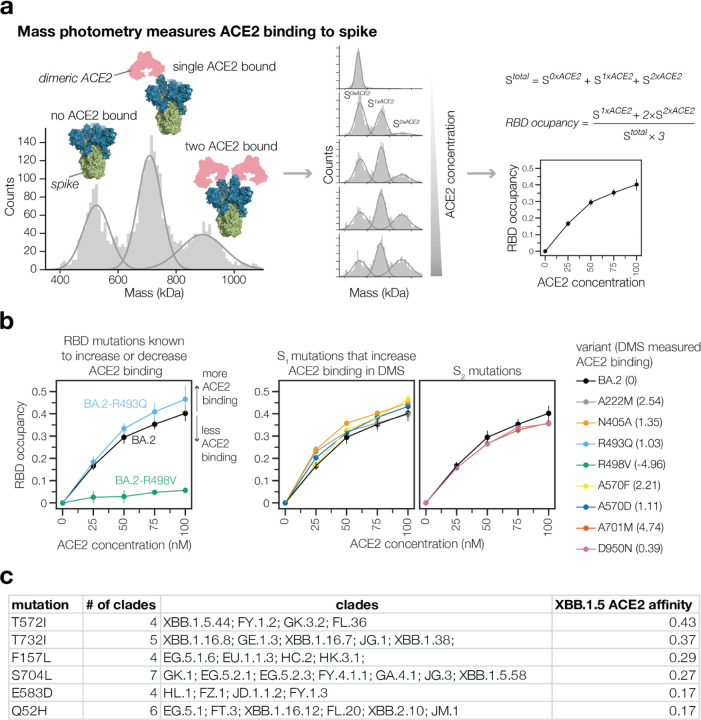
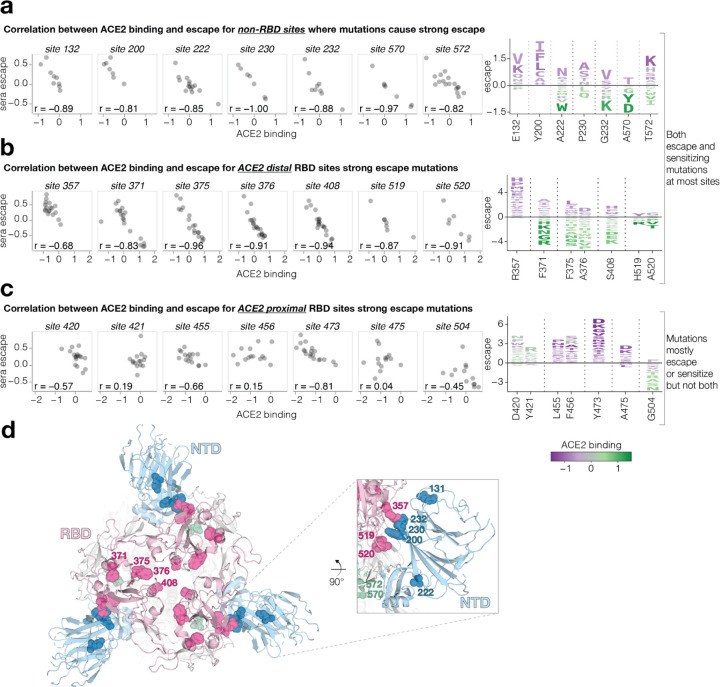
SARS-CoV-2 variants acquire mutations in spike that promote immune evasion and impact other properties that contribute to viral fitness such as ACE2 receptor binding and cell entry. Knowledge of how mutations affect these spike phenotypes can provide insight into the current and potential future evolution of the virus. Here we use pseudovirus deep mutational scanning to measure how >9,000 mutations across the full XBB.1.5 and BA.2 spikes affect ACE2 binding, cell entry, or escape from human sera. We find that mutations outside the receptor-binding domain (RBD) have meaningfully impacted ACE2 binding during SARS-CoV-2 evolution. We also measure how mutations to the XBB.1.5 spike affect neutralization by serum from individuals who recently had SARS-CoV-2 infections. The strongest serum escape mutations are in the RBD at sites 357, 420, 440, 456, and 473-however, the antigenic impacts of these mutations vary across individuals. We also identify strong escape mutations outside the RBD; however many of them decrease ACE2 binding, suggesting they act by modulating RBD conformation. Notably, the growth rates of human SARS-CoV-2 clades can be explained in substantial part by the measured effects of mutations on spike phenotypes, suggesting our data could enable better prediction of viral evolution.
严重急性呼吸综合征冠状病毒2(SARS-CoV-2)变体在刺突蛋白中获得突变,这些突变促进免疫逃逸并影响有助于病毒适应性的其他特性,如血管紧张素转换酶2(ACE2)受体结合和细胞进入。了解突变如何影响这些刺突蛋白表型,有助于洞察病毒当前及未来可能的进化情况。在此,我们使用假病毒深度突变扫描来测量XBB.1.5和BA.2刺突蛋白全长上的9000多个突变如何影响ACE2结合、细胞进入或逃避人血清。我们发现,在SARS-CoV-2进化过程中,受体结合域(RBD)之外的突变对ACE2结合产生了有意义的影响。我们还测量了XBB.1.5刺突蛋白的突变如何影响近期感染过SARS-CoV-2的个体血清的中和作用。最强的血清逃逸突变位于RBD的357、420、440、456和473位点,然而,这些突变的抗原影响在个体间存在差异。我们还在RBD之外鉴定出了强逃逸突变;然而,其中许多突变会降低ACE2结合,这表明它们通过调节RBD构象起作用。值得注意的是,人类SARS-CoV-2进化分支的生长速率在很大程度上可以由突变对刺突蛋白表型的测量效应来解释,这表明我们的数据能够更好地预测病毒进化。