Ball Brendan K, Kuhn Madison K, Fleeman Rebecca M, Proctor Elizabeth A, Brubaker Douglas K
Weldon School of Biomedical Engineering, Purdue University, West Lafayette, IN, USA.
Department of Neurosurgery, Penn State College of Medicine, Hershey, PA, USA.
bioRxiv. 2023 Nov 17:2023.11.17.567595. doi: 10.1101/2023.11.17.567595.
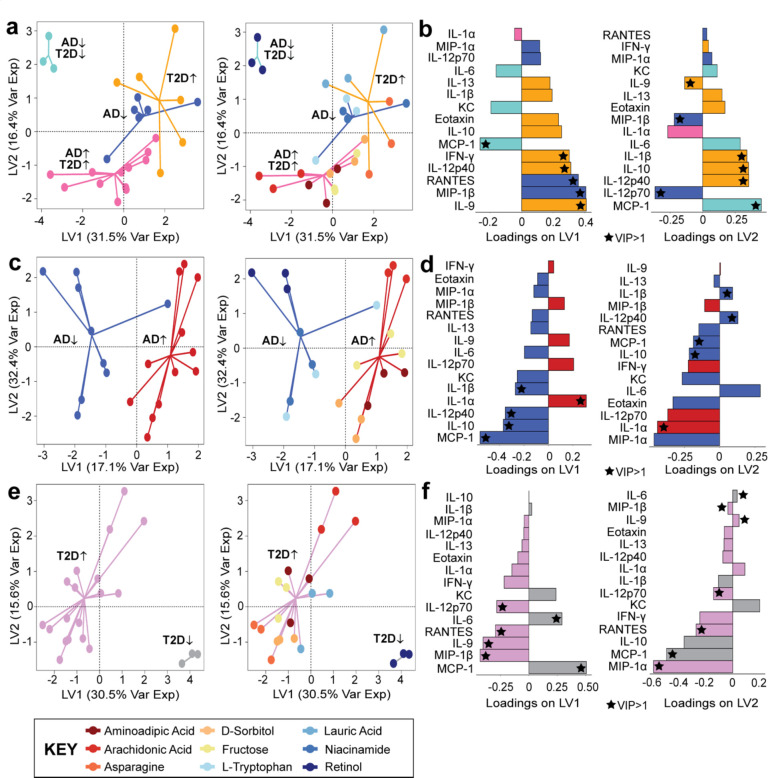
Type 2 diabetes (T2D) is implicated as a risk factor for Alzheimer's disease (AD), the most common form of dementia. In this work, we investigated neuroinflammatory responses of primary neurons to potentially circulating, blood-brain barrier (BBB) permeable metabolites associated with AD, T2D, or both. We identified nine metabolites associated with protective or detrimental properties of AD and T2D in literature (lauric acid, asparagine, fructose, arachidonic acid, aminoadipic acid, sorbitol, retinol, tryptophan, niacinamide) and stimulated primary mouse neuron cultures with each metabolite before quantifying cytokine secretion via Luminex. We employed unsupervised clustering, inferential statistics, and partial least squares discriminant analysis to identify relationships between cytokine concentration and disease-associations of metabolites. We identified MCP-1, a cytokine associated with monocyte recruitment, as differentially abundant between neurons stimulated by metabolites associated with protective and detrimental properties of AD and T2D. We also identified IL-9, a cytokine that promotes mast cell growth, to be differentially associated with T2D. Indeed, cytokines, such as MCP-1 and IL-9, released from neurons in response to BBB-permeable metabolites associated with T2D may contribute to AD development by downstream effects of neuroinflammation.
2型糖尿病(T2D)被认为是阿尔茨海默病(AD)的一个风险因素,AD是最常见的痴呆形式。在这项研究中,我们调查了原代神经元对可能循环的、可透过血脑屏障(BBB)的与AD、T2D或两者相关的代谢物的神经炎症反应。我们从文献中确定了九种与AD和T2D的保护或有害特性相关的代谢物(月桂酸、天冬酰胺、果糖、花生四烯酸、氨基己二酸、山梨醇、视黄醇、色氨酸、烟酰胺),并用每种代谢物刺激原代小鼠神经元培养物,然后通过Luminex技术定量细胞因子分泌。我们采用无监督聚类、推断统计和偏最小二乘判别分析来确定细胞因子浓度与代谢物疾病关联之间的关系。我们发现与单核细胞募集相关的细胞因子单核细胞趋化蛋白-1(MCP-1)在受到与AD和T2D的保护及有害特性相关的代谢物刺激的神经元之间丰度存在差异。我们还发现促进肥大细胞生长的细胞因子白细胞介素-9(IL-9)与T2D存在差异关联。的确,神经元因与T2D相关的可透过血脑屏障的代谢物而释放的诸如MCP-1和IL-9等细胞因子可能通过神经炎症的下游效应促进AD的发展。