Gérontopôle de Toulouse, Institut du Vieillissement, Centre Hospitalier-Universitaire de Toulouse, 37 allées Jules Guesde, 31000, Toulouse, France.
Faculty of Sport Sciences, Universidad Europea de Madrid, Villaviciosa de Odón, 28670, Madrid, Spain.
Alzheimers Res Ther. 2022 Jan 7;14(1):5. doi: 10.1186/s13195-021-00940-2.
Monocyte Chemoattractant Protein-1 (MCP-1), a glial-derived chemokine, mediates neuroinflammation and may regulate memory outcomes among older adults. We aimed to explore the associations of plasma MCP-1 levels (alone and in combination with β-amyloid deposition-Aβ) with overall and domain-specific cognitive evolution among older adults.
Secondary analyses including 1097 subjects (mean age = 75.3 years ± 4.4; 63.8% women) from the Multidomain Alzheimer Preventive Trial (MAPT). MCP-1 (higher is worse) and Aβ (lower is worse) were measured in plasma collected at year 1. MCP-1 in continuous and as a dichotomy (values in the highest quartile (MCP-1)) were used, as well as a dichotomy of Aβ. Outcomes were measured annually over 4 years and included the following: cognitive composite z-score (CCS), the Mini-Mental State Examination (MMSE), and Clinical Dementia Rating (CDR) sum of boxes (overall cognitive function); composite executive function z-score, composite attention z-score, Free and Cued Selective Reminding Test (FCSRT - memory).
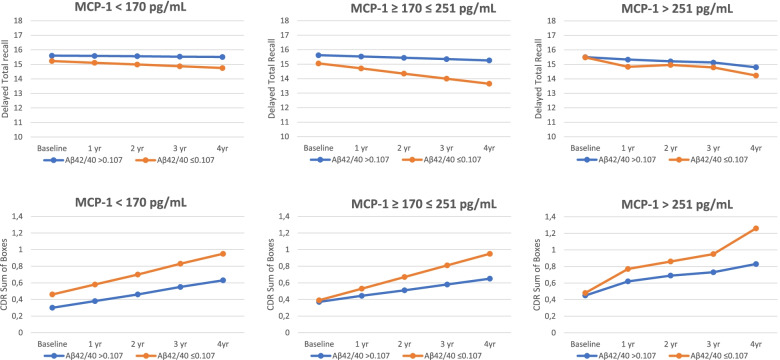
Plasma MCP-1 as a continuous variable was associated with the worsening of episodic memory over 4 years of follow-up, specifically in measures of free and cued delayed recall. MCP-1 was associated with worse evolution in the CCS (4-year between-group difference: β = -0.14, 95%CI = -0.26, -0.02) and the CDR sum of boxes (2-year: β = 0.19, 95%CI = 0.06, 0.32). In domain-specific analyses, MCP-1 was associated with declines in the FCSRT delayed recall sub-domains. In the presence of low Aβ, MCP-1 was not associated with greater declines in cognitive functions. The interaction with continuous biomarker values Aβ× MCP-1 × time was significant in models with CDR sum of boxes and FCSRT DTR as dependent variables.
Baseline plasma MCP-1 levels were associated with longitudinal declines in overall cognitive and episodic memory performance in older adults over a 4-year follow-up. How plasma MCP-1 interacts with Aβ to determine cognitive decline at different stages of cognitive decline/dementia should be clarified by further research. The MCP-1 association on cognitive decline was strongest in those with amyloid plaques, as measured by blood plasma Aβ
单核细胞趋化蛋白-1(MCP-1)是一种神经胶质衍生的趋化因子,可介导神经炎症,并可能调节老年人的记忆结果。我们旨在探索老年人血浆 MCP-1 水平(单独和与β-淀粉样蛋白沉积-Aβ结合)与整体和特定领域认知演变之间的关联。
包括来自多领域阿尔茨海默病预防试验(MAPT)的 1097 名受试者(平均年龄=75.3 岁±4.4;63.8%为女性)的二次分析。在第 1 年采集血浆中测量 MCP-1(更高表示更差)和 Aβ(更低表示更差)。MCP-1 采用连续和二分法(四分位数最高值(MCP-1)),以及 Aβ 的二分法。结果每年测量 4 年,包括以下内容:认知综合评分(CCS)、简易精神状态检查(MMSE)和临床痴呆评定量表(CDR)总和(整体认知功能);综合执行功能评分、综合注意力评分、自由和线索选择性回忆测试(FCSRT-记忆)。
血浆 MCP-1 作为连续变量与 4 年随访期间情景记忆恶化相关,特别是在自由和线索延迟回忆方面。MCP-1 与 CCS 的恶化相关(4 年组间差异:β=-0.14,95%CI=-0.26,-0.02)和 CDR 总和(2 年:β=0.19,95%CI=0.06,0.32)。在特定领域分析中,MCP-1 与 FCSRT 延迟回忆子域的下降相关。在低 Aβ 的情况下,MCP-1 与认知功能的下降无关。与认知功能下降的交互作用随着连续生物标志物 Aβ×MCP-1×时间的变化而变化。
基线血浆 MCP-1 水平与老年人在 4 年随访期间整体认知和情景记忆表现的纵向下降有关。进一步的研究应阐明血浆 MCP-1 如何与 Aβ 相互作用,以确定在认知衰退/痴呆的不同阶段的认知下降。在血液 Aβ 测量的情况下,MCP-1 与认知下降的关联在有淀粉样斑块的个体中最强。