Technical University of Munich, Campus Straubing for Biotechnology and Sustainability, Supply Chain and Value Management, Straubing, Germany.
Catholic University of Eichstätt-Ingolstadt, Supply Chain Management & Operations, Ingolstadt, Germany.
Health Care Manag Sci. 2023 Dec;26(4):785-806. doi: 10.1007/s10729-023-09652-5. Epub 2023 Nov 28.
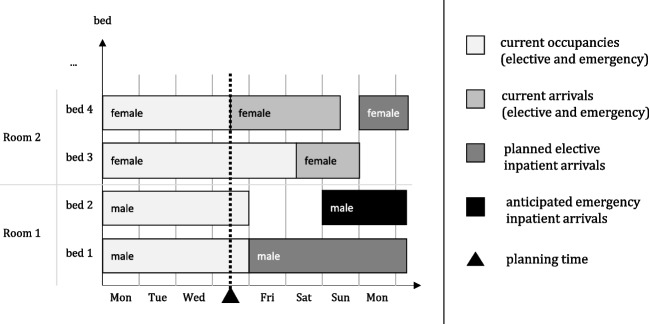
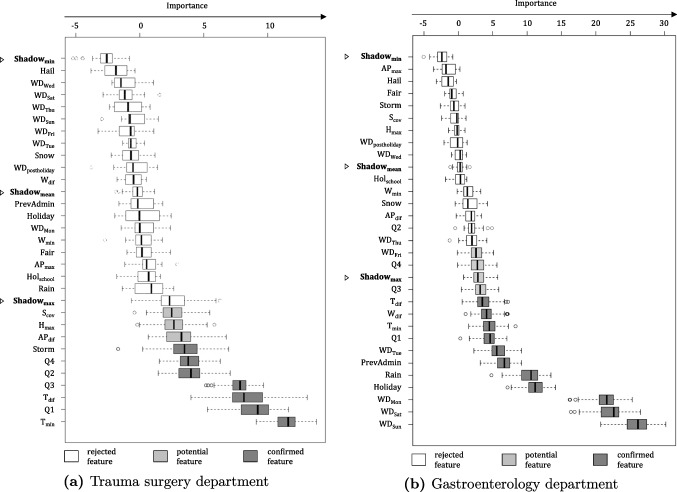
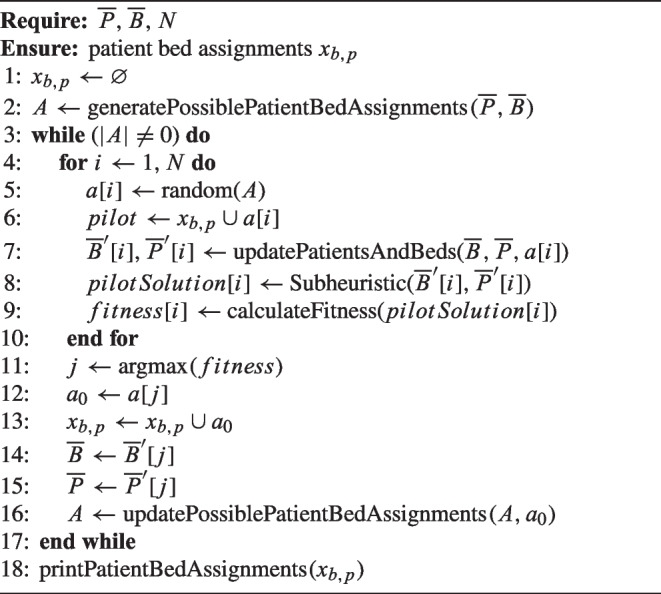
Assigning inpatients to hospital beds impacts patient satisfaction and the workload of nurses and doctors. The assignment is subject to unknown inpatient arrivals, in particular for emergency patients. Hospitals, therefore, need to deal with uncertainty on actual bed requirements and potential shortage situations as bed capacities are limited. This paper develops a model and solution approach for solving the patient bed-assignment problem that is based on a machine learning (ML) approach to forecasting emergency patients. First, it contributes by improving the anticipation of emergency patients using ML approaches, incorporating weather data, time and dates, important local and regional events, as well as current and historical occupancy levels. Drawing on real-life data from a large case hospital, we were able to improve forecasting accuracy for emergency inpatient arrivals. We achieved up to 17% better root mean square error (RMSE) when using ML methods compared to a baseline approach relying on averages for historical arrival rates. We further show that the ML methods outperform time series forecasts. Second, we develop a new hyper-heuristic for solving real-life problem instances based on the pilot method and a specialized greedy look-ahead (GLA) heuristic. When applying the hyper-heuristic in test sets we were able to increase the objective function by up to 5.3% in comparison to the benchmark approach in [40]. A benchmark with a Genetic Algorithm shows also the superiority of the hyper-heuristic. Third, the combination of ML for emergency patient admission forecasting with advanced optimization through the hyper-heuristic allowed us to obtain an improvement of up to 3.3% on a real-life problem.
为住院患者分配病床会影响患者满意度和护士与医生的工作量。由于未知的住院患者到达情况,特别是对于急诊患者,这种分配是不确定的。因此,医院需要应对实际床位需求的不确定性和潜在的短缺情况,因为床位容量是有限的。本文开发了一种模型和解决方案方法,用于解决患者床位分配问题,该方法基于机器学习 (ML) 方法对急诊患者进行预测。首先,通过使用 ML 方法改进对急诊患者的预测,包括天气数据、时间和日期、重要的本地和区域事件以及当前和历史入住率,从而做出贡献。利用来自一家大型案例医院的真实数据,我们能够提高对急诊住院患者到达的预测准确性。与依赖历史到达率平均值的基线方法相比,我们使用 ML 方法实现了高达 17%的根均方误差 (RMSE) 改进。我们进一步表明,ML 方法优于时间序列预测。其次,我们基于试点方法和专门的贪婪前瞻性 (GLA) 启发式方法为解决实际问题实例开发了一种新的超启发式方法。在测试集中应用超启发式方法时,与 [40] 中的基准方法相比,我们能够将目标函数提高高达 5.3%。与遗传算法的基准相比,也证明了超启发式的优越性。第三,将 ML 用于急诊患者入院预测与通过超启发式进行的高级优化相结合,使我们能够在实际问题上提高 3.3%。