Bhoopchand Avishkar, Brownfield Bethanie, Collister Adrian, Dal Lago Agustin, Edwards Ashley, Everett Richard, Fréchette Alexandre, Oliveira Yanko Gitahy, Hughes Edward, Mathewson Kory W, Mendolicchio Piermaria, Pawar Julia, Pȋslar Miruna, Platonov Alex, Senter Evan, Singh Sukhdeep, Zacherl Alexander, Zhang Lei M
Google DeepMind, 6-8 Handyside Street, London, N1C 4UZ, UK.
Nat Commun. 2023 Nov 28;14(1):7536. doi: 10.1038/s41467-023-42875-2.
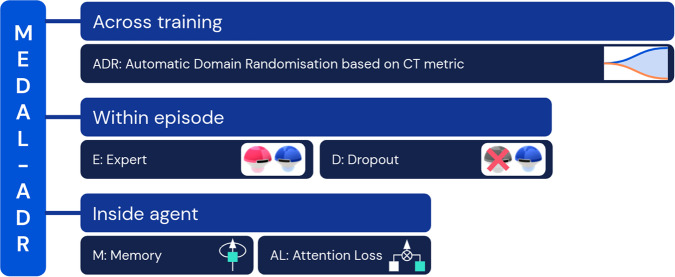
Cultural transmission is the domain-general social skill that allows agents to acquire and use information from each other in real-time with high fidelity and recall. It can be thought of as the process that perpetuates fit variants in cultural evolution. In humans, cultural evolution has led to the accumulation and refinement of skills, tools and knowledge across generations. We provide a method for generating cultural transmission in artificially intelligent agents, in the form of few-shot imitation. Our agents succeed at real-time imitation of a human in novel contexts without using any pre-collected human data. We identify a surprisingly simple set of ingredients sufficient for generating cultural transmission and develop an evaluation methodology for rigorously assessing it. This paves the way for cultural evolution to play an algorithmic role in the development of artificial general intelligence.
文化传播是一种通用的社会技能,它使个体能够实时、高保真且准确地相互获取和使用信息。可以将其视为在文化进化中使适应性变体得以延续的过程。在人类中,文化进化导致了技能、工具和知识在代际间的积累与完善。我们提供了一种以少样本模仿的形式在人工智能体中生成文化传播的方法。我们的智能体能够在不使用任何预先收集的人类数据的情况下,在新情境中实时模仿人类。我们确定了一组令人惊讶地简单却足以产生文化传播的要素,并开发了一种用于严格评估它的评估方法。这为文化进化在通用人工智能的发展中发挥算法作用铺平了道路。