
一个指导基于风险的癌症筛查阈值选择的优化框架。
An optimization framework to guide the choice of thresholds for risk-based cancer screening.
作者信息
Brentnall Adam R, Atakpa Emma C, Hill Harry, Santeramo Ruggiero, Damiani Celeste, Cuzick Jack, Montana Giovanni, Duffy Stephen W
机构信息
Wolfson Institute of Population Health, Queen Mary University of London, London, UK.
Sheffield Centre for Health and Related Research, University of Sheffield, Sheffield, UK.
出版信息
NPJ Digit Med. 2023 Nov 28;6(1):223. doi: 10.1038/s41746-023-00967-9.
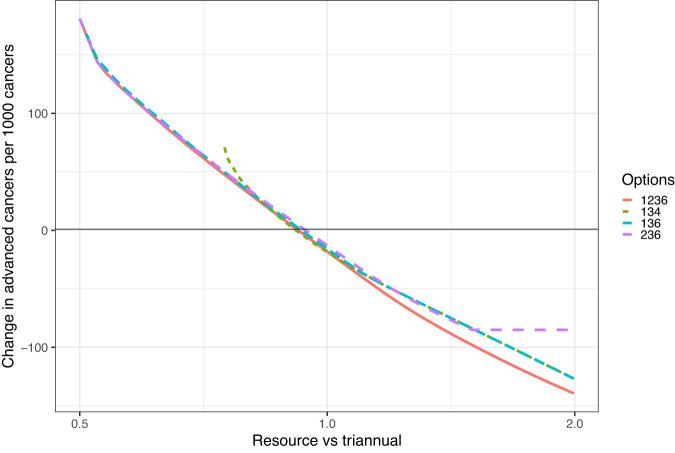
It is uncommon for risk groups defined by statistical or artificial intelligence (AI) models to be chosen by jointly considering model performance and potential interventions available. We develop a framework to rapidly guide choice of risk groups in this manner, and apply it to guide breast cancer screening intervals using an AI model. Linear programming is used to define risk groups that minimize expected advanced cancer incidence subject to resource constraints. In the application risk stratification performance is estimated from a case-control study (2044 cases, 1:1 matching), and other parameters are taken from screening trials and the screening programme in England. Under the model, re-screening in 1 year for the highest 4% AI model risk, in 3 years for the middle 64%, and in 4 years for 32% of the population at lowest risk, was expected to reduce the number of advanced cancers diagnosed by approximately 18 advanced cancers per 1000 diagnosed with triennial screening, for the same average number of screens in the population as triennial screening for all. Sensitivity analyses found the choice of thresholds was robust to model parameters, but the estimated reduction in advanced cancers was not precise and requires further evaluation. Our framework helps define thresholds with the greatest chance of success for reducing the population health burden of cancer when used in risk-adapted screening, which should be further evaluated such as in health-economic modelling based on computer simulation models, and real-world evaluations.
通过综合考虑模型性能和可用的潜在干预措施来选择由统计或人工智能(AI)模型定义的风险组并不常见。我们开发了一个框架,以这种方式快速指导风险组的选择,并将其应用于使用AI模型指导乳腺癌筛查间隔。线性规划用于定义在资源限制下使预期晚期癌症发病率最小化的风险组。在应用中,风险分层性能是根据一项病例对照研究(2044例病例,1:1匹配)估计的,其他参数取自筛查试验和英国的筛查计划。在该模型下,对于AI模型风险最高的4%人群,1年后重新筛查;对于中等风险的64%人群,3年后重新筛查;对于风险最低的32%人群,4年后重新筛查,预计与每三年进行一次筛查的人群平均筛查次数相同时,每1000例接受三年一次筛查诊断出的晚期癌症中,通过这种方式诊断出的晚期癌症数量将减少约18例。敏感性分析发现,阈值的选择对模型参数具有鲁棒性,但晚期癌症减少数量的估计并不精确,需要进一步评估。我们的框架有助于在用于风险适应性筛查时定义最有可能成功降低癌症人群健康负担的阈值,这应进一步评估,例如在基于计算机模拟模型的健康经济建模和实际评估中。



 Zotero 插件