Institute of Sociology, University of Bern, Bern, Switzerland.
PLoS One. 2023 Nov 29;18(11):e0294325. doi: 10.1371/journal.pone.0294325. eCollection 2023.
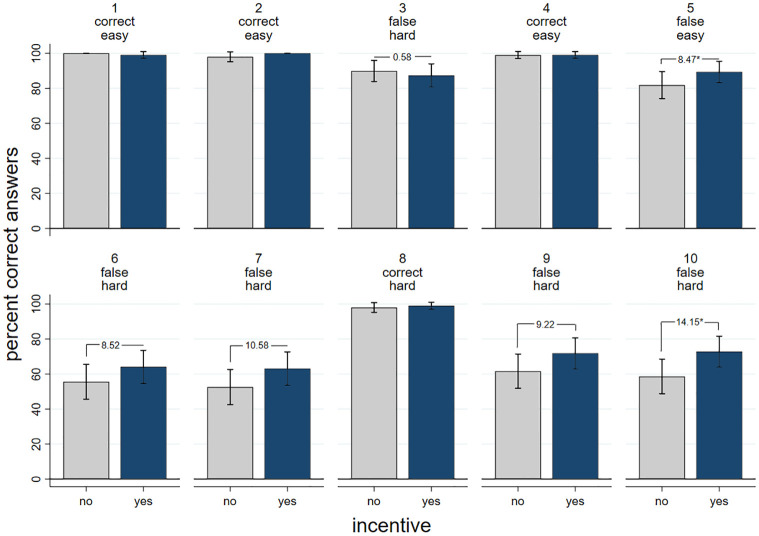
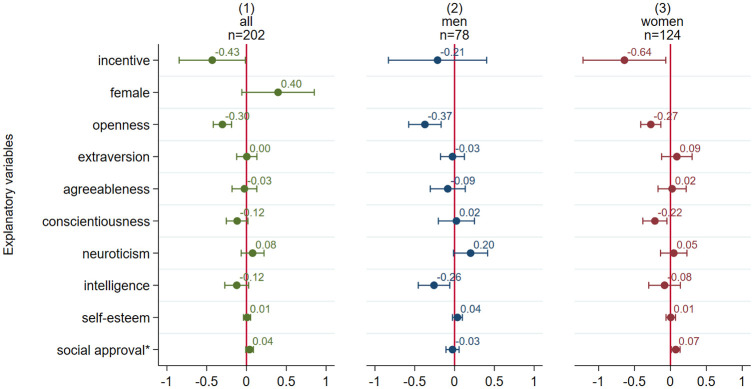
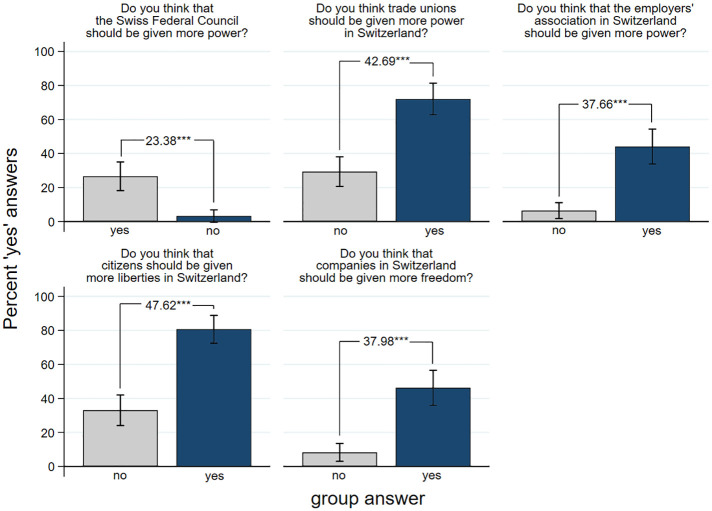
In this paper, we pursue four goals: First, we replicate the original Asch experiment with five confederates and one naïve subject in each group (N = 210). Second, in a randomized trial we incentivize the decisions in the line experiment and demonstrate that monetary incentives lower the error rate, but that social influence is still at work. Third, we confront subjects with different political statements and show that the power of social influence can be generalized to matters of political opinion. Finally, we investigate whether intelligence, self-esteem, the need for social approval, and the Big Five are related to the susceptibility to provide conforming answers. We find an error rate of 33% for the standard length-of-line experiment which replicates the original findings by Asch (1951, 1955, 1956). Furthermore, in the incentivized condition the error rate decreases to 25%. For political opinions we find a conformity rate of 38%. However, besides openness, none of the investigated personality traits are convincingly related to the susceptibility of group pressure.
在本文中,我们追求四个目标:首先,我们复制了原始的阿希实验,每组有五个同谋和一个天真的被试(N=210)。其次,在一项随机试验中,我们对连线实验中的决策进行了激励,并证明了金钱激励可以降低错误率,但社会影响仍然存在。第三,我们让被试面对不同的政治言论,并表明社会影响的力量可以推广到政治观点问题上。最后,我们调查了智力、自尊、对社会认可的需求以及大五人格特质是否与提供从众答案的易感性有关。我们发现,标准的线段长度实验的错误率为 33%,这复制了阿希(Asch)(1951、1955、1956)的原始发现。此外,在激励条件下,错误率下降到 25%。对于政治观点,我们发现从众率为 38%。然而,除了开放性,没有一个被调查的人格特质与群体压力的易感性有明显的关系。