Department of Nuclear Medicine, Seoul National University College of Medicine, Seoul, Republic of Korea.
Department of Nuclear Medicine, Seoul National University Hospital, Seoul, Republic of Korea.
Exp Mol Med. 2023 Dec;55(12):2564-2575. doi: 10.1038/s12276-023-01123-9. Epub 2023 Dec 1.
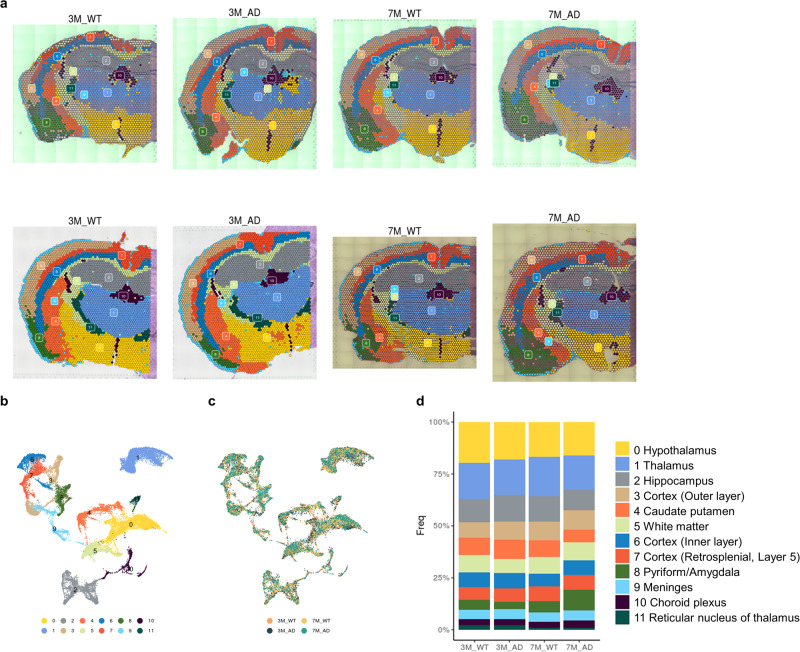
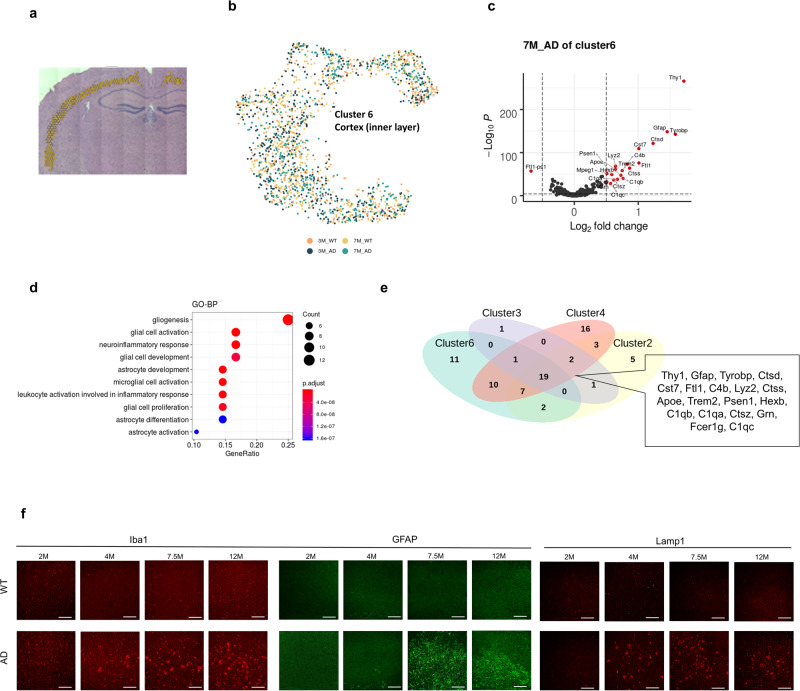
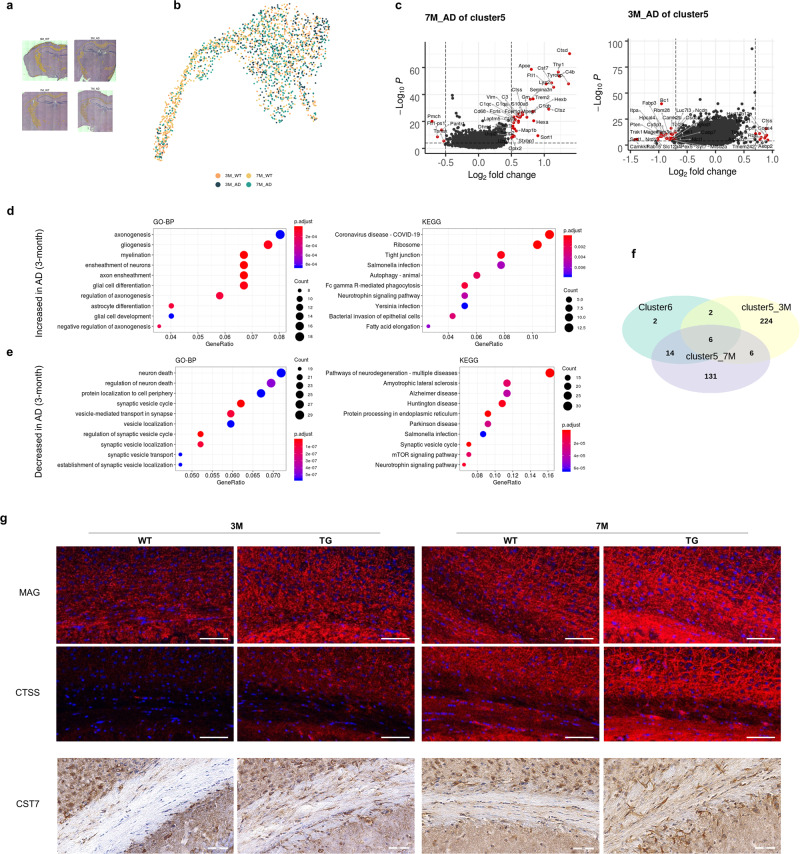
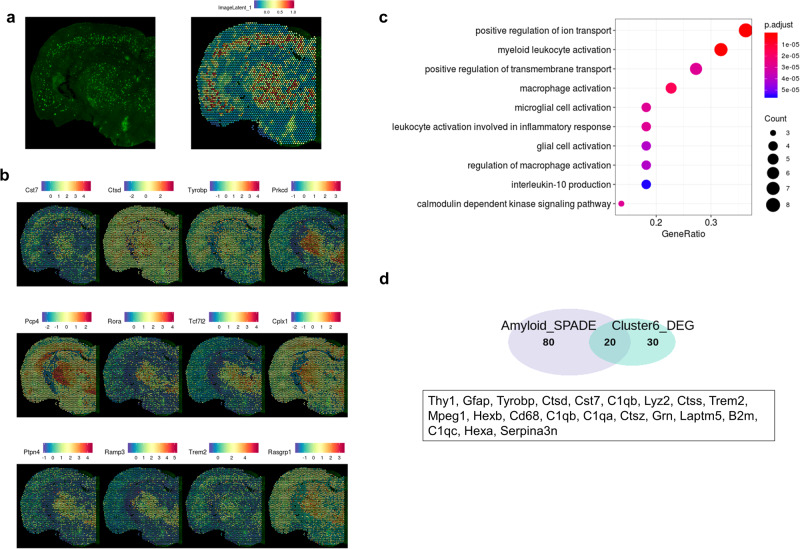
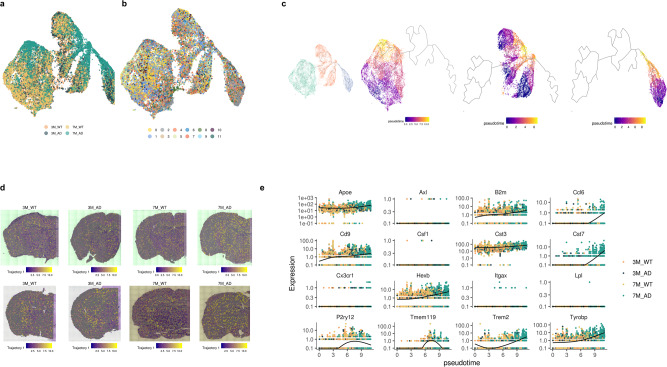
The molecular changes that occur with the progression of Alzheimer's disease (AD) are well known, but an understanding of the spatiotemporal heterogeneity of changes in the brain is lacking. Here, we investigated the spatially resolved transcriptome in a 5XFAD AD model at different ages to understand regional changes at the molecular level. Spatially resolved transcriptomic data were obtained from 5XFAD AD models and age-matched control mice. Differentially expressed genes were identified using spots clustered by anatomical structures. Gene signatures of activation of microglia and astrocytes were calculated and mapped on the spatially resolved transcriptomic data. We identified early alterations in the white matter (WM) of the AD model before the definite accumulation of amyloid plaques in the gray matter (GM). Changes in the early stage of the disease involved primarily glial cell activation in the WM, whereas the changes in the later stage of pathology were prominent in the GM. We confirmed that disease-associated microglia (DAM) and astrocyte (DAA) signatures also showed initial changes in WM and that activation spreads to GM. Trajectory inference using microglial gene sets revealed the subdivision of DAMs with different spatial patterns. Taken together, these results help to understand the spatiotemporal changes associated with reactive glial cells as a major pathophysiological characteristic of AD. The heterogeneous spatial molecular changes apply to identifying diagnostic and therapeutic targets caused by amyloid accumulation in AD.
阿尔茨海默病(AD)进展过程中发生的分子变化众所周知,但对大脑变化的时空异质性的理解却很缺乏。在这里,我们在不同年龄的 5XFAD AD 模型中研究了空间分辨转录组,以了解分子水平上的区域变化。通过解剖结构聚类的斑点获得了空间分辨转录组数据。使用 spots 聚类的方法识别差异表达基因。计算了小胶质细胞和星形胶质细胞激活的基因特征,并将其映射到空间分辨转录组数据上。我们在灰质(GM)中明确出现淀粉样斑块积累之前,在 AD 模型的白质(WM)中发现了早期改变。疾病早期的变化主要涉及 WM 中的神经胶质细胞激活,而在病理学后期的变化则在 GM 中明显。我们证实,与疾病相关的小胶质细胞(DAM)和星形胶质细胞(DAA)特征也在 WM 中显示出最初的变化,并且激活扩散到 GM。使用小胶质细胞基因集进行轨迹推理揭示了具有不同空间模式的 DAM 的细分。总之,这些结果有助于理解与反应性神经胶质细胞相关的时空变化,这是 AD 的主要病理生理特征。这种异质的空间分子变化适用于识别 AD 中由淀粉样蛋白积累引起的诊断和治疗靶点。