Institute of Oceanography (IO), Hellenic Centre for Marine Research (HCMR), Anavyssos, Greece.
Institute of Marine Biology, Biotechnology and Aquaculture (IMBBC), Hellenic Centre for Marine Research (HCMR), Heraklion, Crete, Greece.
PeerJ. 2023 Nov 29;11:e16491. doi: 10.7717/peerj.16491. eCollection 2023.
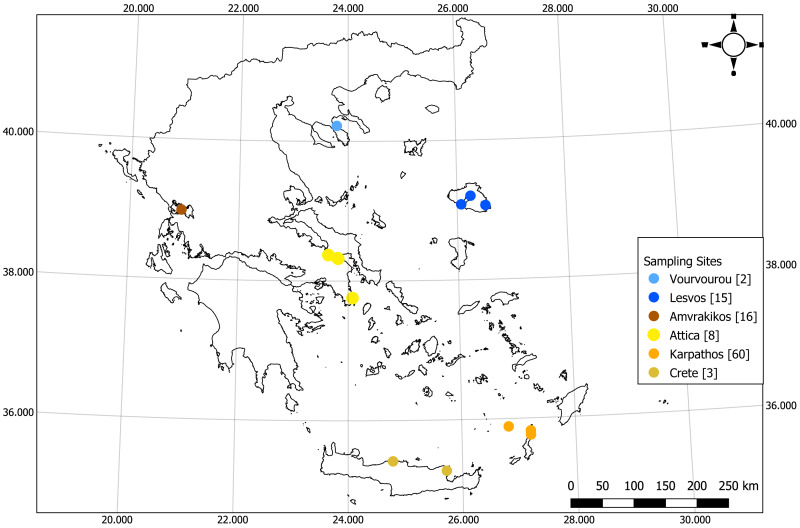
The fan mussel Linnaeus, 1758 is an endemic species of the Mediterranean Sea, protected by international agreements. It is one of the largest bivalves in the world, playing an important role in the benthic communities; yet it has been recently characterized as Critically Endangered by the IUCN, due to mass mortality events. In this context, the assessment of the genetic variation of the remaining populations and the evaluation of connectivity among them are crucial elements for the conservation of the species. For this purpose, samples were collected from six regions of the Eastern Mediterranean Sea; the Islands of Karpathos, Lesvos and Crete; the Chalkidiki and Attica Peninsulas; and the Amvrakikos Gulf. Sampling was performed either by collecting tissue from the individuals or by using a non-invasive method, , by scraping the inside of their shells aiming to collect their mucus and thus avoid stress induction to them. Conventional molecular techniques with the use of the COI and 16S rRNA mitochondrial markers were selected for the depiction of the intra-population genetic variability. The analyses included 104 samples from the present study and publicly available sequences of individuals across the whole Mediterranean Sea. The results of this work (a) suggest the use of eDNA as an efficient sampling method for protected bivalves and (b) shed light to the genetic structure of population in the Eastern Mediterranean; this latter knowledge might prove to be fundamental for the species conservation and hence the ecosystem resilience. The haplotype analyses reinforced the evidence that there is a certain degree of connectivity among the distinct regions of the Mediterranean; yet there is evidence of population distinction within the basin, namely between the Western and the Eastern basins. The combination of both genetic markers in the same analysis along with the inclusion of a large number of individuals produced more robust results, revealing a group of haplotypes being present only in the Eastern Mediterranean and providing insights for the species' most suitable conservation management.
贻贝 (Linnaeus, 1758)是地中海特有的物种,受到国际协议的保护。它是世界上最大的双壳类动物之一,在海底群落中发挥着重要作用;然而,由于大规模死亡事件,它最近被 IUCN 列为极危物种。在这种情况下,评估剩余种群的遗传变异和评估它们之间的连通性对于保护该物种至关重要。为此,从东地中海的六个地区采集了样本;卡帕多西亚岛、莱斯沃斯岛和克里特岛;哈尔基季基半岛和阿提卡半岛;以及阿莫尔戈斯湾。采样是通过从个体中采集组织或使用非侵入性方法完成的,通过刮擦贝壳内部收集它们的黏液,从而避免对它们产生应激诱导。选择使用 COI 和 16S rRNA 线粒体标记物的常规分子技术来描绘种群内的遗传变异性。分析包括来自本研究的 104 个样本和整个地中海地区个体的公开序列。这项工作的结果(a)表明 eDNA 可作为保护双壳类动物的有效采样方法;(b)揭示了东地中海种群的遗传结构;后者的知识对于物种保护和生态系统恢复可能是至关重要的。单倍型分析加强了证据,表明地中海不同地区之间存在一定程度的连通性;然而,在盆地内存在种群差异,即西部和东部盆地之间。在同一分析中结合两种遗传标记并纳入大量个体产生了更可靠的结果,揭示了一组仅存在于东地中海的单倍型,并为该物种最适宜的保护管理提供了见解。