Department of Anatomy, University of Otago, 270 Great King Street, Dunedin, Otago 9016, New Zealand.
Trace and Environmental DNA (TrEnD) Laboratory, School of Molecular and Life Sciences, Curtin University, Bentley, Perth, WA 6102, Australia.
Genes (Basel). 2019 Mar 1;10(3):192. doi: 10.3390/genes10030192.
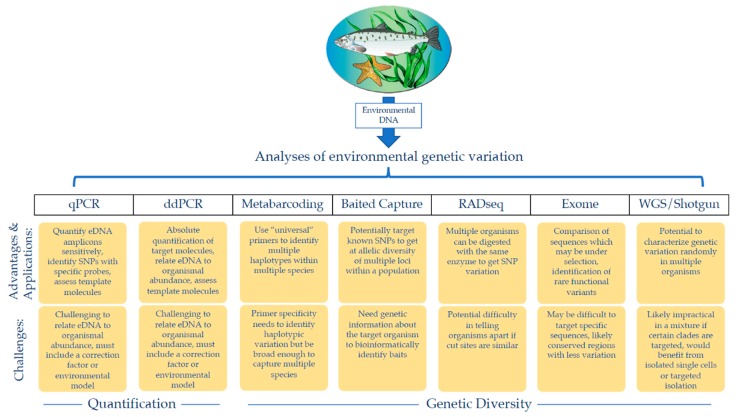
Population genetic data underpin many studies of behavioral, ecological, and evolutionary processes in wild populations and contribute to effective conservation management. However, collecting genetic samples can be challenging when working with endangered, invasive, or cryptic species. Environmental DNA (eDNA) offers a way to sample genetic material non-invasively without requiring visual observation. While eDNA has been trialed extensively as a biodiversity and biosecurity monitoring tool with a strong taxonomic focus, it has yet to be fully explored as a means for obtaining population genetic information. Here, we review current research that employs eDNA approaches for the study of populations. We outline challenges facing eDNA-based population genetic methodologies, and suggest avenues of research for future developments. We advocate that with further optimizations, this emergent field holds great potential as part of the population genetics toolkit.
群体遗传数据为研究野外种群的行为、生态和进化过程提供了基础,并有助于进行有效的保护管理。然而,在研究濒危、入侵或隐匿物种时,采集遗传样本可能具有挑战性。环境 DNA(eDNA)提供了一种无需进行视觉观察即可非侵入性地采集遗传物质的方法。尽管 eDNA 已被广泛试用作为具有强烈分类学重点的生物多样性和生物安保监测工具,但它作为获取群体遗传信息的手段尚未得到充分探索。在这里,我们回顾了目前使用 eDNA 方法研究种群的研究。我们概述了基于 eDNA 的群体遗传方法学所面临的挑战,并为未来的发展提出了研究途径。我们主张,通过进一步优化,这个新兴领域有可能成为群体遗传学工具包的一部分。