Department of Social and Behavioral Sciences, School of Global Public Health, New York University, New York, NY, USA.
Department of Psychiatry, University of Massachusetts Chan Medical School, Worcester, MA, USA.
Prev Sci. 2024 Jul;25(Suppl 3):397-406. doi: 10.1007/s11121-023-01613-2. Epub 2023 Dec 4.
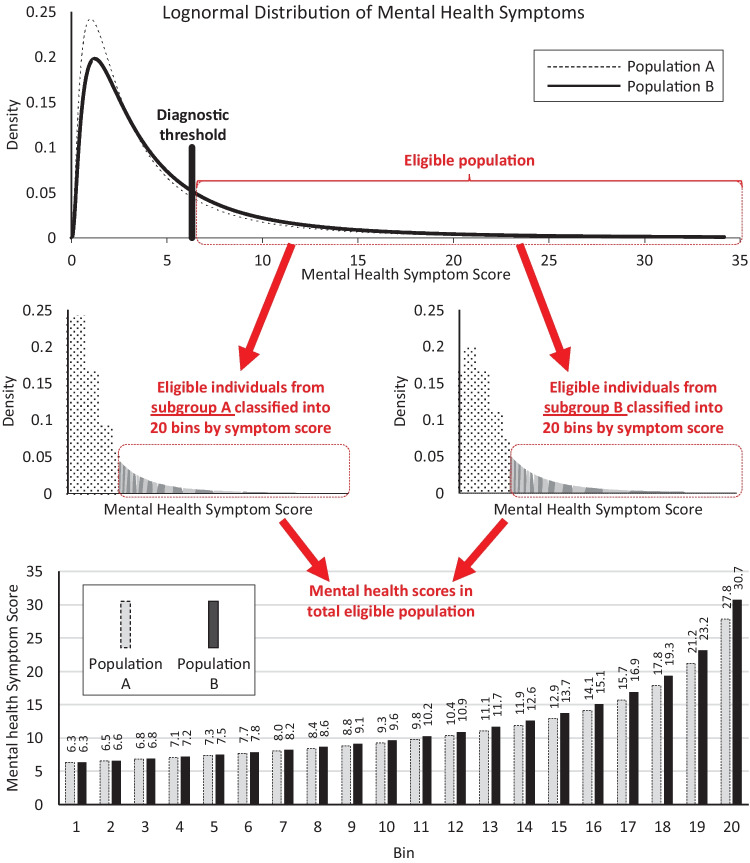
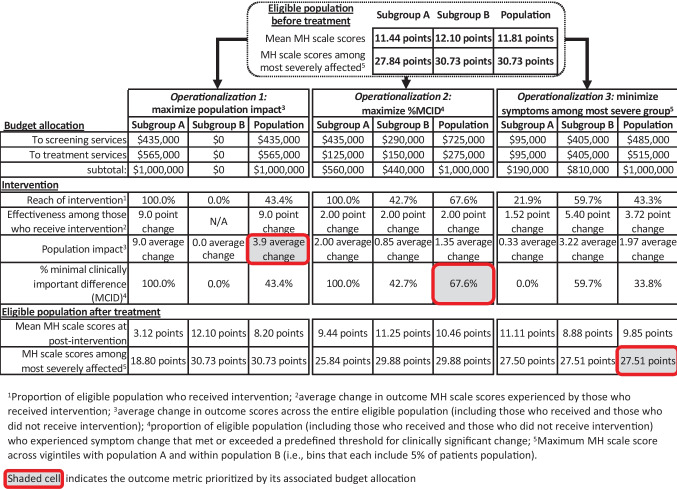
When intervention scientists plan a clinical trial of an intervention, they select an outcome metric that operationalizes their definition of intervention success. The outcome metric that is selected has important implications for which interventions are eventually supported for implementation at scale and, therefore, what health benefits (including how much benefit and for whom) are experienced in a population. Particularly when an intervention is to be implemented in a population that experiences a health disparity, the outcome metric that is selected can also have implications for equity. Some outcome metrics risk exacerbating an existing health disparity, while others may decrease disparities for some but have less effect for the larger population. In this study, we use a computer to simulate implementation of a hypothetical multilevel, multicomponent intervention to highlight the tradeoffs that can occur between outcome metrics that reflect different operationalizations of intervention success. In particular, we highlight tradeoffs between overall mean population benefit and the distribution of health benefits in the population, which has direct implications for equity. We suggest that simulations like the one we present can be useful in the planning of a clinical trial for a multilevel and/or multicomponent intervention, since simulated implementation at scale can illustrate potential consequences of candidate operationalization of intervention success, such that unintended consequences for equity can be avoided.
当干预科学家计划一项干预措施的临床试验时,他们会选择一个能够实现干预成功定义的结果指标。所选的结果指标对最终支持大规模实施的干预措施具有重要影响,因此对人群中获得的健康效益(包括受益多少和惠及哪些人群)有重要影响。特别是当干预措施要在存在健康差异的人群中实施时,所选的结果指标也可能对公平性产生影响。一些结果指标可能会加剧现有的健康差异,而另一些指标可能会减少某些人群的差异,但对更大的人群影响较小。在这项研究中,我们使用计算机模拟实施一个假设的多层次、多成分干预措施,以突出反映干预成功不同操作化的结果指标之间可能出现的权衡。特别是,我们强调了反映总体人群受益的结果指标和人群中健康效益分布之间的权衡,这对公平性有直接影响。我们建议,像我们提出的这种模拟可以用于规划多层次和/或多成分干预措施的临床试验,因为在大规模实施中的模拟可以说明干预成功候选操作化的潜在后果,从而避免对公平性产生意外后果。