Yang Yanying, He Mei, Yang Yuwei, Liu Qiong, Liu Hongmei, Chen Xi, Wu Wanchen, Yang Jing
Nursing Department, Mianyang Central Hospital, School of Medicine, University of Electronic Science and Technology of China, Mianyang, 621000, People's Republic of China.
Department of Laboratory Medicine, Mianyang Central Hospital, School of Medicine, University of Electronic Science and Technology of China, Mianyang, 621000, People's Republic of China.
BMC Nurs. 2023 Dec 6;22(1):466. doi: 10.1186/s12912-023-01632-y.
The case mix index (CMI) may reflect the severity of disease and the difficulty of care objectively, and is expected to be an ideal indicator for assessing the nursing workload. The purpose of this study was to explore the quantitative relationship between daily nursing worktime (DNW) and CMI to provide a method for the rational allocation of nursing human resources.
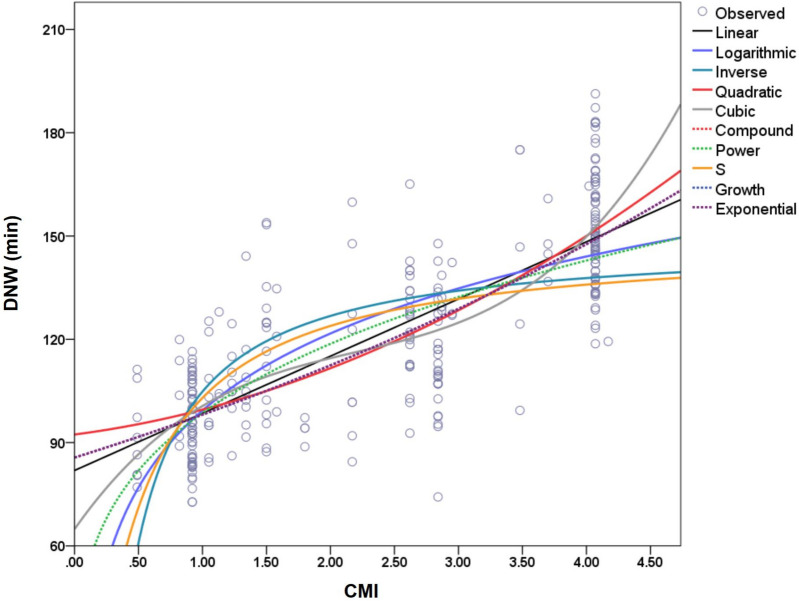
Two hundred and seventy-one inpatients and 36 nurses of the department of hepatobiliary surgery were prospectively included consecutively from August to September 2022. The DNW of each patient were accurately measured, and the CMI data of each patient were extracted. Among 10 curve estimations, the optimal quantitative model was selected for constructing the nursing human resource allocation model. Finally, the applicability of the allocation model was preliminarily assessed by analyzing the relationship between the relative gap in nursing human resources and patient satisfaction, as well as the incidence of adverse events in 17 clinical departments.
The median (P25, P75) CMI of the 271 inpatients was 2.62 (0.92, 4.07), which varied by disease type (F = 3028.456, P < 0.001), but not by patient gender (F = 0.481, P = 0.488), age (F = 2.922, P = 0.089), or level of care (F = 0.096, P = 0.757). The median (P25, P75) direct and indirect DNW were 76.07 (57.98, 98.85) min and 43.42 (39.42, 46.72) min, respectively. Among the 10 bivariate models, the quadratic model established the optimal quantitative relationship between CMI and DNW; DNW = 92.3 + 4.8CMI + 2.4CMI (R = 0.627, F = 225.1, p < 0.001). The relative gap between theoretical and actual nurse staffing in the 17 clinical departments were linearly associated with both patient satisfaction (r = 0.653, P = 0.006) and incidence of adverse events (r = - 0.567, P = 0.021). However, after adjusting for other factors, it was partially correlated only with patient satisfaction (r = 0.636, P = 0.026).
The DNW derived from CMI can be used to allocate nursing human resources in a rational and convenient way, improving patient satisfaction while ensuring quality and safety.
病例组合指数(CMI)可客观反映疾病严重程度和护理难度,有望成为评估护理工作量的理想指标。本研究旨在探讨每日护理工作时间(DNW)与CMI之间的定量关系,为合理配置护理人力资源提供方法。
2022年8月至9月前瞻性连续纳入271例住院患者和36名肝胆外科护士。准确测量每位患者的DNW,并提取每位患者的CMI数据。在10种曲线估计中,选择最佳定量模型构建护理人力资源配置模型。最后,通过分析17个临床科室护理人力资源相对差距与患者满意度以及不良事件发生率之间的关系,初步评估配置模型的适用性。
271例住院患者的CMI中位数(P25,P75)为2.62(0.92,4.07),因疾病类型而异(F = 3028.456,P < 0.001),但不因患者性别(F = 0.481,P = 0.488)、年龄(F = 2.922,P = 0.089)或护理级别(F = 0.096,P = 0.757)而异。直接和间接DNW的中位数(P25,P75)分别为76.07(57.98,98.85)分钟和43.42(39.42,46.72)分钟。在10种双变量模型中,二次模型建立了CMI与DNW之间的最佳定量关系;DNW = 92.3 + 4.8CMI + 2.4CMI(R = 0.627,F = 225.1,p < 0.001)。17个临床科室理论与实际护士配备的相对差距与患者满意度(r = 0.653,P = 0.006)和不良事件发生率(r = -0.567,P = 0.021)均呈线性相关。然而,在调整其他因素后,仅与患者满意度部分相关(r = 0.636,P = 0.026)。
由CMI得出的DNW可用于合理便捷地配置护理人力资源,在保证质量和安全的同时提高患者满意度。