Ann Am Thorac Soc. 2024 Feb;21(2):187-199. doi: 10.1513/AnnalsATS.202310-925ST.
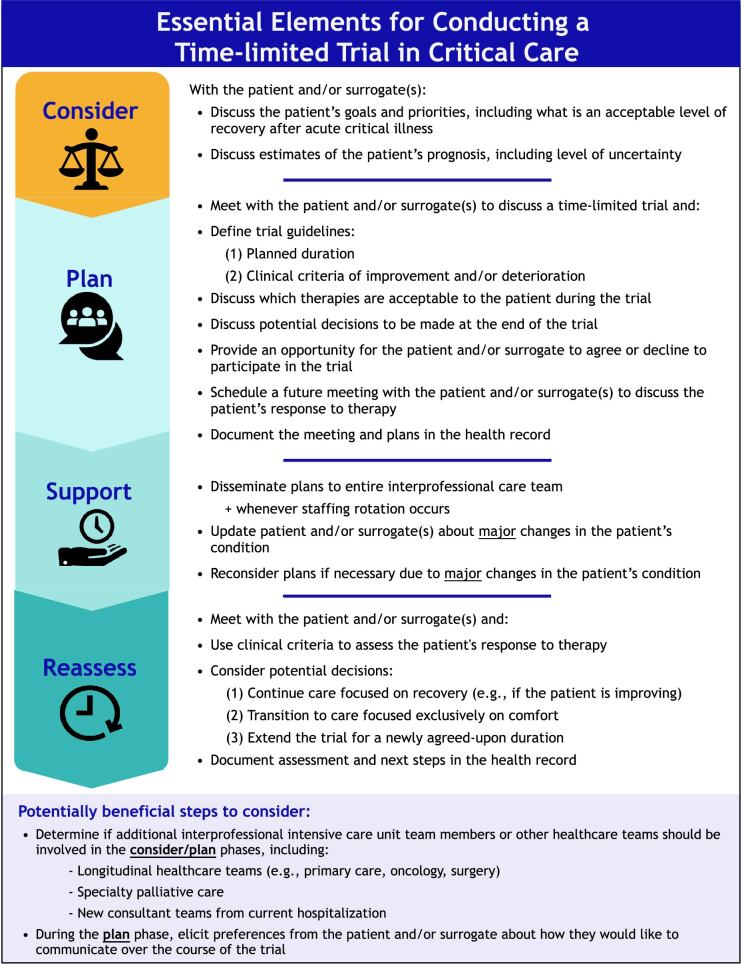
In critical care, the specific, structured approach to patient care known as a "time-limited trial" has been promoted in the literature to help patients, surrogate decision makers, and clinicians navigate consequential decisions about life-sustaining therapy in the face of uncertainty. Despite promotion of the time-limited trial approach, a lack of consensus about its definition and essential elements prevents optimal clinical use and rigorous evaluation of its impact. The objectives of this American Thoracic Society Workshop Committee were to establish a consensus definition of a time-limited trial in critical care, identify the essential elements for conducting a time-limited trial, and prioritize directions for future work. We achieved these objectives through a structured search of the literature, a modified Delphi process with 100 interdisciplinary and interprofessional stakeholders, and iterative committee discussions. We conclude that a time-limited trial for patients with critical illness is a collaborative plan among clinicians and a patient and/or their surrogate decision makers to use life-sustaining therapy for a defined duration, after which the patient's response to therapy informs the decision to continue care directed toward recovery, transition to care focused exclusively on comfort, or extend the trial's duration. The plan's 16 essential elements follow four sequential phases: consider, plan, support, and reassess. We acknowledge considerable gaps in evidence about the impact of time-limited trials and highlight a concern that if inadequately implemented, time-limited trials may perpetuate unintended harm. Future work is needed to better implement this defined, specific approach to care in practice through a person-centered equity lens and to evaluate its impact on patients, surrogates, and clinicians.
在重症监护中,一种被称为“限时试验”的针对患者护理的特定、结构化方法已在文献中得到推广,以帮助患者、替代决策人以及临床医生在面对不确定的情况下,就维持生命的治疗做出重大决策。尽管限时试验方法得到了推广,但由于缺乏对其定义和基本要素的共识,妨碍了其在临床中的最佳应用和对其影响的严格评估。美国胸科学会工作组的目标是为重症监护中的限时试验建立一个共识定义,确定进行限时试验的基本要素,并为未来的工作确定优先方向。我们通过对文献进行系统搜索、对 100 名跨学科和跨专业利益相关者进行修改后的 Delphi 流程以及迭代委员会讨论来实现这些目标。我们的结论是,对于患有危重病的患者,限时试验是临床医生与患者和/或其替代决策人之间的一项协作计划,用于在规定的时间内使用维持生命的治疗,在此之后,患者对治疗的反应将决定继续进行以恢复为目标的护理、过渡到仅关注舒适的护理,或延长试验的持续时间。该计划的 16 个基本要素遵循四个连续阶段:考虑、计划、支持和重新评估。我们承认关于限时试验影响的证据存在很大差距,并强调关注如果实施不当,限时试验可能会造成不必要的伤害。需要进一步的工作来通过以患者为中心的公平视角更好地将这种定义明确、具体的护理方法付诸实践,并评估其对患者、替代决策人和临床医生的影响。