Dhakal Santosh, Park Han-Sol, Seddu Kumba, Lee John, Creisher Patrick S, Davis Kimberly M, Hernandez Isabella R, Maul Robert W, Klein Sabra L
W. Harry Feinstone Department of Molecular Microbiology and Immunology, Johns Hopkins Bloomberg School of Public Health, Baltimore, Maryland, USA.
Laboratory of Molecular Biology and Immunology, National Institute on Aging, National Institutes of Health, Baltimore, Maryland, USA.
bioRxiv. 2023 Nov 27:2023.11.27.568847. doi: 10.1101/2023.11.27.568847.
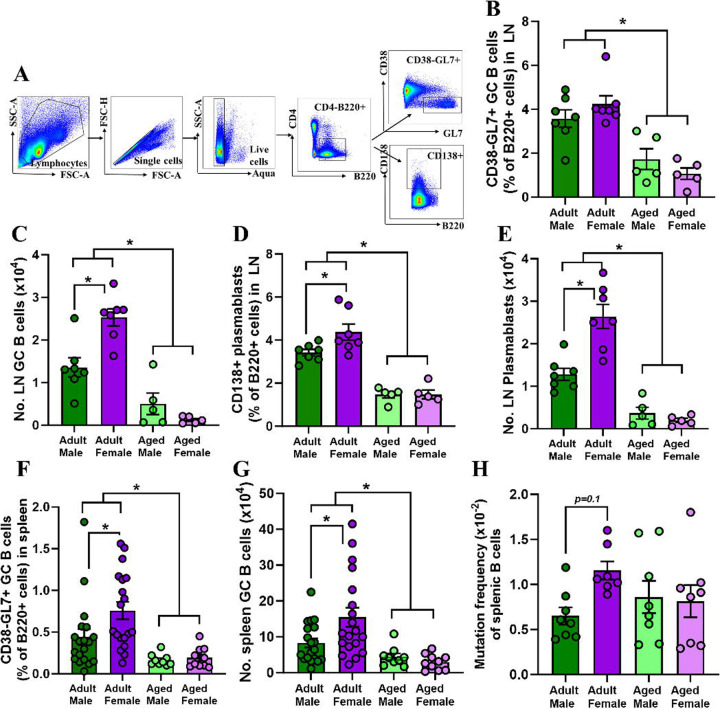
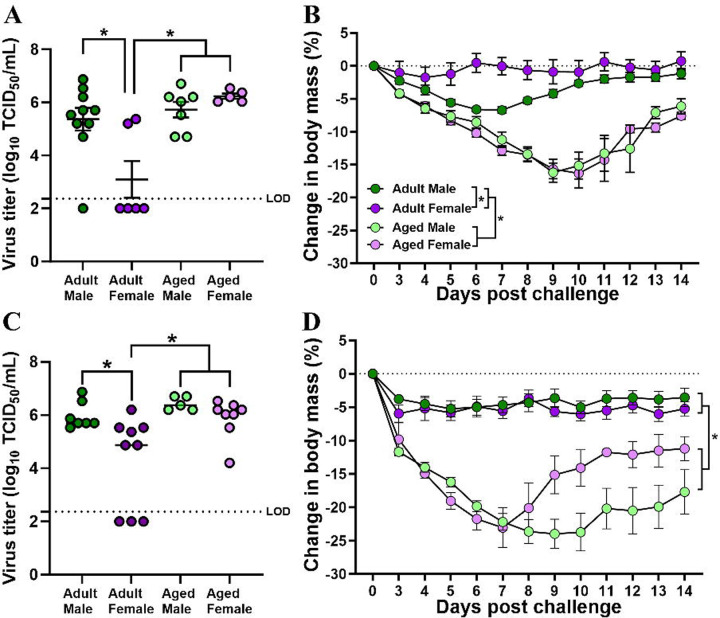
Adult females of reproductive ages develop greater antibody responses to inactivated influenza vaccine (IIV) than males. How sex, age, and sex steroid changes impact B cells and durability of IIV-induced immunity and protection over 4-months post-vaccination (mpv) was analyzed. Vaccinated adult females had greater germinal center (GC) B cell and plasmablast frequencies in lymphoid tissues, higher neutralizing antibody responses 1-4 mpv, and better protection against live H1N1 challenge than adult males. Aged mice, regardless of sex, had reduced B cell frequencies, less durable antibody responses, and inferior protection after challenge than adult mice, which correlated with diminished estradiol among aged females. To confirm that greater IIV-induced immunity was caused by sex hormones, four core genotype (FCG) mice were used, in which the testes determining gene, , was deleted from ChrY and transferred to Chr3, to separate gonadal sex (i.e., ovaries or testes) from sex chromosome complement (i.e., XX or XY complement). Vaccinated, gonadal female FCG mice (XXF and XYF) had greater numbers of B cells, higher antiviral antibody titers, and reduced pulmonary virus titers following live H1N1 challenge than gonadal FCG males (XYM and XXM). To establish that lower estradiol concentrations cause diminished immunity, adult and aged females received either a placebo or estradiol replacement therapy prior to IIV. Estradiol replacement significantly increased IIV-induced antibody responses and reduced morbidity after the H1N1 challenge among aged females. These data highlight that estradiol is a targetable mechanism mediating greater humoral immunity following vaccination among adult females.
育龄成年女性对灭活流感疫苗(IIV)产生的抗体反应比男性更强。分析了性别、年龄和性类固醇变化如何影响B细胞以及IIV诱导的免疫的持久性和接种疫苗后4个月(mpv)的保护作用。接种疫苗的成年女性在淋巴组织中的生发中心(GC)B细胞和浆母细胞频率更高,在1-4 mpv时具有更高的中和抗体反应,并且比成年男性对活H1N1攻击具有更好的保护作用。与成年小鼠相比,老年小鼠无论性别如何,B细胞频率均降低,抗体反应持久性较差,攻击后保护作用较差,这与老年雌性小鼠中雌二醇减少有关。为了证实更强的IIV诱导的免疫是由性激素引起的,使用了四核心基因型(FCG)小鼠,其中决定睾丸的基因从Y染色体删除并转移到3号染色体,以将性腺性别(即卵巢或睾丸)与性染色体组成(即XX或XY组成)分开。接种疫苗的性腺雌性FCG小鼠(XXF和XYF)比性腺FCG雄性小鼠(XYM和XXM)具有更多的B细胞、更高的抗病毒抗体滴度,并且在活H1N1攻击后肺部病毒滴度降低。为了确定较低的雌二醇浓度会导致免疫力下降,成年和老年雌性小鼠在接种IIV之前接受了安慰剂或雌二醇替代疗法。雌二醇替代疗法显著增加了IIV诱导的抗体反应,并降低了老年雌性小鼠在H1N1攻击后的发病率。这些数据表明,雌二醇是介导成年女性接种疫苗后更强体液免疫的一种可靶向机制。