• 文献检索
  • 文档翻译
  • 深度研究
  • 学术资讯
  • Suppr Zotero 插件Zotero 插件
  • 邀请有礼
  • 套餐&价格
  • 历史记录
应用&插件
Suppr Zotero 插件Zotero 插件浏览器插件Mac 客户端Windows 客户端微信小程序
定价
高级版会员购买积分包购买API积分包
服务
文献检索文档翻译深度研究API 文档MCP 服务
关于我们
关于 Suppr公司介绍联系我们用户协议隐私条款
关注我们

Suppr 超能文献

核心技术专利:CN118964589B侵权必究
粤ICP备2023148730 号-1Suppr @ 2026

文献检索

告别复杂PubMed语法,用中文像聊天一样搜索,搜遍4000万医学文献。AI智能推荐,让科研检索更轻松。

立即免费搜索

文件翻译

保留排版,准确专业,支持PDF/Word/PPT等文件格式,支持 12+语言互译。

免费翻译文档

深度研究

AI帮你快速写综述,25分钟生成高质量综述,智能提取关键信息,辅助科研写作。

立即免费体验

急诊住院医师的神经恐惧症。

Neurophobia among resident physicians in the emergency service.

机构信息

Universidad de Zaragoza, 50013 Zaragoza, España.

Hospital Universitari Arnau de Vilanova , Lleida, España.

出版信息

Rev Neurol. 2023 Dec 16;77(12):285-291. doi: 10.33588/rn.7712.2023249.

DOI:10.33588/rn.7712.2023249
PMID:38095052
原文链接:https://pmc.ncbi.nlm.nih.gov/articles/PMC10831740/
Abstract

INTRODUCTION

Neurophobia is defined as the fear towards clinical neurology caused by the inability to apply theoretical knowledge to practical clinical situations. This phenomenon is not restricted to medical students and has never been studied before in the Emergency Department. We aimed to study how resident doctors perceive their knowledge in neurology and urgent neurological conditions as well as possible causes for said fears.

MATERIALS AND METHODS

Cross-sectional multicentric study using self-administered surveys sent to medical residents within the Aragon Health Service. They were questioned about their fear of neurology and other medical specialties, possible causes, and perception of knowledge in neurological pathologies and subareas in the emergency service.

RESULTS

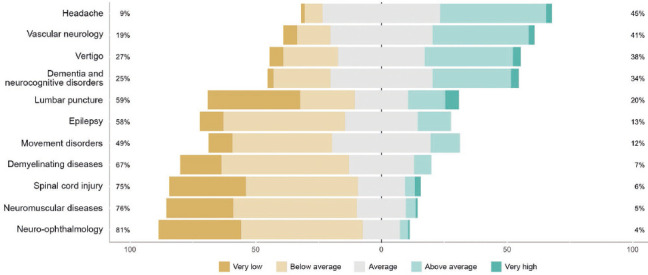
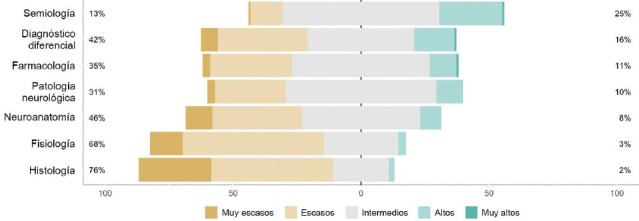
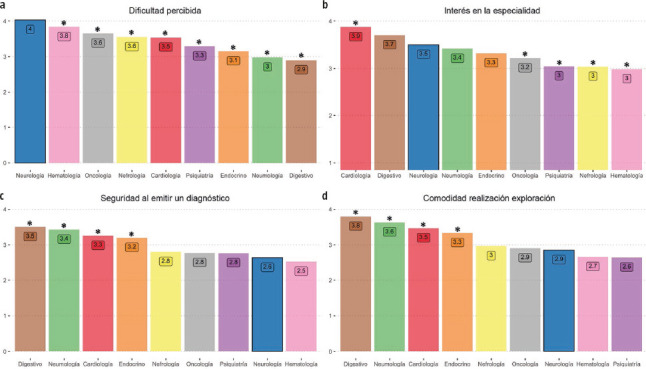
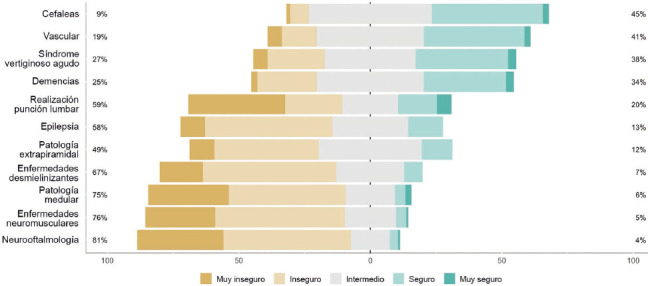
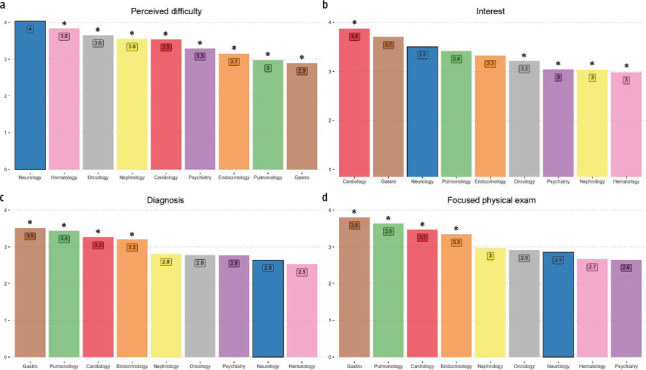
We obtained 134 responses. 27.6% (37) suffered from neurophobia. Despite neurology being considered the most difficult discipline, it did also arouse the third most interest among the students. The areas where they showed the most confidence were headaches and vascular pathology. The areas where they felt the most insecure were neuromuscular diseases, neuro-ophthalmology, and spinal cord injury. In none of the areas surveyed, the percentage of respondents who felt secure exceeded 50%.

CONCLUSIONS

Neurophobia is prevalent among trainee doctors working in the emergency department. Their confidence correlates with the degree of exposure to patients. Neurologist must play an active role in the education of new specialist and promote the collaboration with emergency departments.

摘要

简介

神经恐惧症是指由于无法将理论知识应用于实际临床情况而对临床神经病学产生的恐惧。这种现象不仅限于医学生,以前在急诊科也从未研究过。我们旨在研究住院医师如何看待他们在神经病学和紧急神经状况方面的知识,以及导致这种恐惧的可能原因。

材料和方法

这是一项使用自我管理的问卷调查在阿拉贡卫生服务中心内对住院医师进行的横断面多中心研究。他们被问到对神经病学和其他医学专业的恐惧、可能的原因,以及对在急诊服务中神经病理学和亚领域的知识的看法。

结果

我们共获得了 134 份回复。27.6%(37 人)患有神经恐惧症。尽管神经病学被认为是最难的学科,但它也是学生中最感兴趣的第三大科目。他们最自信的领域是头痛和血管病理学。他们最不自信的领域是神经肌肉疾病、神经眼科和脊髓损伤。在调查的所有领域,感到安全的受访者比例都没有超过 50%。

结论

在急诊科工作的实习医生中普遍存在神经恐惧症。他们的信心与接触患者的程度相关。神经科医生必须在新专家的教育中发挥积极作用,并促进与急诊科的合作。
https://cdn.ncbi.nlm.nih.gov/pmc/blobs/e474/10831740/482d162ef2a0/RN-77-285en-g004.jpg
https://cdn.ncbi.nlm.nih.gov/pmc/blobs/e474/10831740/bff0bb7a8af4/RN-77-285-g001.jpg
https://cdn.ncbi.nlm.nih.gov/pmc/blobs/e474/10831740/2ca563fb7aee/RN-77-285-g002.jpg
https://cdn.ncbi.nlm.nih.gov/pmc/blobs/e474/10831740/14a0b597aef2/RN-77-285-g003.jpg
https://cdn.ncbi.nlm.nih.gov/pmc/blobs/e474/10831740/a3a28a0e58ce/RN-77-285-g004.jpg
https://cdn.ncbi.nlm.nih.gov/pmc/blobs/e474/10831740/55fd93a6640e/RN-77-285en-g001.jpg
https://cdn.ncbi.nlm.nih.gov/pmc/blobs/e474/10831740/71178e43067a/RN-77-285en-g002.jpg
https://cdn.ncbi.nlm.nih.gov/pmc/blobs/e474/10831740/a0b05e8b8c84/RN-77-285en-g003.jpg
https://cdn.ncbi.nlm.nih.gov/pmc/blobs/e474/10831740/482d162ef2a0/RN-77-285en-g004.jpg
https://cdn.ncbi.nlm.nih.gov/pmc/blobs/e474/10831740/bff0bb7a8af4/RN-77-285-g001.jpg
https://cdn.ncbi.nlm.nih.gov/pmc/blobs/e474/10831740/2ca563fb7aee/RN-77-285-g002.jpg
https://cdn.ncbi.nlm.nih.gov/pmc/blobs/e474/10831740/14a0b597aef2/RN-77-285-g003.jpg
https://cdn.ncbi.nlm.nih.gov/pmc/blobs/e474/10831740/a3a28a0e58ce/RN-77-285-g004.jpg
https://cdn.ncbi.nlm.nih.gov/pmc/blobs/e474/10831740/55fd93a6640e/RN-77-285en-g001.jpg
https://cdn.ncbi.nlm.nih.gov/pmc/blobs/e474/10831740/71178e43067a/RN-77-285en-g002.jpg
https://cdn.ncbi.nlm.nih.gov/pmc/blobs/e474/10831740/a0b05e8b8c84/RN-77-285en-g003.jpg
https://cdn.ncbi.nlm.nih.gov/pmc/blobs/e474/10831740/482d162ef2a0/RN-77-285en-g004.jpg

相似文献

1
Neurophobia among resident physicians in the emergency service.急诊住院医师的神经恐惧症。
Rev Neurol. 2023 Dec 16;77(12):285-291. doi: 10.33588/rn.7712.2023249.
2
Neurophobia among undergraduate medical students: a European experience beyond the Anglosphere.医学生中的神经恐惧症:超越英语国家的欧洲经验。
Rev Neurol. 2023 Jun 1;76(11):351-359. doi: 10.33588/rn.7611.2023102.
3
Neurophobia among medical students and resident trainees in a tertiary comprehensive hospital in China.中国一家三级综合医院的医学生和住院医师中的神经恐惧症。
BMC Med Educ. 2023 Nov 2;23(1):824. doi: 10.1186/s12909-023-04812-1.
4
Neurophobia among medical students and non-specialist doctors in Sri Lanka.斯里兰卡医学生和非专科医生的神经恐惧症。
BMC Med Educ. 2013 Dec 9;13:164. doi: 10.1186/1472-6920-13-164.
5
Neurophobia in medical students and junior doctors--blame the GIK.医学生和低年资医生中的神经恐惧症——归咎于极化液疗法(GIK)。
Ann Acad Med Singap. 2013 Nov;42(11):559-66.
6
Perception of neurology among undergraduate medical students - what can be done to counter neurophobia during clinical studies?医学生对神经病学的认知 - 在临床研究中如何克服神经恐惧症?
BMC Med Educ. 2023 Jun 16;23(1):447. doi: 10.1186/s12909-023-04405-y.
7
Attitudes of US medical trainees towards neurology education: "Neurophobia" - a global issue.美国医学实习生对神经病学教育的态度:“神经恐惧症”-一个全球性问题。
BMC Med Educ. 2010 Jun 23;10:49. doi: 10.1186/1472-6920-10-49.
8
Neurophobia in Africa: Survey responses from fifteen African countries.非洲的神经恐惧症:来自 15 个非洲国家的调查回应。
J Neurol Sci. 2022 Mar 15;434:120161. doi: 10.1016/j.jns.2022.120161. Epub 2022 Jan 24.
9
[Neurophobia].[神经恐惧症]
Ideggyogy Sz. 2012 Jul 30;65(7-8):221-8.
10
The role of residents in medical students' neurology education: current status and future perspectives.住院医师在医学生神经病学教育中的作用:现状与未来展望。
BMC Med Educ. 2020 Apr 16;20(1):115. doi: 10.1186/s12909-020-02036-1.

引用本文的文献

1
Exploring emergency department providers' uncertainty in neurological clinical reasoning.探索急诊科医护人员在神经科临床推理中的不确定性。
Diagnosis (Berl). 2025 Mar 18. doi: 10.1515/dx-2024-0184.
2
Neurological history both twinned and queried by generative artificial intelligence.由生成式人工智能孪生并质疑的神经病史。
Front Med (Lausanne). 2025 Jan 17;11:1496866. doi: 10.3389/fmed.2024.1496866. eCollection 2024.
3
Prevalence of neurophobia among medical students and young doctors: a systematic review and meta-analysis.

本文引用的文献

1
Neurophobia: why, how much, consequences and solutions.神经恐惧症:成因、程度、后果及解决办法
MedEdPublish (2016). 2020 Jan 7;9:3. doi: 10.15694/mep.2020.000003.1. eCollection 2020.
2
Neurophobia among undergraduate medical students: a European experience beyond the Anglosphere.医学生中的神经恐惧症:超越英语国家的欧洲经验。
Rev Neurol. 2023 Jun 1;76(11):351-359. doi: 10.33588/rn.7611.2023102.
3
Global, regional, and national burden of stroke and its risk factors, 1990-2019: a systematic analysis for the Global Burden of Disease Study 2019.
医学生和青年医生神经恐惧症的患病率:系统评价和荟萃分析。
BMC Med Educ. 2024 Nov 9;24(1):1286. doi: 10.1186/s12909-024-06303-3.
4
Neuro-ophthalmology in the United Kingdom: providing a sustainable, safe and high-quality service for the future.英国的神经眼科:为未来提供可持续、安全且高质量的服务。
Eye (Lond). 2024 Aug;38(12):2235-2237. doi: 10.1038/s41433-024-03141-x. Epub 2024 May 22.
1990—2019年全球、区域和国家的卒中负担及其风险因素:全球疾病负担研究2019的系统分析
Lancet Neurol. 2021 Oct;20(10):795-820. doi: 10.1016/S1474-4422(21)00252-0. Epub 2021 Sep 3.
4
NeuroQ: A neurophobia screening tool assesses how roleplay challenges neurophobia.NeuroQ:一种神经恐惧症筛查工具,用于评估角色扮演如何应对神经恐惧症。
J Neurol Sci. 2021 Feb 15;421:117320. doi: 10.1016/j.jns.2021.117320. Epub 2021 Jan 20.
5
Global, regional, and national burden of neurological disorders, 1990-2016: a systematic analysis for the Global Burden of Disease Study 2016.全球、区域和国家神经障碍负担,1990-2016 年:2016 年全球疾病负担研究的系统分析。
Lancet Neurol. 2019 May;18(5):459-480. doi: 10.1016/S1474-4422(18)30499-X. Epub 2019 Mar 14.
6
Preventing "Neurophobia": Remodeling Neurology Education for 21-Century Medical Students through Effective Pedagogical Strategies for "Neurophilia".预防“神经恐惧症”:通过培养“神经亲和力”的有效教学策略重塑21世纪医学生的神经病学教育。
Ann Indian Acad Neurol. 2018 Jan-Mar;21(1):9-18. doi: 10.4103/aian.AIAN_371_17.
7
National survey of UK medical students on the perception of neurology.英国医学生对神经学认知的全国性调查。
BMC Med Educ. 2014 Oct 21;14:225. doi: 10.1186/1472-6920-14-225.
8
Regarding emergency department consultations with neurologists. Author's reply.关于急诊科与神经科医生的会诊。作者回复。
Neurologia. 2015 Jun;30(5):320-2. doi: 10.1016/j.nrl.2013.06.020. Epub 2014 Aug 12.
9
Neurophobia inception: a study of trainees' perceptions of neurology education.神经恐惧症的初始:一项关于实习生对神经学教育认知的研究。
Can J Neurol Sci. 2014 Jul;41(4):421-9. doi: 10.1017/s0317167100018436.
10
Neurophobia among general practice trainees: the evidence, perceived causes and solutions.全科医学培训学员中的神经恐惧症:证据、感知到的原因及解决办法。
Clin Neurol Neurosurg. 2014 Jul;122:124-8. doi: 10.1016/j.clineuro.2014.03.021. Epub 2014 Mar 26.