School of Mechanical and Aerospace Engineering, Queen's University Belfast, Belfast, BT9 5GA, Northern Ireland, UK.
Queen's University Marine Laboratory, Queen's University Belfast, 12-13 The Strand, Portaferry, BT22 1PF, Northern Ireland, UK.
Sci Rep. 2023 Dec 14;13(1):22241. doi: 10.1038/s41598-023-47274-7.
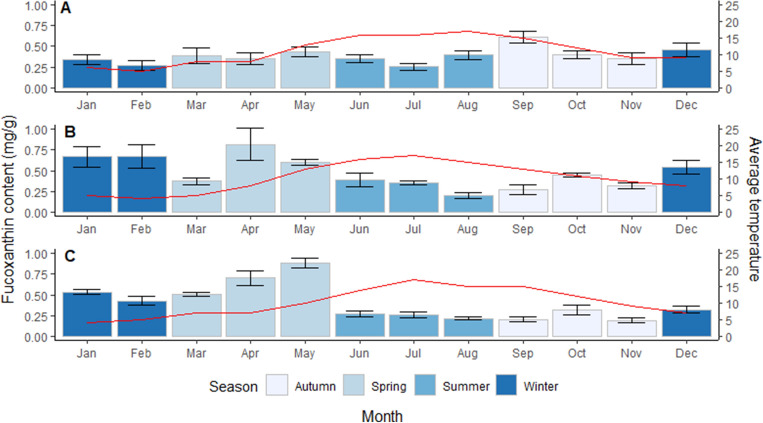
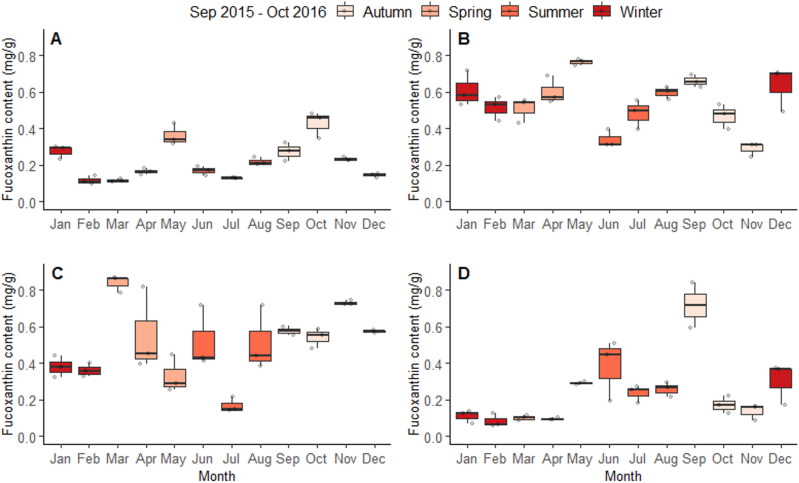
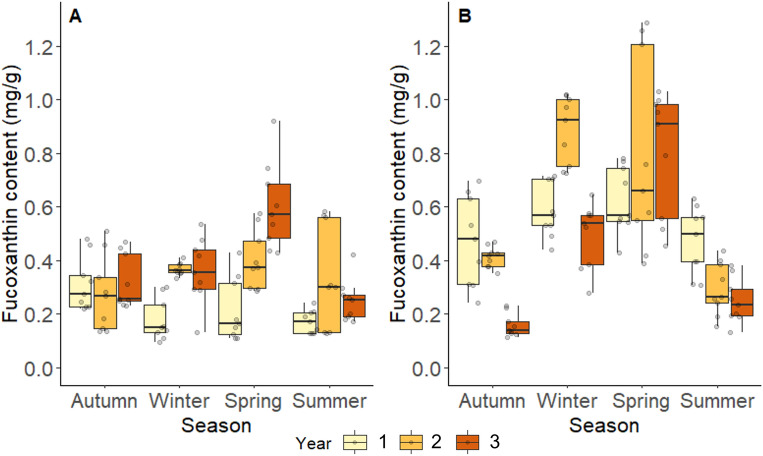
Brown seaweeds are a rich source of carotenoids, particularly fucoxanthin, which has a wide range of potential health applications. Fucoxanthin fluctuates within and among seaweeds over time, frustrating efforts to utilise this resource. Thus, we require comprehensive analyses of long- and short-term concentrations across species in field conditions. Here, we used High Performance Liquid Chromatography to compare fucoxanthin content in four brown macroalgae, Ascophyllum nodosum, Fucus serratus, Fucus vesiculosus and Saccharina latissima, monthly for 1 year. F. serratus and F. vesiculosus had significantly higher fucoxanthin content (mg/g), which was highest in Spring (0.39 ± 0.04) and Autumn (0.45 ± 0.04) [mean (± SE)]. Two species, A. nodosum and F. serratus, were collected monthly at the same location for a further two non-consecutive years. For both A. nodosum and F. serratus, a significant interaction effect of seasons and years was identified, highlighting that there is variation in fucoxanthin content among and within species over time. We also show that fucoxanthin content differs significantly among months even within seasons. Therefore, it is not sufficient to assess fucoxanthin in single months to represent seasonality. We discuss how weather, nutrients and reproduction may have driven the seasonal variation, and reveal patterns of fucoxanthin concentration that can provide information concerning its availability for many important medical functions.
褐藻是类胡萝卜素的丰富来源,特别是岩藻黄质,具有广泛的潜在健康应用。岩藻黄质在时间内在海藻内部和之间波动,这使得利用这一资源的努力受挫。因此,我们需要在野外条件下对物种进行长期和短期浓度的综合分析。在这里,我们使用高效液相色谱法比较了四种褐藻(Ascophyllum nodosum、Fucus serratus、Fucus vesiculosus 和 Saccharina latissima)在 1 年内每月的岩藻黄质含量。F. serratus 和 F. vesiculosus 的岩藻黄质含量(mg/g)明显较高,春季(0.39±0.04)和秋季(0.45±0.04)最高[平均值(±SE)]。两种物种(A. nodosum 和 F. serratus)在同一地点每月采集一次,并在随后的两年中连续两个月采集。对于 A. nodosum 和 F. serratus,均鉴定出季节和年份之间存在显著的交互效应,这突出表明,随着时间的推移,岩藻黄质含量在物种之间和内部存在差异。我们还表明,即使在同一季节内,岩藻黄质含量在不同月份也存在显著差异。因此,仅在单个月份评估岩藻黄质不足以代表季节性。我们讨论了天气、营养物质和繁殖如何可能导致季节性变化,并揭示了岩藻黄质浓度的模式,这些模式可以提供有关其许多重要医学功能可用性的信息。