Liu Jianyi, Fan Tengwen, Chen Yan, Zhao Jingjing
School of Psychology, Shaanxi Normal University, and Key Laboratory for Behavior and Cognitive Neuroscience of Shaanxi Province, Xi'an, China.
Key laboratory of Adolescent Cyberpsychology and Behavior (CCNU), Ministry of Education, Wuhan, China.
NPJ Sci Learn. 2023 Dec 16;8(1):60. doi: 10.1038/s41539-023-00209-3.
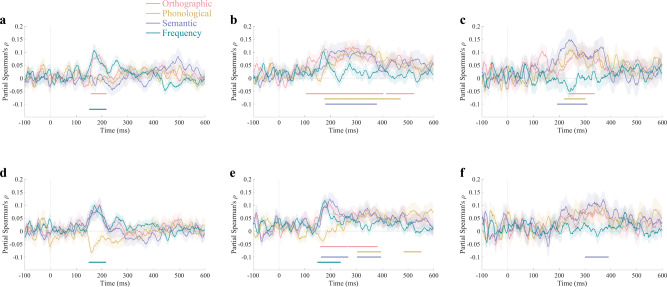
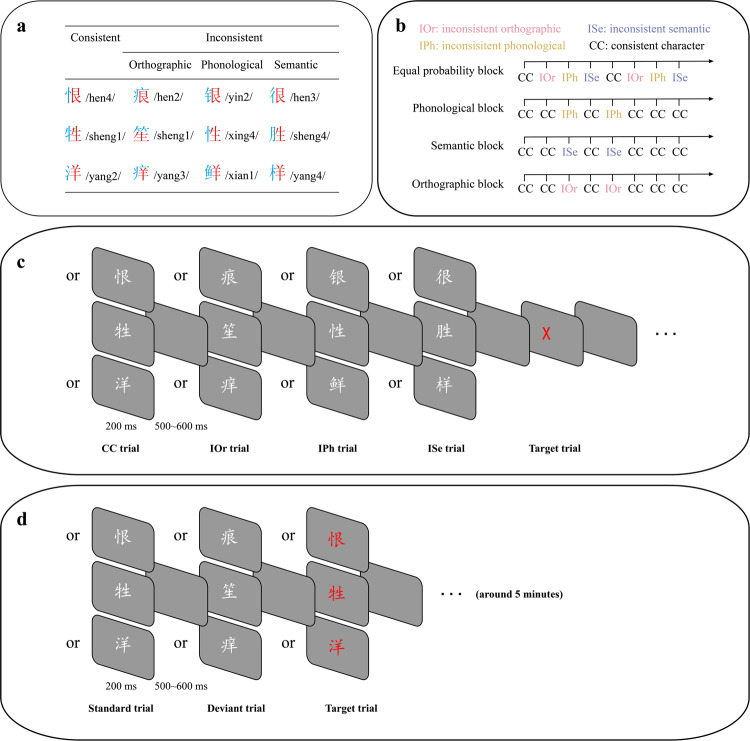
Statistical learning (SL) plays a key role in literacy acquisition. Studies have increasingly revealed the influence of distributional statistical properties of words on visual word processing, including the effects of word frequency (lexical level) and mappings between orthography, phonology, and semantics (sub-lexical level). However, there has been scant evidence to directly confirm that the statistical properties contained in print can be directly characterized by neural activities. Using time-resolved representational similarity analysis (RSA), the present study examined neural representations of different types of statistical properties in visual word processing. From the perspective of predictive coding, an equal probability sequence with low built-in prediction precision and three oddball sequences with high built-in prediction precision were designed with consistent and three types of inconsistent (orthographically inconsistent, orthography-to-phonology inconsistent, and orthography-to-semantics inconsistent) Chinese characters as visual stimuli. In the three oddball sequences, consistent characters were set as the standard stimuli (probability of occurrence p = 0.75) and three types of inconsistent characters were set as deviant stimuli (p = 0.25), respectively. In the equal probability sequence, the same consistent and inconsistent characters were presented randomly with identical occurrence probability (p = 0.25). Significant neural representation activities of word frequency were observed in the equal probability sequence. By contrast, neural representations of sub-lexical statistics only emerged in oddball sequences where short-term predictions were shaped. These findings reveal that the statistical properties learned from long-term print environment continues to play a role in current word processing mechanisms and these mechanisms can be modulated by short-term predictions.
统计学习(SL)在读写能力的获得中起着关键作用。研究越来越多地揭示了单词的分布统计特性对视觉单词处理的影响,包括词频(词汇层面)以及正字法、音系学和语义学之间的映射(亚词汇层面)的影响。然而,几乎没有证据直接证实印刷品中包含的统计特性可以由神经活动直接表征。本研究使用时间分辨表征相似性分析(RSA),考察了视觉单词处理中不同类型统计特性的神经表征。从预测编码的角度出发,设计了一个具有低内在预测精度的等概率序列和三个具有高内在预测精度的异常序列,以一致的和三种类型不一致的(正字法不一致、正字法到音系学不一致、正字法到语义学不一致)汉字作为视觉刺激。在这三个异常序列中,一致的汉字被设置为标准刺激(出现概率p = 0.75),三种类型不一致的汉字分别被设置为偏差刺激(p = 0.25)。在等概率序列中,相同的一致和不一致汉字以相同的出现概率(p = 0.25)随机呈现。在等概率序列中观察到了显著的词频神经表征活动。相比之下,亚词汇统计的神经表征仅出现在形成短期预测的异常序列中。这些发现表明,从长期印刷环境中学到的统计特性在当前的单词处理机制中继续发挥作用,并且这些机制可以被短期预测所调节。