UMR 1253 iBrain, Université de Tours, Inserm, Tours, France.
Hôpital Fondation Adolphe de Rothschild, Paris, France.
Transl Psychiatry. 2021 Jan 5;11(1):10. doi: 10.1038/s41398-020-01133-5.
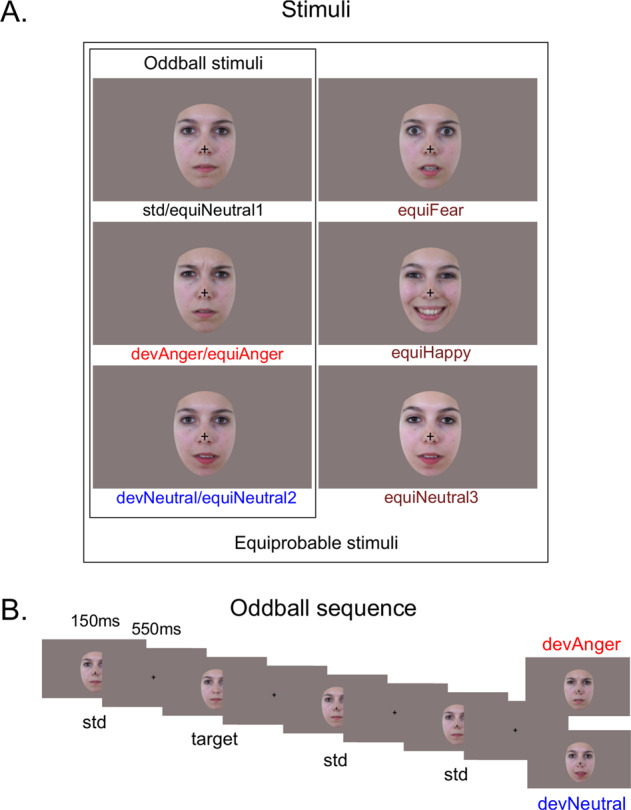
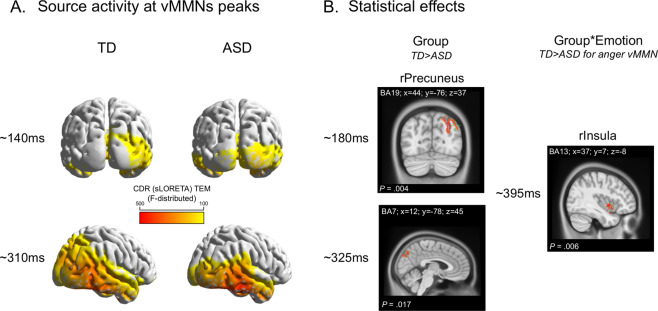
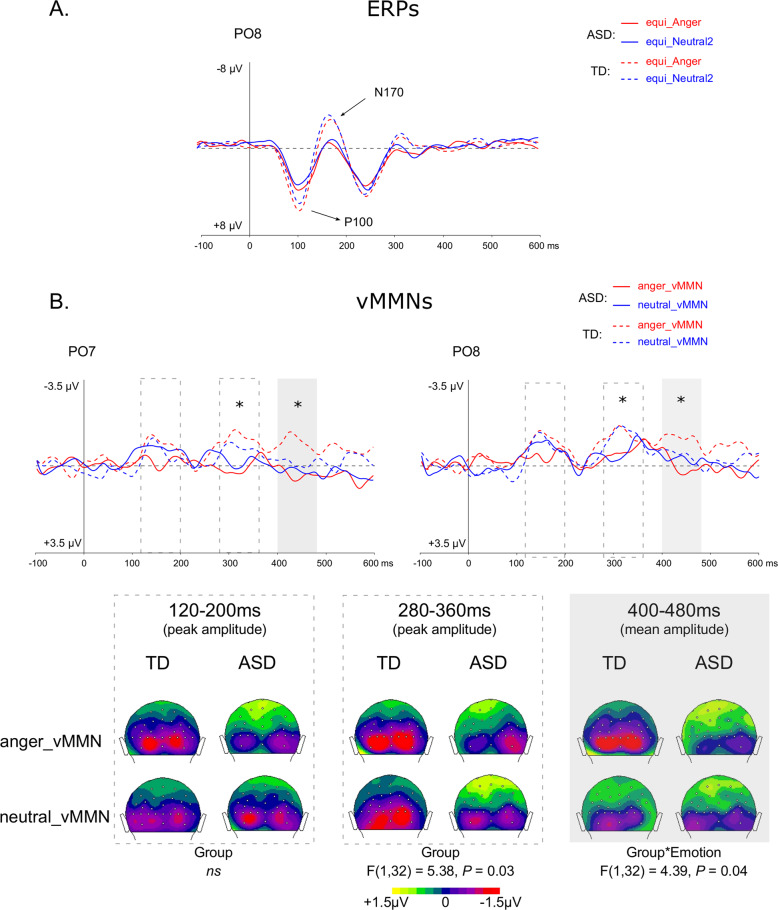
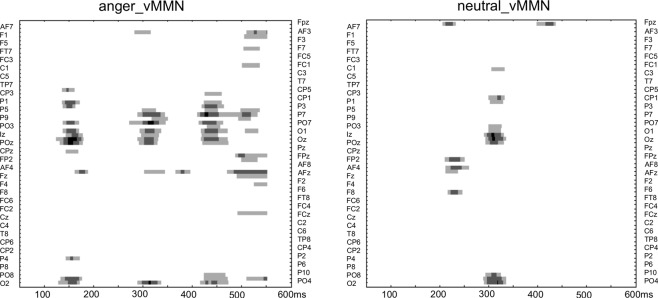
Unusual behaviors and brain activity to socio-emotional stimuli have been reported in Autism Spectrum Disorder (ASD). Atypical reactivity to change and intolerance of uncertainty are also present, but little is known on their possible impact on facial expression processing in autism. The visual mismatch negativity (vMMN) is an electrophysiological response automatically elicited by changing events such as deviant emotional faces presented among regular neutral faces. While vMMN has been found altered in ASD in response to low-level changes in simple stimuli, no study has investigated this response to visual social stimuli. Here two deviant expressions were presented, neutral and angry, embedded in a sequence of repetitive neutral stimuli. vMMN peak analyses were performed for latency and amplitude in early and late time windows. The ASD group presented smaller amplitude of the late vMMN to both neutral and emotional deviants compared to the typically developed adults (TD) group, and only the TD group presented a sustained activity related to emotional change (i.e., angry deviant). Source reconstruction of the vMMNs further revealed that any change processing elicited a reduced activity in ASD group compared to TD in the saliency network, while the specific processing emotional change elicited activity in the temporal region and in the insula. This study confirms atypical change processing in ASD and points to a specific difficulty in the processing of emotional changes, potentially playing a crucial role in social interaction deficits. Nevertheless, these results require to be further replicated with a greater sample size and generalized to other emotional expressions.
在自闭症谱系障碍 (ASD) 中,已经报道了对社会情感刺激的异常行为和大脑活动。对变化的反应异常和对不确定性的容忍度也存在,但对其在自闭症中对面部表情处理的可能影响知之甚少。视觉失匹配负波 (vMMN) 是一种自动引发的电生理反应,由变化的事件引起,例如在规则中性面孔中呈现的偏差情绪面孔。虽然已经发现 vMMN 在 ASD 中对简单刺激的低水平变化反应发生改变,但没有研究调查这种对视觉社交刺激的反应。在这里,两个偏差表情(中性和愤怒)嵌入在重复中性刺激的序列中呈现。对潜伏期和振幅进行了早期和晚期时间窗口的 vMMN 峰分析。与典型发育的成年人 (TD) 组相比,ASD 组在晚期 vMMN 对中性和情绪偏差的振幅较小,而只有 TD 组表现出与情绪变化相关的持续活动(即,愤怒偏差)。vMMNs 的源重建进一步表明,与 TD 相比,ASD 组在突显网络中任何变化处理都会引起活动减少,而特定的情绪变化处理会在颞区和脑岛中引起活动。这项研究证实了 ASD 中异常的变化处理,并指出了在处理情绪变化方面的特定困难,这可能在社交互动缺陷中起着至关重要的作用。然而,这些结果需要进一步用更大的样本量进行复制,并推广到其他情绪表达。