Fricke Katrin, Ryd Daniel, Weismann Constance G, Hanséus Katarina, Hedström Erik, Liuba Petru
Cardiology, Pediatric Heart Center, Skåne University Hospital, Lund, Sweden.
Pediatrics, Department of Clinical Sciences Lund, Lund University, Lund, Sweden.
Front Cardiovasc Med. 2023 Dec 1;10:1285391. doi: 10.3389/fcvm.2023.1285391. eCollection 2023.
Severe left-sided cardiac obstructions are associated with high morbidity and mortality if not detected in time. The correct prenatal diagnosis of coarctation of the aorta (CoA) is difficult. Fetal cardiac magnetic resonance imaging (CMR) may improve the prenatal diagnosis of complex congenital heart defects. Flow measurements in the ascending aorta could aid in predicting postnatal CoA, but its accurate visualization is challenging.
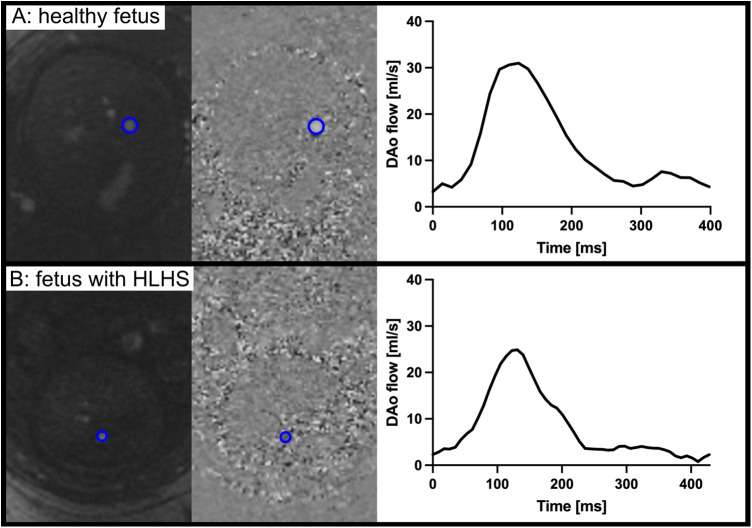
To compare the flow in the descending aorta (DAo) and umbilical vein (UV) in fetuses with suspected left-sided cardiac obstructions with and without the need for postnatal intervention and healthy controls by fetal phase-contrast CMR flow. A second objective was to determine if adding fetal CMR to echocardiography (echo) improves the fetal CoA diagnosis.
Prospective fetal CMR phase-contrast flow in the DAo and UV and echo studies were conducted between 2017 and 2022.
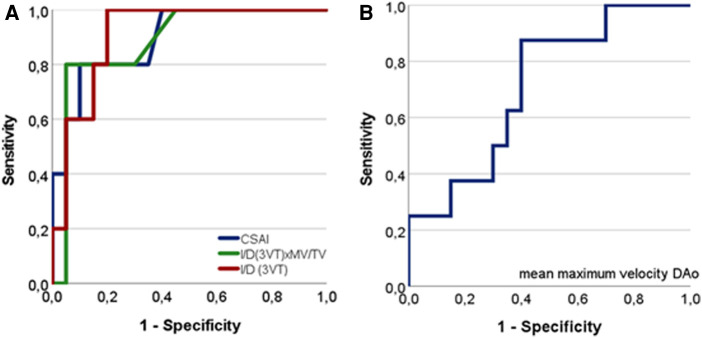
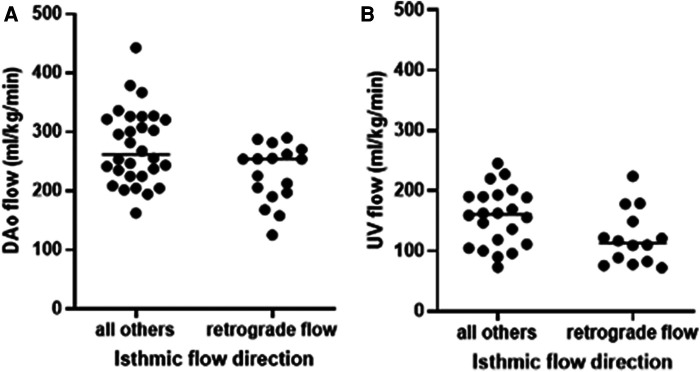
A total of 46 fetuses with suspected left-sided cardiac obstructions [11 hypoplastic left heart syndrome (HLHS), five critical aortic stenosis (cAS), and 30 CoA] and five controls were included. Neonatal interventions for left-sided cardiac obstructions ( = 23) or comfort care ( = 1 with HLHS) were pursued in all 16 fetuses with suspected HLHS or cAS and in eight (27%) fetuses with true CoA. DAo or UV flow was not different in fetuses with and without need of intervention. However, DAo and UV flows were lower in fetuses with either retrograde isthmic systolic flow [DAo flow 253 (72) vs. 261 (97) ml/kg/min, = 0.035; UV flow 113 (75) vs. 161 (81) ml/kg/min, = 0.04] or with suspected CoA and restrictive atrial septum [DAo flow 200 (71) vs. 268 (94) ml/kg/min, = 0.04; UV flow 89 vs. 159 (76) ml/kg/min, = 0.04] as well as in those without these changes. Adding fetal CMR to fetal echo predictors for postnatal CoA did not improve the diagnosis of CoA.
Fetal CMR-derived DAo and UV flow measurements do not improve the prenatal diagnosis of left-sided cardiac obstructions, but they could be important in identifying fetuses with a more severe decrease in blood flow across the left side of the heart. The physiological explanation may be a markedly decreased left ventricular cardiac output with subsequent retrograde systolic isthmic flow and decreased total DAo flow.
严重的左侧心脏梗阻若未及时发现,会导致高发病率和死亡率。主动脉缩窄(CoA)的产前正确诊断较为困难。胎儿心脏磁共振成像(CMR)可能会改善复杂先天性心脏病的产前诊断。升主动脉的血流测量有助于预测产后CoA,但准确显示其血流具有挑战性。
通过胎儿相位对比CMR血流,比较疑似左侧心脏梗阻且需要或不需要产后干预的胎儿与健康对照胎儿降主动脉(DAo)和脐静脉(UV)的血流情况。第二个目的是确定在超声心动图(echo)基础上增加胎儿CMR是否能改善胎儿CoA的诊断。
在2017年至2022年期间进行了前瞻性胎儿CMR相位对比血流在DAo和UV以及echo研究。
共纳入46例疑似左侧心脏梗阻的胎儿[11例左心发育不全综合征(HLHS)、5例严重主动脉瓣狭窄(cAS)和30例CoA]以及5例对照胎儿。所有16例疑似HLHS或cAS的胎儿以及8例(27%)确诊CoA的胎儿接受了针对左侧心脏梗阻的新生儿干预(n = 23)或舒适护理(1例HLHS)。需要和不需要干预的胎儿的DAo或UV血流无差异。然而,存在峡部收缩期逆向血流的胎儿[DAo血流:253(72)对261(97)ml/kg/min,P = 0.035;UV血流:113(75)对161(81)ml/kg/min,P = 0.04]、疑似CoA且房间隔狭窄的胎儿[DAo血流:200(71)对268(94)ml/kg/min,P = 0.04;UV血流:89对159(76)ml/kg/min,P = 0.04]以及无这些变化的胎儿的DAo和UV血流均较低。在胎儿echo预测产后CoA的指标基础上增加胎儿CMR并不能改善CoA的诊断。
胎儿CMR得出的DAo和UV血流测量并不能改善左侧心脏梗阻的产前诊断,但在识别心脏左侧血流明显减少的胎儿方面可能很重要。其生理学解释可能是左心室心输出量显著降低,随后出现峡部收缩期逆向血流以及总DAo血流减少。