Mostaghimi Mersad, Pacheco Hernandez Helmy, Jiang Yunzhe, Wenzel Wolfgang, Heinke Lars, Kozlowska Mariana
Institute of Nanotechnology (INT), Karlsruhe Institute of Technology (KIT), Kaiserstraße 12, 76131, Karlsruhe, Germany.
Institute of Functional Interfaces (IFG), Karlsruhe Institute of Technology (KIT), Kaiserstraße 12, 76131, Karlsruhe, Germany.
Commun Chem. 2023 Dec 18;6(1):275. doi: 10.1038/s42004-023-01072-4.
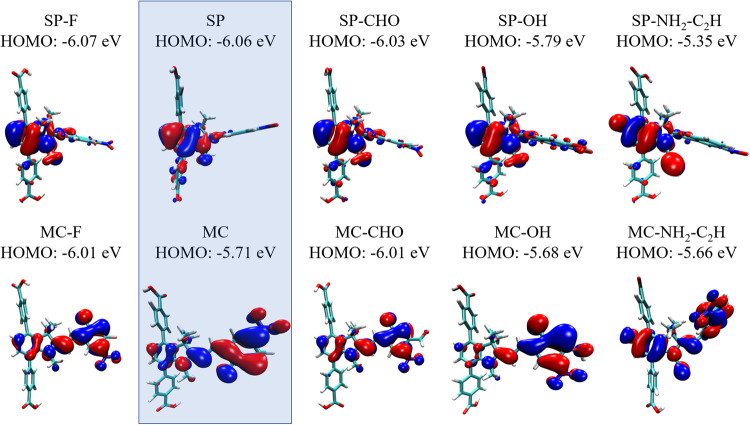
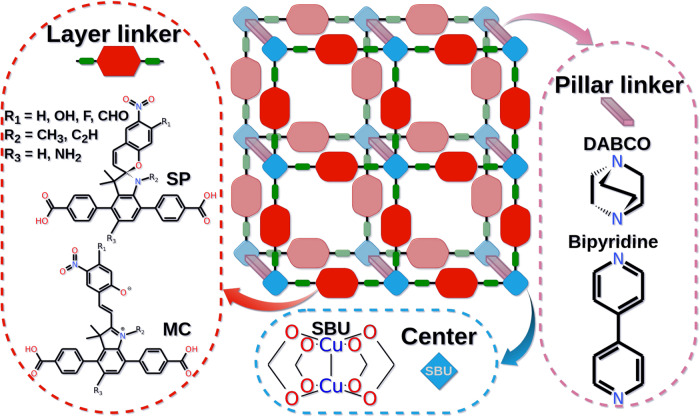
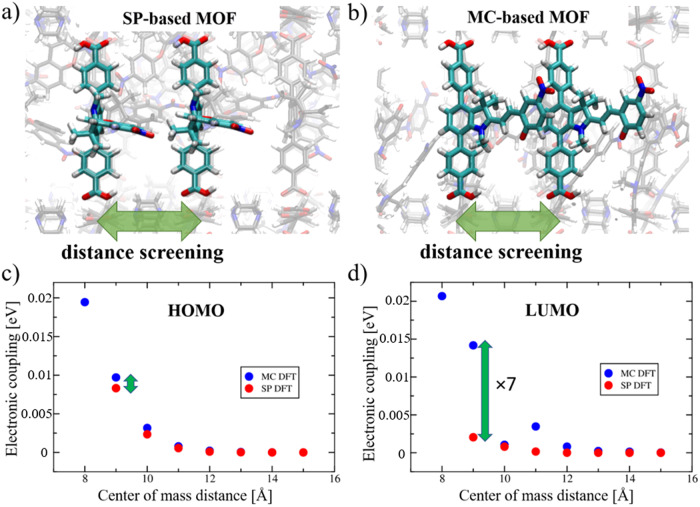
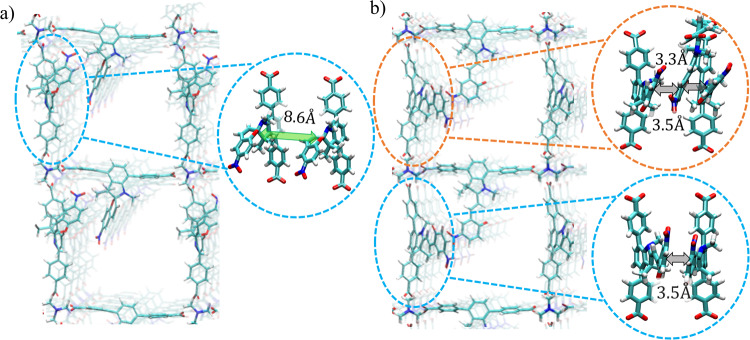
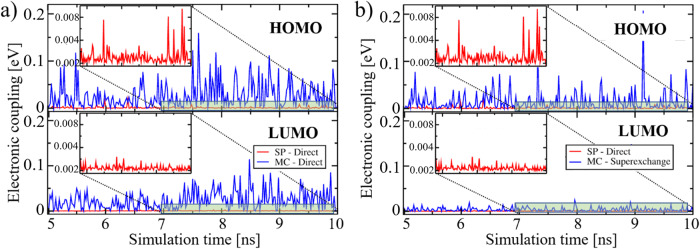
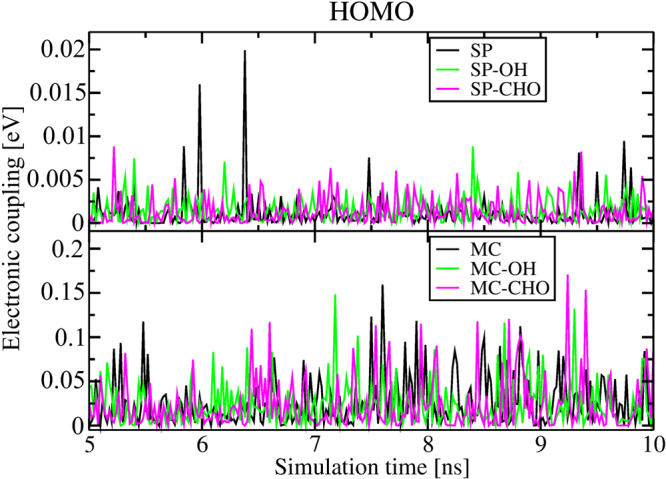
Materials with photoswitchable electronic properties and conductance values that can be reversibly changed over many orders of magnitude are highly desirable. Metal-organic framework (MOF) films functionalized with photoresponsive spiropyran molecules demonstrated the general possibility to switch the conduction by light with potentially large on-off-ratios. However, the fabrication of MOF materials in a trial-and-error approach is cumbersome and would benefit significantly from in silico molecular design. Based on the previous proof-of-principle investigation, here, we design photoswitchable MOFs which incorporate spiropyran photoswitches at controlled positions with defined intermolecular distances and orientations. Using multiscale modelling and automated workflow protocols, four MOF candidates are characterized and their potential for photoswitching the conductivity is explored. Using ab initio calculations of the electronic coupling between the molecules in the MOF, we show that lattice distances and vibrational flexibility tremendously modulate the possible conduction photoswitching between spiropyran- and merocyanine-based MOFs upon light absorption, resulting in average on-off ratios higher than 530 and 4200 for p- and n-conduction switching, respectively. Further functionalization of the photoswitches with electron-donating/-withdrawing groups is demonstrated to shift the energy levels of the frontier orbitals, permitting a guided design of new spiropyran-based photoswitches towards controlled modification between electron and hole conduction in a MOF.
具有可光开关电子特性且电导率值能在多个数量级上可逆变化的材料是非常理想的。用光响应性螺吡喃分子功能化的金属有机框架(MOF)薄膜展示了通过光来切换导电性的一般可能性,且具有潜在的大开关比。然而,以试错法制备MOF材料很麻烦,而计算机辅助分子设计将使其受益匪浅。基于先前的原理验证研究,在此我们设计了可光开关的MOF,其在可控位置以确定的分子间距离和取向结合了螺吡喃光开关。使用多尺度建模和自动化工作流程协议,对四种MOF候选物进行了表征,并探索了它们光开关导电性的潜力。通过对MOF中分子间电子耦合的从头算计算,我们表明晶格距离和振动灵活性极大地调节了基于螺吡喃和部花青的MOF在光吸收时可能的传导光开关,对于p型和n型传导开关,平均开关比分别高于530和4200。用供电子/吸电子基团对光开关进行进一步功能化被证明可以移动前沿轨道的能级,从而允许对基于螺吡喃的新型光开关进行定向设计,以实现MOF中电子和空穴传导之间的可控修饰。