Warrior Research Center, School of Kinesiology, Auburn University, 301 Wire Road, Auburn, AL, 38632, USA.
Neurovascular Physiology Lab, School of Kinesiology, Auburn University, 301 Wire Road, Auburn, AL, USA.
Sci Rep. 2023 Dec 15;13(1):22503. doi: 10.1038/s41598-023-49929-x.
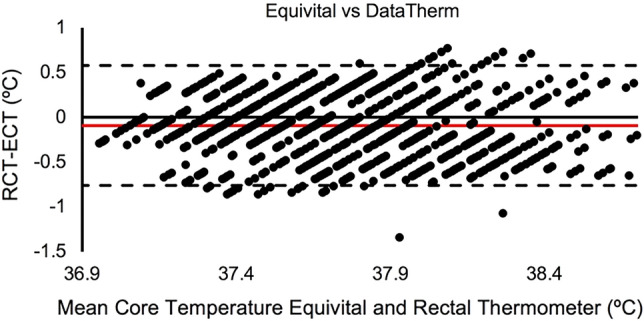
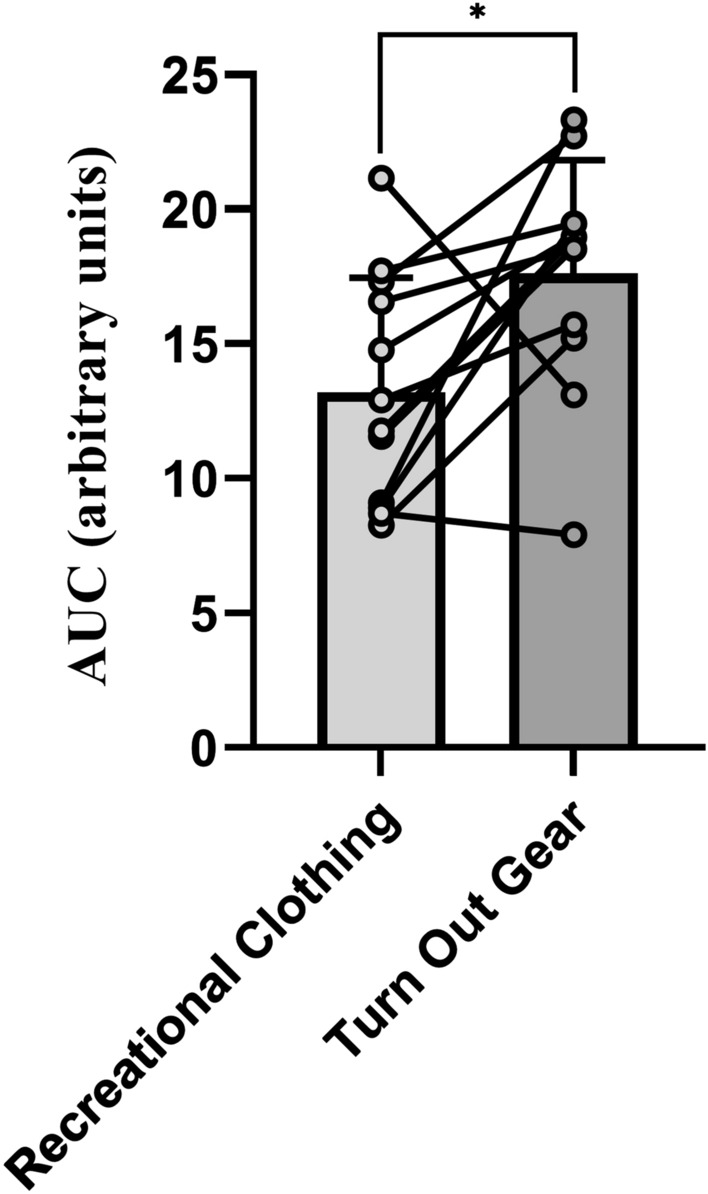
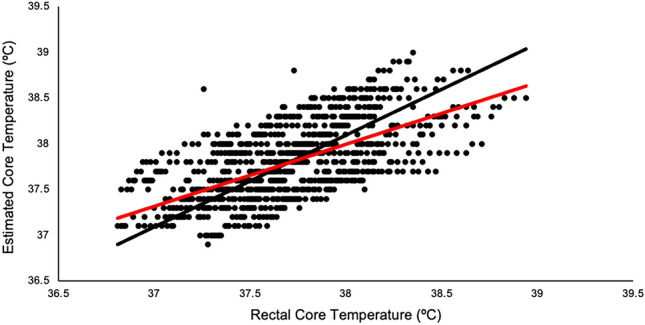
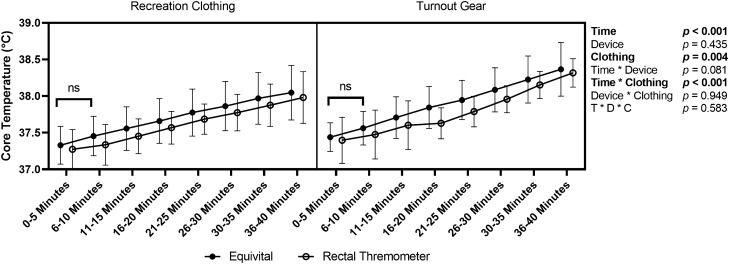
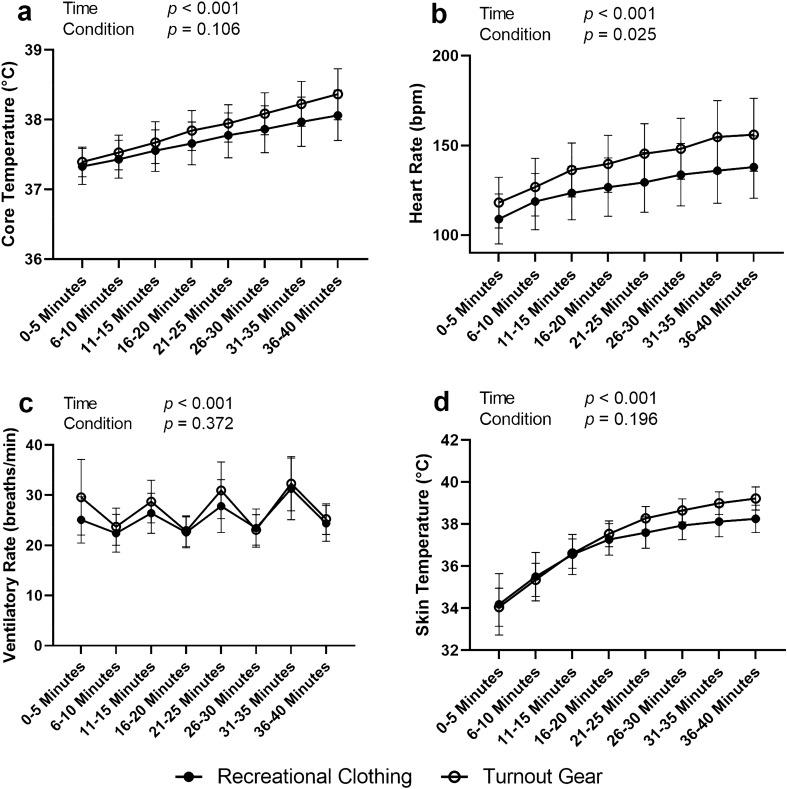
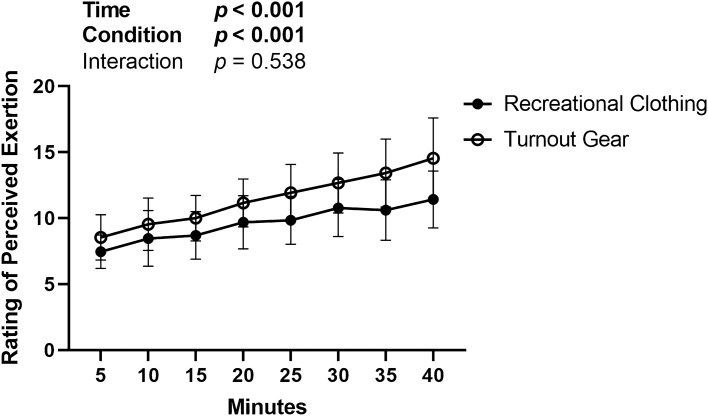
Rectal core temperature monitoring can help fire services mitigate heat injury but can be invasive and impractical. EQ02 + LifeMonitor provides a non-invasive estimation of core temperature. Therefore, the primary purpose of this study was to determine the validity of the EQ02 + LifeMonitor compared to the gold standard rectal thermometer core temperature assessment, as well as the potential influence of turnout gear on the estimated and physiological strain experienced during these activities. Thirteen participants completed simulated firefighting tasks with and without turnout gear, involving four rounds of a 5-min walk on a treadmill at 2.8 mph/2.5% grade and 20 deadlifts over 5 min in an environmental chamber set to 40.6 °C; 50% humidity. During each trial participants wore both an EQ02 + LifeMonitor and DataTherm II rectal thermometer. The results from the devices were statistically equivalent (p < 0.001), yet there was a statistically significant difference in the value (~ 0.1 °C; p < 0.001). There was a significant effect of devices [p < 0.001] and time [p < 0.001], but no interaction effect [p = 0.70] on core temperature drift. Estimated core temperature was marginally different from that measured via the DataTherm II. The EQ02 on average overestimated core temperature. Heart rate, rating of perceived exertion, and area under the curve of core temperature were significantly elevated due to turnout gear [ps < 0.025], but not core temperature skin temperature, or ventilatory rate [ps > 0.372]. These results suggest the EQ02 + LifeMonitor may be a viable, non-invasive alternative for assessing core temperature compared to rectal temperature monitoring, especially during rigorous, intermittent activities. Turnout gear does however increase heart rate, cumulative core temperature, and perceived exertion. Additionally, the validity of the estimated core temperature is not impacted by the use turnout gear. This is likely due to significant changes in heart rate, which allowed the heart-rate derived estimate of core temperature to remain consistent with changes in DataTherm II rectal temperatures.
直肠核心温度监测有助于消防部门减轻热损伤,但可能具有侵入性且不切实际。EQ02 + LifeMonitor 提供了对核心温度的非侵入性估计。因此,本研究的主要目的是确定 EQ02 + LifeMonitor 与直肠温度计核心温度评估的金标准相比的有效性,以及在这些活动中穿着消防装备对估计和生理应变的潜在影响。13 名参与者穿着和不穿着消防装备完成了模拟消防任务,包括在环境室中以 40.6°C;50%湿度设置的跑步机上进行四轮 5 分钟 2.8 英里/小时/2.5%坡度的步行和 5 分钟 20 次举重;在每个试验中,参与者都穿着 EQ02 + LifeMonitor 和 DataTherm II 直肠温度计。设备的结果在统计学上是等效的(p < 0.001),但数值上存在统计学差异(~0.1°C;p < 0.001)。设备有显著影响[p < 0.001]和时间[p < 0.001],但核心温度漂移没有交互作用[p = 0.70]。估计的核心温度与通过 DataTherm II 测量的核心温度略有不同。EQ02 平均高估了核心温度。由于穿着消防装备,心率、感知用力等级和核心温度曲线下面积显著升高[p < 0.025],但核心温度皮肤温度或通气率没有升高[p > 0.372]。这些结果表明,与直肠温度监测相比,EQ02 + LifeMonitor 可能是一种可行的、非侵入性的替代方法,用于评估核心温度,尤其是在剧烈、间歇性的活动中。然而,消防装备会增加心率、累积核心温度和感知用力。此外,使用消防装备不会影响估计核心温度的有效性。这可能是由于心率的显著变化,这使得基于心率的核心温度估计与 DataTherm II 直肠温度的变化保持一致。