Warrior Research Center, School of Kinesiology, Auburn University, 301 Wire Road, Auburn, AL, 38632, USA.
Nutrabolt Applied and Molecular Physiology Lab, Auburn University, Auburn, AL, USA.
Sci Rep. 2024 Nov 30;14(1):29778. doi: 10.1038/s41598-024-81015-8.
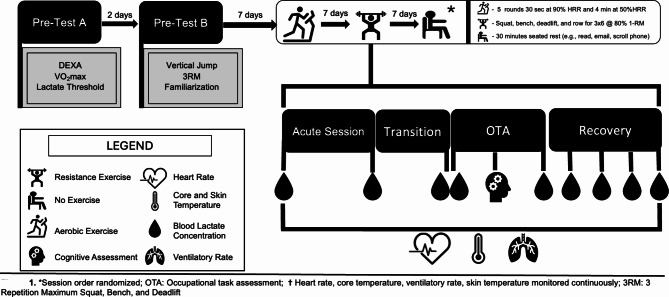
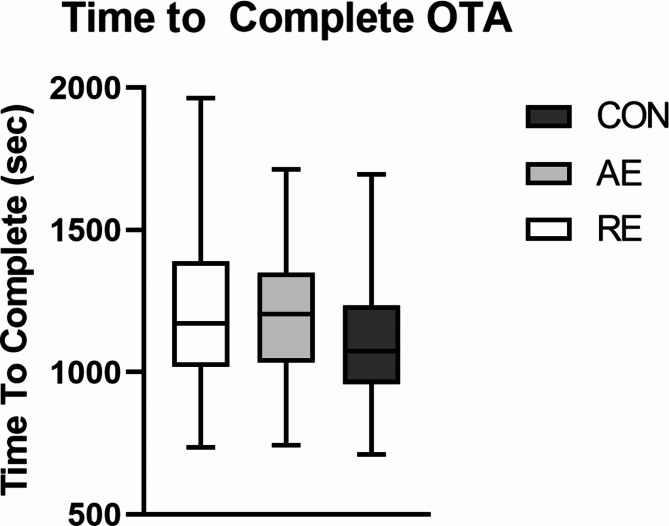
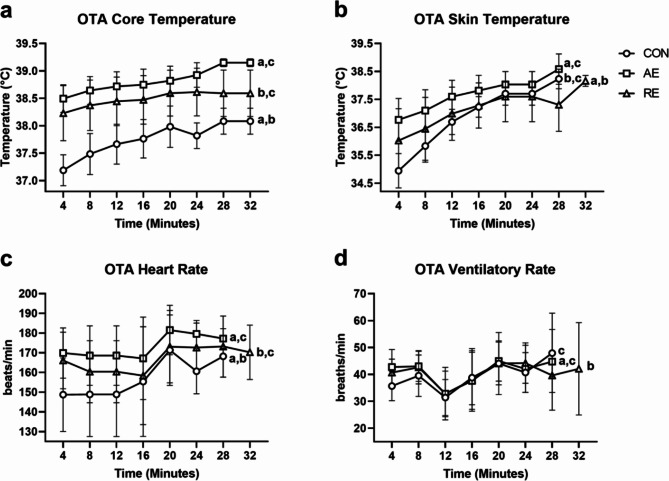
We aimed to determine how a bout of resistance or aerobic exercise impacts physiological responses and performance during firefighting occupational tasks. Thirty-two non-firefighters completed two baseline assessments and three trials: resistance exercise (RE), aerobic exercise (AE), or a rested control (CON). Trials were followed by an occupational task assessment (OTA; four rounds of 10 deadlifts (38.6-61.4 kg) and 0.24-km 40lb-sandbag carry) in an environmental chamber (35 °C/50% humidity) while wearing standard municipal firefighter gear. Time to complete by condition was not statistically different (CON: 18.9 ± 4.4, AE: 20.0 ± 3.6, RE: 20.2 ± 5.0 min; p = 0.16). During the OTA average heart rate (CON: 149 ± 16, AE: 166 ± 12, RE: 160 ± 13 bpm; p < 0.01), estimated core temperature (CON: 37.6 ± 0.4, AE: 38.7 ± 0.3, RE: 38.4 ± 0.5 °C; p < 0.01), and skin temperature (CON: 36.3 ± 0.5, AE: 37.5 ± 0.6, RE: 36.9 ± 0.9 °C; p < 0.01) were elevated following AE and RE compared to CON, and higher following AE compared to RE. Our findings suggest job performance may not be impacted, although physiological stress during the tasks may be elevated, following on-shift exercise, and more prominently following aerobic exercise.
我们旨在确定一次抗阻或有氧训练如何影响消防作业任务期间的生理反应和表现。32 名非消防员完成了两次基线评估和三次试验:抗阻运动(RE)、有氧运动(AE)或休息对照(CON)。试验后,他们在环境室(35°C/50%湿度)中穿着标准市消防服进行职业任务评估(OTA;四轮 10 次深蹲(38.6-61.4 公斤)和 0.24 公里 40 磅沙袋携带)。按条件完成的时间没有统计学差异(CON:18.9±4.4、AE:20.0±3.6、RE:20.2±5.0 分钟;p=0.16)。在 OTA 期间,平均心率(CON:149±16、AE:166±12、RE:160±13 bpm;p<0.01)、估计核心温度(CON:37.6±0.4、AE:38.7±0.3、RE:38.4±0.5°C;p<0.01)和皮肤温度(CON:36.3±0.5、AE:37.5±0.6、RE:36.9±0.9°C;p<0.01)在 AE 和 RE 后均高于 CON,且 AE 后高于 RE。我们的发现表明,作业表现可能不会受到影响,尽管在任务期间的生理应激可能会因轮班后运动而升高,并且在有氧运动后更为明显。