Pearson Stephen J, Highlands Brian, Jones Rebecca, Matthews Martyn J
Centre for Health, Sport and Rehabilitation Sciences Research, University of Salford, Greater Manchester, UK.
Greater Manchester Fire and Rescue Service, UK.
Saf Health Work. 2022 Mar;13(1):99-103. doi: 10.1016/j.shaw.2021.11.003. Epub 2021 Nov 26.
Firefighters may experience high environmental temperatures or carry out intensive physical tasks, or both, which leads to increased core body temperature and risk of fatalities. Hence there is a need to remotely and non-invasively monitor core body temperature.
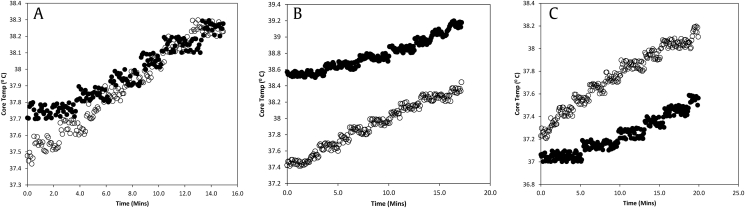
Estimated (heart rate algorithm) and actual core body temperature (ingested telemetric pill) measures were collected simultaneously for comparison during training exercises on 44 firefighter volunteers.
Prediction of core body temperature varied, with no specific identifiable pattern between the algorithm values and directly measured body core temperatures. Group agreement of Lin's Concordance of 0.74 (95% Upper 0.75, lower CI 0.73), was deemed poor.
From individual agreement data Lin's Concordance was variable (Min 0.11, CI 0.13-0.01; Max 0.83, CI 0.86-0.80), indicating that the heart rate algorithm approach was not suitable for core body temperature monitoring in this population group, especially at the higher more critical core body temperatures seen.
消防员可能会经历高温环境或执行高强度体力任务,或两者兼而有之,这会导致核心体温升高和死亡风险增加。因此,需要对核心体温进行远程和非侵入性监测。
在44名消防员志愿者的训练演习中,同时收集估计的(心率算法)和实际的核心体温(摄入遥测药丸)测量值进行比较。
核心体温的预测结果各不相同,算法值与直接测量的身体核心温度之间没有特定的可识别模式。林氏一致性系数为0.74(95%置信区间上限0.75,下限0.73),被认为较差。
从个体一致性数据来看,林氏一致性系数是可变的(最小值0.11,置信区间0.13 - 0.01;最大值0.83,置信区间0.86 - 0.80),表明心率算法方法不适用于该人群的核心体温监测,尤其是在观察到的较高且更关键的核心体温时。